Time-Duration Math (Adding/Subtracting Hours & Minutes)
Adding and subtracting durations expressed as hours and minutes requires carrying or borrowing in base 60 (60 minutes to an hour) instead of the base 10 used for ordinary number subtraction, so a minutes column that goes negative has to borrow a full 60 minutes from the hours column, not 10.
Reading time
— 4 min
Updated
— Aug 21, 2026
Fact-reviewed
— Aug 21, 2026
Key Takeaways
Key Takeaways
1Minutes and seconds run in base 60, not base 10 — which is why subtracting clock times requires borrowing a full 60 minutes from the hours column, not 10, whenever the minutes subtraction would go negative.
2Adding durations works the same way in reverse: whenever a minutes sum reaches 60 or more, subtract 60 from the minutes and carry 1 to the hours column.
3Converting to decimal hours (hour + minutes/60) sidesteps the base-60 borrowing entirely and is what most payroll and scheduling software actually does internally, even when it displays hours and minutes to the user.
The concept
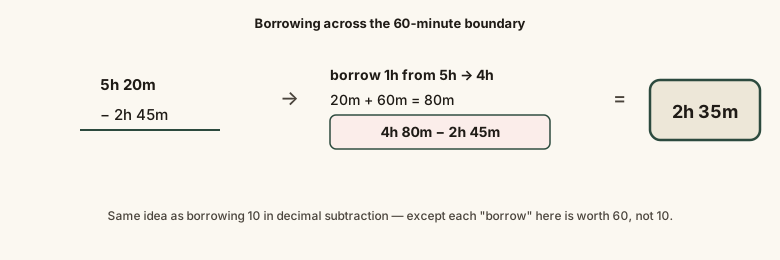
Subtracting 2 hours 45 minutes from 5 hours 20 minutes looks like ordinary subtraction, but 20 minus 45 goes negative — you can't take 45 minutes from only 20. The fix is borrowing: take 1 hour from the 5, turning it into 4, and add that borrowed hour's worth — 60 minutes — to the 20, making 80. Now 80 minus 45 works cleanly: 35 minutes. Combined with the 4 remaining hours minus 2, the answer is 2 hours 35 minutes.
Once the borrow-60-instead-of-10 adjustment is automatic, duration subtraction stops being a special case and becomes exactly the subtraction most people already know how to do.
Quick check
Why can't you subtract 2h 45m from 5h 20m by just subtracting the minutes and hours columns separately (20−45 and 5−2)?
Worked examples
Example 1: Subtracting durations with a borrow (baseline case)
5 hours 20 minutes minus 2 hours 45 minutes: since 20 < 45, borrow 1 hour from the 5 (leaving 4) and add 60 minutes to the 20, making 80. Now: 80 − 45 = 35 minutes, and 4 − 2 = 2 hours. Final answer: 2 hours 35 minutes.
Example 2: Adding durations that carry past 60 minutes (edge case / variation)
Adding 3 hours 40 minutes and 2 hours 35 minutes: add the minutes first, 40 + 35 = 75. Since 75 is 60 or more, subtract 60 (75 − 60 = 15 minutes) and carry 1 hour to the hours column. Add the hours: 3 + 2 + 1 (carried) = 6 hours. Final answer: 6 hours 15 minutes — the mirror-image operation of borrowing, carrying a full 60 forward instead of pulling 60 back.
Quick check
Adding 1h 50m and 0h 25m, someone gets 1h 75m as their final answer. What's the error?
Example 3: Calculating a work shift's length using decimal hours (real-world / applied case)
A shift starts at 9:15 AM and ends at 5:40 PM (17:40 in 24-hour time). Converting both to decimal hours sidesteps borrowing entirely: clock-in is 9 + 15/60 = 9.25 decimal hours, clock-out is 17 + 40/60 ≈ 17.667 decimal hours. Subtracting normally: 17.667 − 9.25 ≈ 8.417 decimal hours, which converts back to 8 hours and 0.417 × 60 ≈ 25 minutes — an 8-hour, 25-minute shift, calculated with ordinary decimal subtraction instead of hand-tracking a borrow.
How it works (visual)
Borrowing 60 minutes from the hours column
The borrowed hour converts into exactly 60 extra minutes, never 10 — that single substitution is the entire difference between time-duration subtraction and the ordinary decimal subtraction most people learned first.
Common mistakes
Common Mistakes
✕
Borrowing 10 minutes (the decimal habit) instead of 60 when a time subtraction goes negative.
→ Always borrow exactly 60 minutes for 1 hour — time math runs in base 60 for the minutes place, never base 10.
✕
Leaving a minutes total of 60 or more uncarried after addition (writing '6h 75m' instead of '7h 15m').
→ Any minutes sum of 60 or more must be reduced by 60 with 1 hour carried forward, the same as carrying a 1 in decimal addition.
✕
Treating a decimal hours value like 8.5 as '8 hours 50 minutes' instead of '8 hours 30 minutes'.
→ The decimal part of decimal hours is a fraction of 60 minutes, not a direct minutes count — multiply the decimal by 60 (0.5 × 60 = 30) to get the actual minutes.
Common misconception
“8.5 hours means 8 hours and 50 minutes, since the .5 looks like it should map directly onto the minutes.”
Decimal hours express the fractional part as a fraction of 60 minutes, not as a direct minutes count. 8.5 hours means 8 hours plus 0.5 of an hour, and 0.5 × 60 = 30 minutes — so 8.5 hours is 8 hours 30 minutes, not 8 hours 50 minutes. The confusion comes from decimal intuition (where .5 often reads as 'halfway between 0 and 100' in percentage terms) colliding with the base-60 minutes system underneath.
Quick check
Converting 6.25 hours to hours and minutes, what's the correct minutes value?
Try it yourself
Find the duration between two clock times (in minutes)
Duration (total minutes)505
What to do next
What to do next
When subtracting and the minutes column would go negative, borrow exactly 60 minutes (1 hour) from the hours column before subtracting.
When adding and the minutes column reaches 60 or more, subtract 60 and carry 1 hour forward.
For payroll or spreadsheet math, convert clock times to decimal hours (hour + minutes/60) first, to avoid manual borrowing entirely.
When converting a decimal hours value back to minutes, multiply the decimal part by 60 — don't read the digits directly as minutes.
FAQ
FAQ
Related terms
Related terms
Base-60 (sexagesimal) system
A number system using 60 as its base, inherited from ancient Babylonian mathematics, still used today for measuring minutes within an hour and seconds within a minute.
Borrowing
The subtraction technique of taking a unit from the next-higher place value and converting it into the current place's base when a direct subtraction would go negative — 60 minutes in time math, 10 in ordinary decimal subtraction.
Duration
The length of an elapsed time interval, found by subtracting a start time from an end time.
Decimal hours
A duration expressed as a single number with a fractional part (like 2.5 hours) rather than separate hours-and-minutes components, used for payroll and scheduling math.
This entry was researched from public sources and drafted with AI-assisted tools, then edited — errors are still possible. Spot one, or want a topic covered? Read our disclaimer.
 KnowThis