Understanding Work Rate & Time Problems (Person-Hours, etc.)
Work-rate problems (classically 'two pipes filling a tank') are solved by converting each worker's or machine's time into a rate (fraction of the job per hour), adding the rates together, then taking the reciprocal of the combined rate to find the combined time — a method that generalizes directly to person-hours and staffing calculations.
Reading time
— 5 min
Updated
— Aug 21, 2026
Fact-reviewed
— Aug 21, 2026
Key Takeaways
Key Takeaways
1Work-rate problems can't be solved by averaging times — two workers with different individual times combine by adding their rates (fraction of the job per hour), not their raw hours.
2The standard method: convert each individual time to a rate (1 ÷ time), add the rates, then take the reciprocal of that sum (1 ÷ combined rate) to get the combined time.
3Working together is always faster than the fastest individual alone — the combined time can never be longer than the quickest single worker's or machine's own time.
The concept
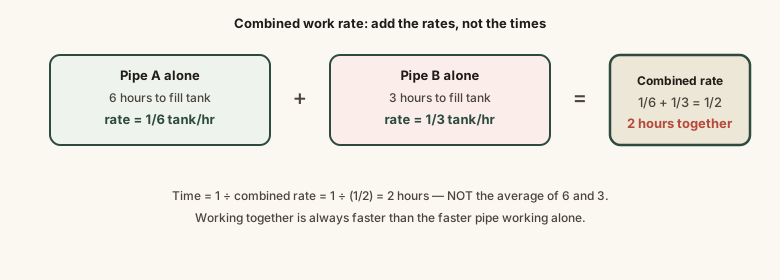
If Pipe A can fill a tank alone in 6 hours, its work rate is 1/6 of the tank per hour. If Pipe B can fill the same tank alone in 3 hours, its rate is 1/3 of the tank per hour. Running both pipes together, their rates add: 1/6 + 1/3 = 1/2 of the tank per hour. To find the combined time, take the reciprocal of that combined rate: 1 ÷ (1/2) = 2 hours. Both pipes together fill the tank in 2 hours — notably not the average of 6 and 3 (which would incorrectly suggest 4.5 hours).
Once the "rates add, times don't" rule is internalized, work-rate problems stop feeling like a special algebra trick and start looking like ordinary rate math applied to a shared task.
Quick check
Pipe A fills a tank alone in 6 hours; Pipe B fills it alone in 3 hours. Why is the combined time NOT simply the average of 6 and 3 (4.5 hours)?
Worked examples
Example 1: Two workers painting a room (baseline case)
Worker A can paint a room alone in 4 hours (rate: 1/4 room/hour). Worker B can paint it alone in 4 hours as well (rate: 1/4 room/hour). Combined rate: 1/4 + 1/4 = 1/2 room/hour. Combined time: 1 ÷ (1/2) = 2 hours — exactly half of either worker's individual time, which makes intuitive sense since they're equally fast and splitting the work evenly.
Example 2: Three workers with different speeds (edge case / variation)
Worker A takes 10 hours alone (rate 1/10), Worker B takes 15 hours alone (rate 1/15), and Worker C takes 30 hours alone (rate 1/30). Combined rate: 1/10 + 1/15 + 1/30. Using a common denominator of 30: 3/30 + 2/30 + 1/30 = 6/30 = 1/5. Combined time: 1 ÷ (1/5) = 5 hours. Notice the combined time (5 hours) is less than even the fastest individual worker's time (10 hours) — a general rule for this kind of problem: adding more simultaneous workers can only speed the job up, never slow it down, since each additional worker contributes a positive rate to the sum.
Quick check
Can the combined time for two or more workers ever be longer than the fastest individual worker's own time?
Example 3: Estimating a construction job with person-hours (real-world / applied case)
A contractor estimates a fencing job requires 120 person-hours of labor total (based on past jobs of similar size). With a crew of 4 workers working simultaneously at a comparable pace, the job time is 120 person-hours ÷ 4 workers = 30 hours of actual elapsed work time. If the contractor instead sends a crew of 6, the same 120 person-hours divides differently: 120 ÷ 6 = 20 hours. This is the person-hours version of the same reciprocal logic — the total labor required is fixed, and elapsed time shrinks as more simultaneous workers share that fixed total, though real crews eventually hit diminishing returns from coordination overhead that this simplified model doesn't capture.
How it works (visual)
Combining two work rates: add the rates, then invert for time
Each pipe's individual time converts to a rate first; only the rates are added directly. The final combined time comes from inverting that summed rate — never from averaging or adding the original two times.
Common mistakes
Common Mistakes
✕
Averaging the individual times to estimate the combined time.
→ Convert each time to a rate (1 ÷ time), add the rates, then take the reciprocal of the sum (1 ÷ combined rate) — never average the raw times directly.
✕
Forgetting to take the final reciprocal, and reporting the combined rate itself as if it were the combined time.
→ The combined rate (e.g. 1/2 tank per hour) is not the answer to 'how long does it take' — divide 1 by that rate to get the actual combined time (2 hours).
✕
Assuming doubling the workers always exactly halves the time, ignoring that workers may have different individual rates.
→ The 'double workers, halve time' shortcut only holds when all workers have identical rates — with mismatched individual speeds, add the actual individual rates rather than assuming a clean halving.
Common misconception
“If Pipe A takes 6 hours alone and Pipe B takes 3 hours alone, running them together takes the average of the two times, 4.5 hours.”
Time and rate are reciprocals, not linearly related quantities — what actually combines additively when two processes run simultaneously is the rate (fraction of the job per hour), not the raw time. Converting 6 hours and 3 hours to rates (1/6 and 1/3), adding them (1/2), and inverting (1 ÷ 1/2) gives the true combined time of 2 hours — noticeably faster than even the naive average, and always faster than the quicker of the two individual times alone.
Quick check
A job takes 120 total person-hours. With a crew of 4 workers at a comparable pace, how many elapsed hours does the job take?
Try it yourself
Calculate combined time for two workers/machines working together
Combined time working together (hours)2
What to do next
What to do next
Convert each individual time to a rate (1 ÷ time) before combining anything — never average or add raw times directly.
Add the individual rates together, then take the reciprocal of that sum to get the true combined time.
For staffing estimates, use total person-hours divided by the number of simultaneous workers to estimate elapsed time, keeping in mind real crews may see diminishing returns beyond a certain size.
Sanity-check any combined-time answer: it should always be faster than (or equal to) the quickest individual worker or machine's own time alone.
FAQ
FAQ
Related terms
Related terms
Work rate
The fraction of a job completed per unit of time, found by taking the reciprocal of the time needed to complete the whole job alone (1 ÷ time).
Combined rate
The sum of two or more individual work rates, representing how much of a job gets done per unit of time when multiple workers or machines operate simultaneously.
Person-hours
A unit of work measuring one person working for one hour, used to estimate total labor needed for a task regardless of how many people are actually assigned to it.
Reciprocal
The result of dividing 1 by a number — used here to convert a combined work rate back into a combined time (time = 1 ÷ rate).
This entry was researched from public sources and drafted with AI-assisted tools, then edited — errors are still possible. Spot one, or want a topic covered? Read our disclaimer.
 KnowThis