Daylight saving time shifts clocks forward by one hour in spring and back by one hour in fall, moving an hour of daylight from the early morning (when most people are still asleep) to the evening (when more people are awake to use it), without changing the total amount of daylight in a day.
Reading time
— 5 min
Updated
— Aug 21, 2026
Fact-reviewed
— Aug 21, 2026
Key Takeaways
Key Takeaways
1Daylight saving time doesn't add or subtract any actual daylight — a day's total sunlight is fixed by Earth's tilt and orbit. DST just shifts the clock so that fixed daylight lines up differently against the hours people are typically awake.
2'Spring forward' (clocks jump ahead 1 hour, commonly 2 AM to 3 AM) shifts an hour of daylight from early morning to evening; 'fall back' (clocks move back 1 hour) reverses the shift as the change stops being worth it in winter's shorter days.
3Not every region observes DST — the practice is a policy choice, not a physical necessity, and areas near the equator in particular gain little from it since their day length barely varies by season.
The concept
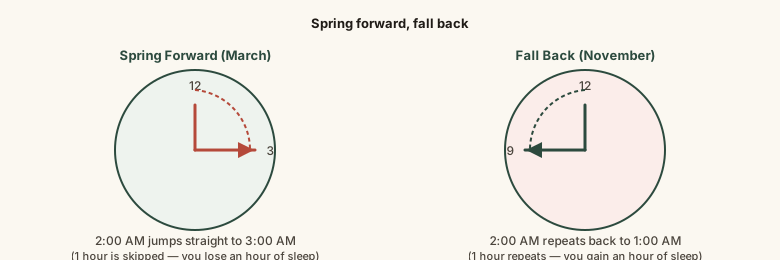
Daylight saving time moves clocks forward by one hour in spring (commonly, 2:00 AM instantly becomes 3:00 AM) and back by one hour in fall (2:00 AM repeats, effectively becoming 1:00 AM). The point isn't to create more sunlight — a day has the same total daylight regardless of what the clock says. The point is to shift when that daylight falls relative to when people are awake: without the spring shift, sunrise would happen uselessly early (many people still asleep) while sunset would come earlier in the evening (less usable daylight after work or school).
Because the shift is exactly one hour and applied region by region, the actual clock-math is simple — the part that trips people up is usually the direction (which way to shift) rather than the amount.
Quick check
Does daylight saving time change the actual total amount of daylight in a day?
Worked examples
Example 1: The spring-forward clock jump (baseline case)
In a region observing DST, standard time is UTC-5 in winter. When DST begins in spring, the local offset becomes UTC-4 — clocks are set one hour ahead of where they were. If an alarm was set for 6:00 AM standard time the day before the change, the equivalent moment after the change reads as 7:00 AM — the actual moment of waking (relative to sunrise) hasn't changed, only the number displayed on the clock.
Example 2: The one night that has 23 hours — or 25 (edge case / variation)
On the specific night clocks spring forward, that calendar day is only 23 hours long — the hour between 2:00 AM and 3:00 AM never happens locally, since the clock jumps straight over it. On the fall-back night, the reverse happens: 1:00 AM to 2:00 AM occurs twice, making that day 25 hours long. This is a genuine edge case for any duration math done across a DST transition — a "24-hour" calculation spanning a spring-forward night will be off by an hour unless the shift is accounted for explicitly.
Quick check
A flight departs at 11:00 PM the night clocks 'spring forward' and lands 7 hours later by the aircraft's actual elapsed flight time. What local clock time does it land at?
Example 3: Scheduling an international call across a DST transition (real-world / applied case)
A recurring weekly call is scheduled for 9:00 AM Eastern Time with a colleague in a region that doesn't observe DST at all (like most of Arizona). Before the US spring-forward transition, the UTC offset gap between the two locations might be 2 hours; after the transition, it becomes 3 hours, even though neither location's standard time actually changed — only the Eastern Time side shifted with DST. A recurring meeting set purely by a fixed UTC offset (rather than by each location's local wall-clock time) will silently land an hour off for one side of the call right after the transition, unless the scheduling tool explicitly tracks each region's DST rules.
How it works (visual)
Spring forward vs. fall back
The spring transition skips an hour entirely (it never occurs locally that night); the fall transition repeats an hour (it occurs twice) — the two changes are exact mirror images, which is exactly why the total shift nets to zero across a full year.
Common mistakes
Common Mistakes
✕
Believing DST creates extra daylight rather than just shifting when existing daylight falls relative to the clock.
→ Remember total daylight is fixed by Earth's tilt and orbit — DST only relabels the clock, moving the same daylight window earlier or later in the day's schedule.
✕
Doing duration math across a DST transition night without accounting for the skipped or repeated hour.
→ Check whether a calculation spans a spring-forward (23-hour) or fall-back (25-hour) night, and add or subtract the extra hour explicitly rather than assuming every day has 24 hours.
✕
Assuming every region observes DST, or observes it on the same dates.
→ DST start/end dates and even whether it's observed at all vary by country and, within some countries, by region (Arizona and Hawaii in the US, for example) — never assume a fixed universal schedule.
Common misconception
“Daylight saving time gives everyone an extra hour of sunlight during the summer months.”
The actual number of daylight hours in a day is set entirely by Earth's axial tilt and its position in orbit around the sun — no clock policy can add sunlight that isn't astronomically there. What daylight saving time actually does is shift the clock so a portion of already-existing early-morning daylight (when most people are asleep and it goes unused) becomes evening daylight instead (when more people are awake to use it) — a redistribution, not a creation, of daylight.
Quick check
Why do Arizona and Hawaii choose not to observe daylight saving time, unlike most of the rest of the United States?
Try it yourself
Calculate the clock shift between two UTC offsets
Clock shift (hours)1
What to do next
What to do next
Remember DST redistributes existing daylight rather than creating any — useful for correcting the common 'extra hour of sun' framing.
When doing duration math across a DST transition date, explicitly check for and add/subtract the skipped or repeated hour rather than assuming every day is 24 hours.
For recurring meetings or schedules that cross a region observing DST and one that doesn't, verify the local wall-clock time on both sides after each transition rather than relying on a fixed UTC offset gap.
Don't assume every country or region observes DST, or observes it on the same calendar dates — confirm for the specific locations involved.
FAQ
FAQ
Related terms
Related terms
Daylight saving time (DST)
The practice of setting clocks forward by one hour during warmer months so evenings have more usable daylight, then setting them back in fall.
Standard time
A region's normal, non-shifted UTC offset — the baseline that daylight saving time temporarily adds an hour to.
Spring forward
The March clock change where clocks jump ahead by one hour (commonly 2:00 AM becomes 3:00 AM), losing an hour of sleep but gaining an hour of evening daylight.
Fall back
The November clock change where clocks are set back by one hour (commonly 2:00 AM repeats as 1:00 AM), gaining an hour of sleep as daylight saving time ends.
This entry was researched from public sources and drafted with AI-assisted tools, then edited — errors are still possible. Spot one, or want a topic covered? Read our disclaimer.
 KnowThis