Dimensional weight is a carrier-calculated figure — a package's length × width × height divided by a standard divisor (commonly 166 for domestic air shipping) — and shippers are billed for whichever is greater, actual scale weight or dimensional weight, so bulky, lightweight packages often cost more than their true weight implies.
Reading time
— 4 min
Updated
— Aug 21, 2026
Fact-reviewed
— Aug 21, 2026
Key Takeaways
Key Takeaways
1Dimensional weight is calculated as length × width × height (in inches) divided by a carrier's DIM divisor — commonly 166 for US domestic air shipments — not measured on a scale at all.
2Carriers always bill for whichever is greater between actual scale weight and dimensional weight, which is why a large, mostly-empty box can cost more to ship than a small, dense one of the same actual weight.
3Reducing box size to fit the contents more tightly is often the single most effective way to lower a shipping bill, since it directly lowers the dimensional-weight side of the comparison.
The concept
Shipping carriers don't just charge based on how much a package weighs on a scale — they also calculate a second figure, dimensional weight, based on the box's size, and then bill for whichever number is bigger. A big, mostly-empty box can end up costing more to ship than its actual scale weight suggests, because it takes up truck and cargo-plane space that a carrier prices accordingly.
Quick check
A shipper packs a small item into an unnecessarily large box. What effect does this have on the shipping cost, if any?
Worked examples
Example 1: A dense, compact package (baseline case)
A box measuring 10 × 8 × 6 inches weighs 8 lb on a scale. Dimensional weight: (10 × 8 × 6) ÷ 166 = 480 ÷ 166 ≈ 2.89 lb. Since the actual weight (8 lb) is greater than the dimensional weight (≈2.89 lb), the carrier bills the actual weight — dimensional weight has no effect on this dense, tightly-packed shipment.
Example 2: A large, lightweight package (edge case / variation)
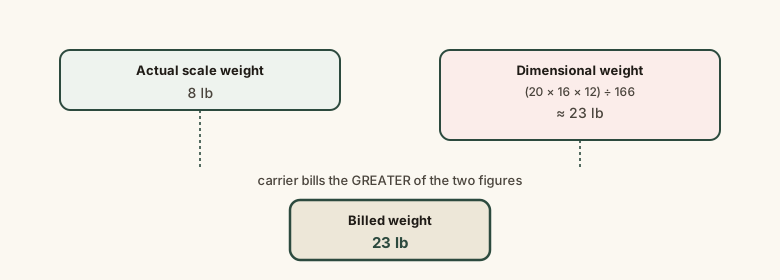
A box measuring 20 × 16 × 12 inches (holding a bulky but light item like a lampshade) weighs only 8 lb on a scale. Dimensional weight: (20 × 16 × 12) ÷ 166 = 3,840 ÷ 166 ≈ 23.13 lb, rounded up to 24 lb by most carriers' whole-pound rounding rules. Since the dimensional weight (24 lb) is far greater than the actual weight (8 lb), the carrier bills 24 lb — triple the package's true scale weight, purely because of its bulky dimensions.
Quick check
A package weighs 8 lb on a scale but has a calculated dimensional weight of 24 lb. What weight will the carrier actually bill for?
Example 3: How right-sizing packaging cuts a real shipping bill (real-world / applied case)
An online seller ships the same 8 lb item in an oversized 20 × 16 × 12 box (dimensional weight ≈24 lb, billed at 24 lb) versus a right-sized 12 × 10 × 8 box (dimensional weight = (12×10×8) ÷ 166 = 960 ÷ 166 ≈ 5.78 lb, so the carrier bills the greater figure — the actual 8 lb). At a typical rate of roughly $1 per billed pound for this weight tier, right-sizing the box saves about $16 per shipment (24 lb vs. 8 lb billed). Across a few hundred shipments a month, that single packaging change is a meaningful, recurring cost reduction with zero change to the product itself.
How it works (visual)
Billed weight is the greater of actual weight and dimensional weight
The carrier never averages or splits the difference between actual and dimensional weight — it's always a straightforward "take the larger number" comparison, which is exactly why box size matters as much as, or sometimes more than, actual contents weight.
Common mistakes
Common Mistakes
✕
Estimating shipping cost based only on a package's scale weight, ignoring box dimensions entirely.
→ Always calculate dimensional weight alongside actual weight for anything bulky or irregularly shaped, and expect to be billed for the larger of the two.
✕
Using an unnecessarily large box 'to be safe' when packing a shipment.
→ Right-size packaging to the actual contents wherever possible — a smaller box directly lowers dimensional weight, which is often the deciding factor in billed cost for lightweight items.
✕
Assuming every carrier uses the same DIM divisor.
→ Check the specific carrier's and shipping mode's DIM divisor (commonly around 166 for US domestic air, but it varies) before estimating cost — using the wrong divisor produces an inaccurate estimate.
Common misconception
“Shipping cost is fundamentally about how heavy a package is — a light package should always be cheap to ship.”
Shipping cost is really about how much space and capacity a package consumes on a truck, plane, or in a sorting facility — weight is only one proxy for that, and a poor one for large, light items. Dimensional weight pricing exists specifically because a bulky, empty-feeling box can occupy as much valuable cargo space as a small, dense, genuinely heavy one, and carriers price accordingly rather than by scale weight alone.
Quick check
Why might right-sizing a package's box be the single most effective way to lower its shipping cost, for a bulky but light item?
Try it yourself
Calculate a package's dimensional weight
Dimensional weight (lb)23.13
What to do next
What to do next
Before shipping, calculate both actual weight and dimensional weight — expect the carrier to bill for whichever is larger.
Right-size packaging to the actual contents wherever possible, especially for bulky, lightweight items — this is the most direct lever for reducing dimensional-weight-driven cost.
Confirm the specific DIM divisor used by your carrier and shipping mode before estimating shipping costs, since it varies.
Use the calculator above to check whether a given box size will trigger dimensional-weight billing for a specific item's actual weight.
FAQ
FAQ
Related terms
Related terms
Dimensional weight (DIM weight)
A shipping weight figure calculated from a package's volume rather than its scale weight, using the formula length × width × height ÷ a carrier-set divisor (commonly 166 for domestic air shipments).
Billed weight
The weight a carrier actually charges for, equal to whichever is greater between a package's actual scale weight and its calculated dimensional weight.
DIM divisor
The fixed number a package's cubic-inch (or cubic-centimeter) volume is divided by to produce its dimensional weight — a value set by each carrier and shipping mode, commonly 166 for US domestic air.
This entry was researched from public sources and drafted with AI-assisted tools, then edited — errors are still possible. Spot one, or want a topic covered? Read our disclaimer.
 KnowThis