U.S. veterans benefits, run by the Department of Veterans Affairs (VA), are a set of separate programs, each with its own eligibility rules. Most require a discharge under conditions other than dishonorable. VA health care is generally available to veterans who served 24 continuous months or the full period they were called up, with many exceptions, and the 2022 PACT Act widened access for toxic-exposure veterans. Disability compensation is a tax-free monthly payment for conditions caused or worsened by service, rated from 0% to 100% in 10% steps; several ratings are combined with VA's own math, not by adding them. The Post-9/11 GI Bill pays tuition, a housing allowance and a books stipend for up to 36 months, scaled by length of service. VA-backed home loans often need no down payment and no mortgage insurance but carry a one-time funding fee, which veterans receiving disability compensation don't pay. Needs-based pension, vocational rehabilitation, life insurance and burial benefits round out the main list. Dollar figures change each year, so check VA's current tables.
Reading time
— 6 min
Updated
— Oct 8, 2026
Fact-reviewed
— Oct 8, 2026
This entry explains how U.S. veterans benefits are structured, cited to the Department of Veterans Affairs. It is general education, not legal or benefits advice. Eligibility depends on your service record and circumstances, and dollar figures change every year. For your situation, contact VA (VA.gov or 800-827-1000) or a free VA-accredited Veterans Service Organization representative.
Key Takeaways
Key Takeaways
1Veterans benefits aren't one package. They're separate VA programs (health care, disability compensation, education, home loans, pension, rehabilitation, insurance, burial), each with its own eligibility test.
2Most require a discharge under conditions other than dishonorable. Disability compensation also requires service connection, and multiple ratings are combined with VA math, so 50% plus 30% equals 70%, not 80%.
3Figures change yearly: as of the rates effective December 1, 2025, compensation runs from about $180 a month at 10% to about $3,900 at 100% for a veteran alone. Always check VA's current tables.
The concept
People often talk about "veterans benefits" as if it were one thing you either get or don't. It's closer to a building with several doors, each with its own key. One door is health care through VA hospitals and clinics. Another is disability compensation, a monthly tax-free payment if an injury or illness was caused or worsened by service. Another is education, mainly the Post-9/11 GI Bill, which can pay tuition and a housing allowance. Others are VA-backed home loans, a needs-based pension for lower-income wartime veterans, job training through Veteran Readiness and Employment, life insurance, and burial benefits. Almost every door shares one basic key: a discharge that isn't dishonorable. After that, each program checks different things: how long you served, when, whether a condition is linked to service, or your income. That's why two veterans with the same years in uniform can end up with very different benefits, and why it's worth checking each program separately rather than assuming you don't qualify.
A veteran with a general (under honorable conditions) discharge has never applied for anything because she assumes benefits are only for honorable discharges and combat veterans. What's the accurate picture?
Worked examples
Example 1: One service-connected condition (baseline case)
Marcus injured his knee during a training exercise and still has limited motion years later. He files a claim with his service treatment records and a current diagnosis. VA finds service connection and rates the knee at 30%. Using the rate table effective December 1, 2025, a 30% rating for a veteran with no dependents pays roughly $550 a month, tax-free; at 30% and above, adding a spouse or children raises the amount. The rating also places him in a higher VA health care priority group. Had he filed an intent to file first, VA could have paid back to that date once the full claim was approved, as long as he completed it within a year. The exact payment depends on the current year's table, which VA adjusts every December in line with the Social Security cost-of-living adjustment.
Example 2: Why 50% plus 30% isn't 80% (edge case)
Dana has two service-connected conditions: one rated 50% and one rated 30%. Adding them suggests 80%, but VA doesn't add. It treats a person as 100% "whole" and applies each rating to what's left, largest first. The 50% rating leaves Dana 50% "efficient." The 30% rating applies to that remaining 50%: 30% × 50 = 15. So 50 + 15 = 65, and VA rounds to the nearest 10, giving a combined rating of 70%. The same method means two 10% ratings combine to 19, rounding to 20%, and it's why reaching 100% through many smaller ratings is harder than adding suggests. A separate bilateral factor can add a little when conditions affect both arms or both legs.
Example 3: The home loan funding fee (applied case)
Two veterans each buy a $320,000 home with a VA-backed loan for the first time and no down payment. VA loans typically require no down payment (when the price doesn't exceed the appraised value) and no private mortgage insurance, but they carry a one-time funding fee. Under VA's current fee table, the first-use rate with less than 5% down is 2.15%: $320,000 × 0.0215 = $6,880, usually rolled into the loan. With 10% down, the rate drops to 1.25% on a $288,000 loan, or $3,600. The second veteran receives disability compensation, so she's exempt: her fee is $0. That single exemption can be worth thousands of dollars, which is one reason a disability claim can matter even when the monthly payment is small. Fee rates are set by law and VA policy and have changed before, so check the current table when you apply.
Quick check
A veteran has two service-connected conditions rated 40% and 20%. What combined rating will VA assign?
How it works (visual)
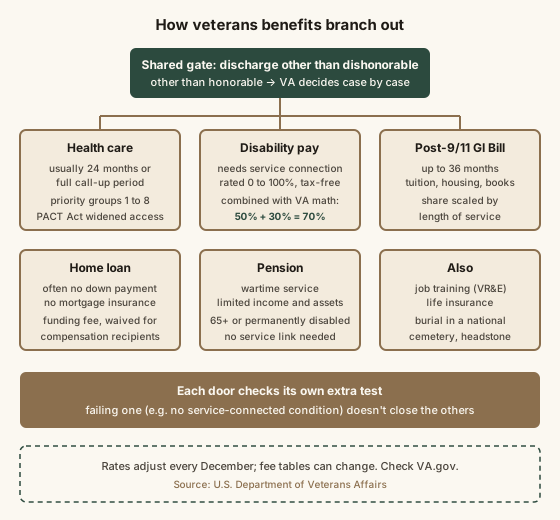
How veterans benefits branch out
The diagram's point is that eligibility is checked program by program. Failing one test, such as having no service-connected condition, doesn't close the other doors.
Common mistakes
Common Mistakes
✕
Assuming you don't qualify for anything because you didn't serve in combat or didn't retire.
→ Check each program separately on VA.gov. Health care, the GI Bill and home loans depend on service length and dates, not combat or retirement.
✕
Adding disability ratings together to predict your combined rating.
→ VA applies each rating to the remaining 'whole person' and rounds. Use VA's combined ratings table or calculator.
✕
Paying an unaccredited company to file a VA claim.
→ Use a free accredited Veterans Service Organization representative, or check accreditation on VA's website before paying anyone.
✕
Waiting until all your records are gathered before contacting VA.
→ Submit an intent to file first. It can hold your start date for up to a year while you build the claim.
✕
Treating last year's payment amount or fee rate as permanent.
→ Compensation rates are adjusted each December and fee tables can change. Check VA's current figures.
Common misconception
“A 0% disability rating is worthless, so there's no point getting one.”
A 0% rating pays no monthly compensation, but it formally establishes service connection. That can affect your VA health care priority group and copays for that condition, and if the condition worsens later, you can ask VA to increase the rating rather than proving the link from scratch. Whether it's worth pursuing in your case is a good question for an accredited representative.
What to do next
What to do next
Get a copy of your DD214 (or equivalent separation document); nearly every VA application starts with it.
Check eligibility program by program on VA.gov: health care, disability, education, home loan, pension and burial.
If you're preparing a disability claim, submit an intent to file to protect your potential start date.
Contact a free VA-accredited Veterans Service Organization representative for help with claims.
If your discharge is other than honorable, ask VA about a character-of-discharge review, and look into a discharge upgrade.
Check VA's current rate and fee tables before relying on any dollar figure, including those in this article.
FAQ
FAQ
Related terms
Related terms
Service connection
VA's finding that a disability was caused or made worse by military service. It's the gateway to disability compensation.
Combined disability rating
The single overall percentage VA assigns when a veteran has several rated conditions. It's calculated against the remaining 'whole person', not by adding the ratings, then rounded to the nearest 10%.
Character of discharge
The type of separation from service, such as honorable, general, other than honorable or dishonorable. Most VA benefits require a discharge under conditions other than dishonorable.
VA funding fee
A one-time fee on VA-backed home loans, set as a percentage of the loan, that helps fund the program. Veterans receiving VA disability compensation are exempt.
Intent to file
A notice to VA that you plan to file a claim. It can hold your potential start date for benefits for up to one year while you gather evidence.
Accredited representative
A Veterans Service Organization representative, claims agent or attorney accredited by VA to help with claims. VSO representatives help for free.
This entry was researched from public sources and drafted with AI-assisted tools, then edited — errors are still possible. Spot one, or want a topic covered? Read our disclaimer.
 KnowThis