 KnowThis
Key Takeaways
Key Takeaways
- 1A warranty can be express (explicitly stated, written or verbal) or implied (arising automatically by law, like a basic expectation a product works for its ordinary purpose).
- 2The word 'guarantee' has no single fixed legal meaning — its actual protections depend entirely on the specific terms stated, not on the word itself.
- 3A warranty period has a defined end date, after which the specific protections it offered generally no longer apply, regardless of how the product performs afterward.
The concept
Because "warranty" and "guarantee" describe a spectrum of possible promises rather than one fixed legal package, reading the specific terms is the only reliable way to know what's actually covered.
A product is sold with no written warranty card at all, but it breaks the first time it's used for its intended, ordinary purpose. Does the buyer necessarily have zero legal recourse?
Worked examples
Example 1: A standard one-year express warranty (baseline case)
Example 2: An 'as-is' sale attempting to waive implied warranties (edge case / variation)
Example 3: A 'lifetime guarantee' with specific conditions (real-world / applied case)
Why might a 'lifetime guarantee' not cover a specific product failure even though the product is clearly still within its 'lifetime'?
Try it yourself
Estimate how many days remain on a warranty based on its stated length and how many days have passed since purchase.
How it works (visual)
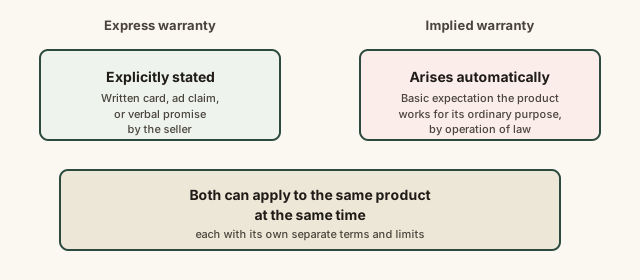
A product can be covered by both types simultaneously, and each carries its own separate set of terms and limitations.
Common mistakes
Common Mistakes
Assuming a product with no written warranty card has zero legal protection.
→ Check whether an implied warranty of merchantability might apply automatically under local law, especially for goods sold by a retailer rather than a private individual.
Assuming a 'lifetime guarantee' means unconditional coverage forever, regardless of cause.
→ Read the specific exclusions — misuse, lost proof of purchase, and normal wear and tear are common carve-outs even under lifetime guarantees.
Discarding a receipt or warranty card shortly after purchase.
→ Keep proof of purchase and any warranty documentation for the full stated warranty period, since many claims require it.
Common misconception
“The word 'guarantee' on a product always carries the same fixed legal meaning as a warranty.”
"Guarantee" has no single, fixed legal definition the way certain other contract terms do — its actual protections come entirely from whatever specific conditions and exclusions accompany it. A "satisfaction guarantee" and a "lifetime guarantee" can carry very different practical protections, so the specific stated terms matter far more than the word itself.
What to do next
What to do next
- Read the full warranty terms before purchase, focusing on what's excluded, not just what's covered.
- Keep receipts and warranty documentation for the entire stated warranty period.
- Before buying an 'as-is' item, check whether that disclaimer is enforceable in your jurisdiction for the type of sale involved.
- For a significant purchase with an unclear or disputed warranty claim, consult your local consumer protection office or a licensed attorney.