 KnowThis
Key Takeaways
Key Takeaways
- 1In the U.S., employment is generally presumed 'at-will' by default — either side can end it at almost any time, for almost any legal reason — unless a specific contract overrides that default.
- 2An offer letter and a full employment contract aren't necessarily the same thing; a brief offer letter may not include the detailed terms (non-compete, severance, duration) found in a more formal contract.
- 3Non-compete clause enforceability varies enormously by state, with several states banning or heavily restricting them regardless of what the contract says.
The concept
Because at-will employment is the default, the presence (or absence) of specific contract language is what actually determines whether that default applies to a given job.
An employee has only a brief offer letter stating salary and start date, with no mention of contract duration or termination terms. What employment status most likely applies by default?
Worked examples
Example 1: A standard at-will offer letter (baseline case)
Example 2: A fixed-term contract overriding at-will status (edge case / variation)
Example 3: A non-compete clause across two different states (real-world / applied case)
Why can the same non-compete clause be enforceable in one situation but not another?
How it works (visual)
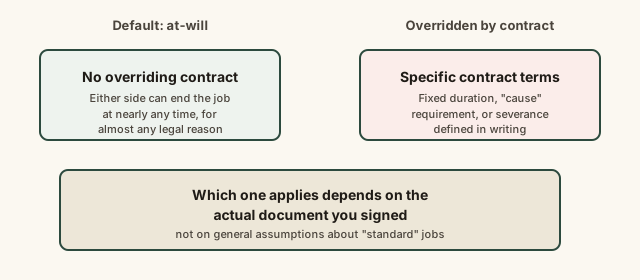
Without a specific overriding contract, the at-will default generally applies — which is why checking the actual document you signed matters more than assuming a standard arrangement.
Common mistakes
Common Mistakes
Assuming a brief offer letter guarantees job security or a fixed employment term.
→ Check whether the letter or any accompanying contract specifically overrides at-will status — absent that language, the at-will default likely still applies.
Assuming a non-compete clause is automatically enforceable just because it's in a signed contract.
→ Check your state's specific stance on non-compete enforceability, since some states void these clauses regardless of contract language, and consult a licensed attorney if the stakes are significant.
Treating 'employment contract' as a single standardized document type.
→ Recognize that employment agreements range widely, from a one-page offer letter to a detailed multi-year contract with severance and cause-for-termination provisions — read the specific document you have.
Common misconception
“An employer can never fire you without a specific documented reason, since 'wrongful termination' protects most employees.”
Under the default at-will doctrine that applies in nearly every U.S. state, an employer generally can terminate an employee for almost any reason (or no stated reason at all), as long as the reason isn't illegal — such as discrimination based on a protected characteristic or retaliation for protected activity. "Wrongful termination" refers specifically to those narrower illegal categories, not to termination without a stated reason in general.
What to do next
What to do next
- Read your actual offer letter or contract to check whether it specifies at-will status or overrides it with a fixed term or cause requirement.
- If a non-compete clause is included, research your specific state's current stance on non-compete enforceability before assuming it applies as written.
- Note any confidentiality or intellectual-property assignment clauses, since these often survive employment and can affect future work.
- For a significant executive contract or a non-compete with real career impact, have a licensed attorney review it before signing.