 KnowThis
Key Takeaways
Key Takeaways
- 1An NDA creates a legal duty to keep specifically defined information confidential — its real strength depends entirely on how that definition, duration, and set of exceptions are written.
- 2NDAs can be one-way (only one party discloses confidential information) or mutual (both parties disclose and both are bound), and the correct type depends on who's actually sharing what.
- 3Information that's already public, independently developed, or required to be disclosed by law is typically carved out as an exception, even under a broadly written NDA.
The concept
Because an NDA only protects what it actually defines as confidential, two NDAs that look similar on the surface can offer very different real-world protection depending on the specific wording.
A company shares a product roadmap under an NDA with a contractor. The contractor later mentions a detail from that roadmap that was independently reported by a news outlet before the NDA was signed. Has the contractor likely violated the NDA?
Worked examples
Example 1: A one-way NDA before a pitch meeting (baseline case)
Example 2: A mutual NDA between two companies (edge case / variation)
Example 3: An NDA with a narrow definition of confidential information (real-world / applied case)
Why might a broadly written definition of 'confidential information' in an NDA matter more than simply having an NDA in place at all?
How it works (visual)
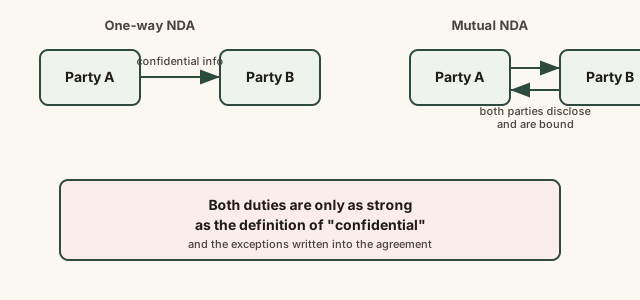
Choosing the right type isn't a formality — using a one-way NDA when both sides are actually disclosing confidential information leaves one party's disclosures unprotected.
Common mistakes
Common Mistakes
Signing an NDA without reading how narrowly or broadly it defines 'confidential information.'
→ Check the definition section specifically — a vague definition can be argued either way later, which weakens the practical protection for everyone involved.
Using a one-way NDA when both sides will actually be sharing sensitive information.
→ Use a mutual NDA whenever both parties are disclosing confidential information, so both sides get the same contractual protection.
Assuming an NDA protects information indefinitely with no time limit.
→ Check the stated duration of the confidentiality duty — many NDAs specify a fixed term (commonly 1-5 years), after which the duty may expire unless the information separately qualifies as a trade secret.
Common misconception
“Signing an NDA means literally everything discussed afterward is automatically confidential and protected.”
An NDA only protects what it specifically defines as confidential information, and it typically carves out information that's already public, independently developed, or legally required to be disclosed. Two NDAs can look similar on the surface but offer very different real-world protection depending on how carefully the definition, duration, and exceptions are drafted.
What to do next
What to do next
- Read the definition of 'confidential information' closely before signing — check whether it's a broad catch-all or a narrow, itemized list.
- Confirm whether the NDA should be one-way or mutual based on who is actually disclosing sensitive information.
- Check the stated duration of the confidentiality obligation and whether it matches how long the information genuinely needs protection.
- For high-stakes business relationships or significant trade secrets, have a licensed attorney review the NDA before signing rather than relying on a template alone.