 KnowThis
Key Takeaways
Key Takeaways
- 1A freelance or service contract's core job is to define scope of work, payment terms, timeline, and ownership of the finished product before work begins.
- 2Most freelancer-client disputes trace back to a vague or missing term in one of those four areas, not to a genuine disagreement over facts that a contract couldn't have prevented.
- 3A 'kill fee' clause protects a contractor's time investment if a client cancels mid-project, and its absence can leave a contractor with no payment at all for partially completed work.
The concept
Because scope, payment, timeline, and ownership are the four recurring flashpoints, a contract that clearly nails down just those four areas prevents the overwhelming majority of freelance disputes.
A client asks a freelance web designer for 'a few extra pages' beyond what was originally quoted, without discussing additional payment. What contract term would most directly address this situation?
Worked examples
Example 1: A clearly scoped logo design project (baseline case)
Example 2: A project canceled mid-way (edge case / variation)
Example 3: An ownership dispute over finished work (real-world / applied case)
Why might a contract's silence on intellectual-property ownership lead to a dispute even when both sides acted in good faith?
How it works (visual)
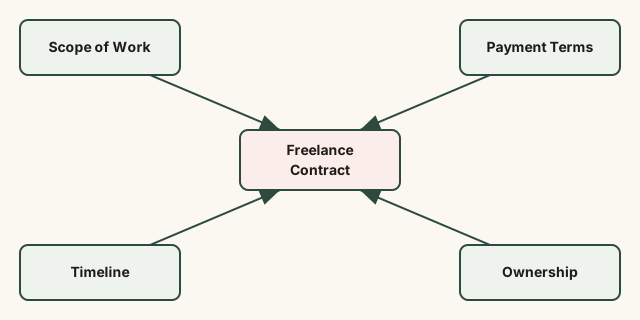
Most freelance disputes trace back to one of these four boxes being left vague or unaddressed rather than to a genuine disagreement over facts.
Common mistakes
Common Mistakes
Starting work based on a verbal understanding without a written scope of work.
→ Write down exactly what's included and excluded before starting, even for small projects — this single step prevents most scope-related disputes.
Leaving out a kill fee clause, assuming a project will always be completed once started.
→ Include a kill fee or cancellation clause specifying partial payment for work completed if the client cancels mid-project.
Not specifying when ownership or usage rights of the finished work transfer to the client.
→ State explicitly whether rights transfer upon final payment, upon delivery, or under some other condition, so neither side is left guessing later.
Common misconception
“Being called an 'independent contractor' in a contract automatically makes someone a contractor for tax and labor-law purposes.”
The label used in a contract doesn't automatically control legal classification. Tax authorities and labor law generally look at the actual working relationship — level of control over how work is performed, whether tools and equipment are provided, exclusivity, and other factors — to determine whether someone is genuinely an independent contractor or functions more like an employee, regardless of what the contract calls them.
What to do next
What to do next
- Write a specific scope of work section listing exactly what's included, and note that anything beyond it requires a separate agreement or additional payment.
- Specify the payment schedule clearly — deposit amount, milestone payments, and final payment terms — before work begins.
- Include a kill fee or cancellation clause to protect against being left uncompensated if a project ends early.
- State explicitly when ownership or usage rights of the finished work transfer, and consider a licensed attorney's review for high-value or complex projects.