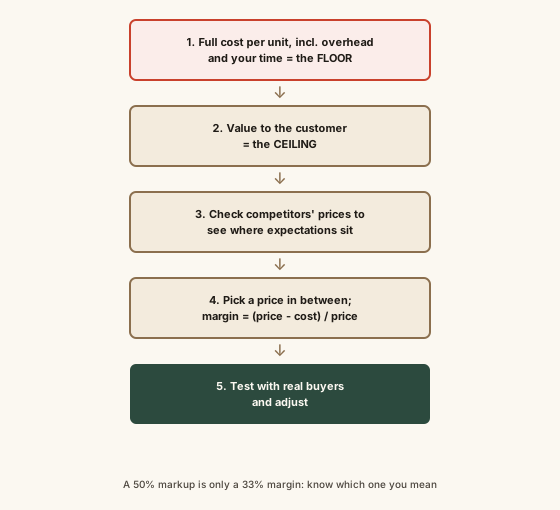
Pricing a product or service means finding a number between two limits: a floor set by your full costs, including overhead and your own time, and a ceiling set by the value customers place on what you offer, with competitors' prices as a reference point in between. The SBA's business guide stresses knowing your costs and researching competitors and customers before setting prices. Common methods are cost-plus (cost times a markup), competitor-based (priced relative to alternatives), and value-based (priced from the customer's gain or willingness to pay), as covered in standard marketing texts such as OpenStax's Principles of Marketing. Two arithmetic traps catch many new owners: markup and margin aren't the same (a 50% markup yields a 33% margin), and freelancers who divide their target income by 2,080 working hours forget that many of those hours won't be billable.
Reading time
— 4 min
Updated
— Sep 26, 2026
Fact-reviewed
— Sep 26, 2026
Key Takeaways
Key Takeaways
1Every price sits between a floor (your full cost, including overhead and your time) and a ceiling (what customers believe it's worth).
2Competitors' prices tell you where customers' expectations are, but not whether a price covers your costs.
3Markup and margin are different numbers. A 50% markup gives only a 33% margin, and confusing them is a common way to underprice.
The concept
Think of your price as a spot on a ruler. The left end is what it really costs you to deliver, counting materials, but also rent, software, insurance, and the hours you spend on emails and invoices. Price below that, and every sale digs you deeper. The right end is what the product is worth to the buyer: the money it saves them, the hassle it removes, the result it gets. Price above that and nobody buys. Competitors show you where buyers are used to seeing prices, somewhere in the middle. Your job is to pick a spot that covers the left end with room to spare and that you can justify toward the right end.
Pricing works best after you've checked that people actually want the thing, which is the point of validating a business idea. Early price tests are part of that validation.
Quick check
You buy mugs for $8 and sell them for $12. Your friend says you have a 50% margin. Are they right?
Worked examples
Example 1: A product with a target margin (baseline case)
A candle costs $6 in wax, wick and jar. Shipping supplies and card fees add $1.50, and monthly overhead (booth fee, website, insurance) of $300 spread over 200 candles adds another $1.50. Full cost: $9. To reach a 55% gross margin, price = $9 / (1 − 0.55) = $20. Comparable handmade candles nearby sell for $18 to $28, so $20 is within what customers expect, and it covers every cost with room left over.
Example 2: A freelancer's hourly rate (the billable-hours trap)
A freelance designer wants $60,000 a year in income and expects $10,000 a year in costs (software, equipment, insurance) plus self-employment tax. Dividing $60,000 by 2,080 hours (40 hours × 52 weeks) gives about $29 an hour, which is far too low. After vacation, sick days, admin, marketing and gaps between clients, perhaps 1,000 hours a year are billable. ($60,000 + $10,000) / 1,000 = $70 an hour before taxes. Self-employment tax pushes the real number higher still. Freelancers who price at $29 an hour find out the difference the hard way.
Example 3: Pricing on value (real-world use)
A consultant sets up a scheduling system that saves a clinic 10 staff hours a week, at $25 an hour. That's about $13,000 a year in saved time. The consultant's cost to deliver is about $2,000. Cost-plus might suggest $3,000. Value-based pricing suggests the clinic would happily pay $5,000 to $6,000, since it earns that back in under six months. Both prices are above the floor, but one captures far more of the value created, and the client is still clearly better off.
Quick check
In Example 2, why does the rate jump from about $29 to $70 an hour?
How it works (visual)
Setting a price step by step
Common mistakes
Common Mistakes
✕
Counting only materials when working out cost.
→ Add overhead (rent, software, fees, insurance) and a value for your own time, spread across expected sales.
✕
Using markup when you meant margin.
→ For a target margin m, use price = cost / (1 − m). A 50% margin needs a 100% markup.
✕
Copying the cheapest competitor's price.
→ Use competitor prices as a reference, then check them against your own cost floor and what makes your offer different.
Common misconception
“The lowest price wins, so a new business should undercut everyone.”
Customers weigh quality, speed, trust, convenience and fit, not just price, and a very low price can even signal low quality. More importantly, a small business rarely has the scale to survive a price war: its per-unit costs are usually higher than a large competitor's. Underpricing also makes it hard to raise prices later. A price that covers full costs and is justified by clear value is usually more sustainable than the cheapest one.
What to do next
What to do next
List every cost for one unit or one hour of work, including a share of overhead and your own time.
Write down the specific value your customer gets: money saved, time saved, a result achieved.
Collect 5 to 10 real competitor prices for comparable offers.
Choose a price, then calculate its gross margin with (price − cost) / price.
Test it with real buyers, and review prices at least once a year as costs change.
FAQ
FAQ
Related terms
Related terms
Cost-plus pricing
Setting a price by adding a fixed percentage markup to what the item costs you.
Value-based pricing
Setting a price from what the product is worth to the customer (money saved, time saved, results), rather than from what it costs you.
Markup
Profit as a percentage of cost. Cost $20, price $30: markup is $10 / $20 = 50%.
Gross margin
Profit as a percentage of the selling price. Cost $20, price $30: margin is $10 / $30 = 33%.
Overhead
Costs of running the business that aren't tied to any single sale, such as rent, software, insurance and your unbilled time.
This entry was researched from public sources and drafted with AI-assisted tools, then edited — errors are still possible. Spot one, or want a topic covered? Read our disclaimer.
 KnowThis