What Cash Flow Actually Means for a Small Business
Cash flow is the movement of money into and out of a business over a period, and it differs from profit mainly in timing. Under accrual accounting, a sale counts as revenue when it's earned, even if the customer pays 30 or 60 days later; cash flow only counts it when the money arrives. That's why a profitable business can still be unable to pay rent or payroll. A statement of cash flows splits movement into three parts: operating activities (day-to-day sales and expenses), investing activities (buying or selling equipment and other long-term assets) and financing activities (loans, repayments and owner contributions or draws). Growth often makes the gap worse, because materials and wages are paid before customers pay. The standard defenses are a rolling 13-week cash forecast, invoicing promptly with clear payment terms, a cash reserve, and arranging a line of credit before it's needed. The U.S. Small Business Administration lists cash flow management as a core part of running a business's finances.
Reading time
— 4 min
Updated
— Sep 27, 2026
Fact-reviewed
— Sep 27, 2026
Key Takeaways
Key Takeaways
1Cash flow is the money actually moving through your bank account. Profit is what the books say you earned. They often differ.
2A profitable business can run out of cash if customers pay late and bills, payroll and suppliers have to be paid first.
3A simple weekly cash forecast, fast invoicing and a reserve prevent most cash crunches.
The concept
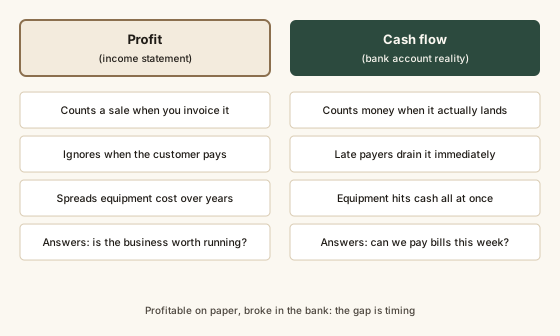
You finish a $10,000 job on June 1 and send the invoice. Your books say you earned $10,000 in June. But the customer pays on July 1, and your rent, your helper's wages and your supplier are all due in June. For that month you're profitable and broke at the same time. That gap is what cash flow is about. Profit tells you whether the business is worth running. Cash flow tells you whether you can pay the bills this week. Small businesses rarely fail because a single job lost money; they get into trouble when the cash runs out before the money they're owed arrives. Profit itself comes in layers; how profit margin actually gets calculated separates gross, operating and net.
Quick check
You invoice $10,000 on June 1, and it's paid July 1. When does it show up in June's cash flow?
Worked examples
Example 1: A month of cash in and out (baseline case)
A two-person cleaning company starts March with $6,000 in the bank. Customers pay $18,000 during March. Cash out: $9,000 in wages, $1,500 van lease, $1,200 supplies, $800 insurance and $600 software, totaling $13,100. Net operating cash flow is +$4,900, so it ends March with $10,900. If its average slow-month outflow is about $3,300 a week, that balance is roughly 3 weeks of runway. That single number is a better early warning than monthly profit.
Example 2: The big contract that nearly sinks the business (edge case)
A landscaping company with $15,000 in the bank wins a $60,000 commercial job with a 20% margin. It has to buy $25,000 of materials up front and pay $20,000 in crew wages over six weeks. The client pays on net-60 terms after completion. On paper, the job adds $12,000 profit. In the bank, the company needs to fund $45,000 of costs for about three months with only $15,000 of cash. Without a deposit, progress billing or a line of credit, a profitable contract can empty the account. The fix is to negotiate a deposit (say 30% up front) and milestone payments before signing.
Example 3: Building a 13-week forecast (real-world use)
In a spreadsheet, make 13 columns, one per week. Row 1: opening cash. Next rows: expected cash in (invoices due that week, weighted by how reliably each customer pays). Then cash out: payroll dates, rent, loan payments, quarterly estimated taxes, known supplier bills. Last row: closing cash, which becomes next week's opening cash. Update it every Monday with actual numbers. When any week dips below your minimum (say, two weeks of expenses), you'll see it a month or more ahead, while there's still time to chase invoices, delay a purchase or draw on credit.
Quick check
In the landscaping example, what's the best fix before signing?
How it works (visual)
Profit vs cash flow
Common mistakes
Common Mistakes
✕
Judging the business's health by profit alone.
→ Look at the bank balance, receivables and a forward cash forecast every week.
✕
Invoicing late or with vague terms.
→ Invoice the day work is delivered, state the due date, and make paying easy (card, bank transfer).
✕
Forgetting lumpy bills like quarterly taxes, insurance and annual renewals.
→ Put every known lump payment into the forecast and set cash aside monthly for it.
Common misconception
“If my business is profitable, cash will take care of itself.”
Profit and cash move on different clocks. Customers who pay late, inventory bought ahead of sales, equipment purchases and loan principal repayments all drain cash without showing up as losses. Growth makes it worse, because costs arrive before the revenue from new work does. Plenty of profitable businesses have closed because they couldn't make payroll during that gap.
What to do next
What to do next
Build a simple 13-week cash forecast this week and update it every Monday.
List who owes you money, how much and how late, and follow up on anything past due.
Set a minimum cash balance (for example, two weeks of expenses) and treat dipping below it as an alarm.
Ask your bank about a line of credit while the business is healthy, before you need it.
FAQ
FAQ
Related terms
Related terms
Cash flow
The money moving into and out of a business over a period, counted when it actually changes hands.
Accrual accounting
Recording revenue when it's earned and expenses when they're incurred, regardless of when cash moves.
Accounts receivable
Money customers owe you for work already delivered or invoiced but not yet paid.
Operating cash flow
Cash generated or used by the business's everyday activities, before equipment purchases and financing.
Cash runway
How long a business can keep paying its bills from the cash it has, at its current rate of spending.
This entry was researched from public sources and drafted with AI-assisted tools, then edited — errors are still possible. Spot one, or want a topic covered? Read our disclaimer.
 KnowThis