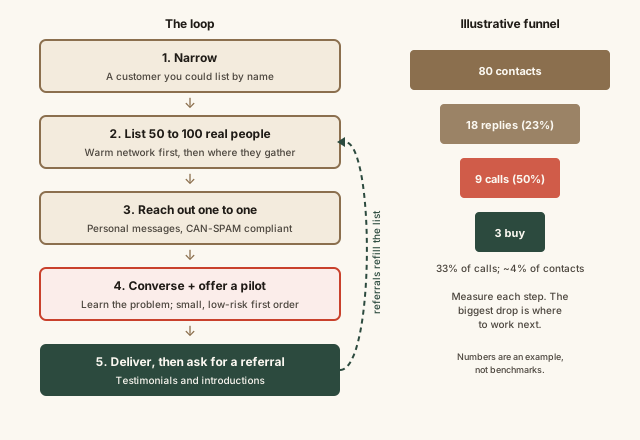
Finding your first customers is a manual process, not a marketing one. It starts with narrowing who you serve to a group specific enough to list by name, then contacting those people directly through your existing network and the places they already gather, such as trade groups, local associations and online communities. Each conversation is part research and part sale: you learn what the problem costs them and offer a small, low-risk first purchase or pilot. Because only a fraction of outreach becomes a conversation and only a fraction of conversations become a sale, the work is a numbers game you should measure. The SBA recommends grounding this in market research about who your customers are and where they buy. Paid ads and broad social posts tend to work better later, once you know which message and which customer actually convert. Outreach also has legal limits: commercial email must follow the FTC's CAN-SPAM rules, including a working opt-out and a valid postal address.
Reading time
— 5 min
Updated
— Sep 30, 2026
Fact-reviewed
— Sep 30, 2026
Key Takeaways
Key Takeaways
1First customers come from direct, one-to-one outreach to a narrow, nameable group of people, not from ads or a launch announcement.
2Every step loses people: messages become replies, replies become calls, calls become sales. Measure each rate and you'll know how much outreach you need.
3Start with your warm network and the places your customers already gather, offer a small low-risk first purchase, and ask every happy customer for a referral.
The concept
A new business has no reviews, no reputation and no one searching for its name. So the usual marketing tools don't have much to work with yet. What does work is the slow, personal route: decide exactly who you're for, write down real people who fit, and talk to them one at a time. Think of it like opening a restaurant on a quiet street. You don't buy a billboard on day one. You invite the neighbors, cook for them, and ask the ones who liked it to bring a friend. Each conversation either wins a customer or teaches you why not, and both are useful. After 20 or 30 of those conversations, you'll know which pitch lands and which customers say yes, and that's when broader marketing starts to pay off.
If you haven't yet checked that people will pay for the idea, start with how to validate a business idea. Finding first customers and validating the idea often happen in the same conversations.
Quick check
Which target is narrow enough to start outreach?
Worked examples
Example 1: A freelance bookkeeper (baseline case)
Maria starts a bookkeeping service for local contractors: plumbers, electricians and roofers with one to ten employees. She lists 80 names: 25 from her own contacts and their introductions, and 55 from her county's trade association directory. She sends short personal messages, not a template blast. Suppose 18 reply, 9 agree to a 20-minute call, and 3 sign up for a one-month trial at a reduced rate. Her funnel: 80 → 18 → 9 → 3. Overall that's about 4% of contacts, but 33% of calls. Now she knows the bottleneck is getting replies, not closing, so she works on her opening line and asks each of the 3 new clients for one introduction.
Example 2: Software for businesses (edge case: long decisions)
Dev builds scheduling software for veterinary clinics. A clinic owner can't decide in one call, because staff need to try it and the practice manager has to approve. Instead of chasing quick sales, Dev offers 5 clinics a 60-day pilot at half price in exchange for weekly feedback. Two convert to full price, one leaves, and two need more time. The two paying clinics give Dev something more valuable than revenue: real usage data and a reference other clinic owners will call. When decisions take months, plan for fewer, deeper first customers and expect a longer gap before the first payment, which matters for cash flow.
Example 3: Working out what outreach costs (applied)
Sam runs a home-baking business and tests two channels for a month. A booth at a weekend farmers market costs $240 in fees for 4 weekends plus 24 hours of time, and brings 30 new customers. Social ads cost $300 and 3 hours, and bring 6 customers. Valuing time at $20 an hour, the market cost $240 + $480 = $720, or $24 per customer. The ads cost $300 + $60 = $360, or $60 per customer. That's the customer acquisition cost. The market wins for now, and the comparison only exists because Sam measured both. Compare that figure with what a customer spends over time, and with your pricing, to see if a channel is worth keeping. Whether a venture like Sam's stays a side hustle depends less on revenue than on whether it can earn beyond her own hours; see what makes a side hustle different from a real business.
Quick check
Your funnel is 100 messages → 4 replies → 3 calls → 2 sales. Where should you focus first?
How it works (visual)
The first-customer loop
Common mistakes
Common Mistakes
✕
Spending the first budget on ads before anyone has bought.
→ Sell to the first handful of customers by hand. You'll learn which message and which customer convert, so later ad spending is aimed.
✕
Targeting 'everyone who might need this.'
→ Pick a group narrow enough to list by name. You can widen it once you have proof.
✕
Sending one template to a bought email list.
→ Write short personal messages to people you chose. Bought lists bring low replies and CAN-SPAM risk.
✕
Counting compliments as demand.
→ Ask for a commitment: a paid pilot, a deposit, a signed letter of intent or at least a scheduled next step.
Common misconception
“If the product is good enough, customers will find it.”
Nobody can find a product they've never heard of, from a company with no reviews and no search history. Early demand is created by the founder's outreach. Paul Graham's widely read essay "Do Things that Don't Scale" makes the same point about startups: the founders of companies that later grew huge typically recruited their first users by hand.
What to do next
What to do next
Write a one-sentence description of your ideal customer that you could use to search for real names.
List 50 specific people or businesses, starting with your own network and introductions.
Find two places your customers already gather, such as a trade association, local group or online community, and join them.
Set up a simple spreadsheet tracking messages, replies, calls and sales so you can see your conversion rates.
Read the FTC's CAN-SPAM guide before sending any commercial email.
Book a free session with a SCORE mentor or your local Small Business Development Center to review your outreach plan.
FAQ
FAQ
Related terms
Related terms
Ideal customer profile
A specific description of the customer most likely to buy and benefit, narrow enough that you could list real examples by name.
Warm outreach
Contacting people who already know you, or who are introduced by someone they know, rather than strangers.
Conversion rate
The share of people at one step who move to the next, such as messages sent that turn into conversations, or conversations that turn into sales.
Pilot
A small, time-limited first engagement, often at a reduced price or scope, that lets a customer try the product with low risk.
Customer acquisition cost (CAC)
The total sales and marketing spending, including your own time if you value it, divided by the number of new customers it produced.
This entry was researched from public sources and drafted with AI-assisted tools, then edited — errors are still possible. Spot one, or want a topic covered? Read our disclaimer.
 KnowThis