 KnowThis
Key Takeaways
Key Takeaways
- 1A power of attorney lets one person (the agent) act legally on behalf of another (the principal) — but the scope of that authority depends entirely on how the specific document is written.
- 2A 'durable' power of attorney remains valid if the principal becomes incapacitated, while a non-durable POA automatically ends the moment the principal loses mental capacity — the opposite of what many people assume it does.
- 3A general POA grants broad authority across many types of decisions, while a limited (or 'special') POA restricts the agent's authority to specific, named tasks or a defined time period.
The concept
Because a standard POA ends exactly when incapacity begins, anyone planning for the possibility of future incapacity specifically needs the durable version — not just any power of attorney document.
A person signs a standard (non-durable) power of attorney and later becomes incapacitated due to a medical event. What happens to the agent's authority under that document?
Worked examples
Example 1: A limited POA for a single transaction (baseline case)
Example 2: A durable POA prepared for future incapacity (edge case / variation)
Example 3: Confusing a general POA with a healthcare directive (real-world / applied case)
Why might a family be surprised to learn a financial power of attorney doesn't cover medical decisions?
How it works (visual)
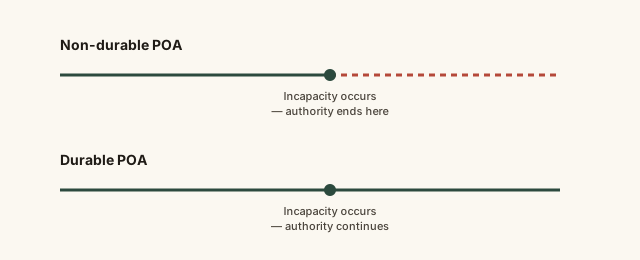
The single word "durable" in the document's title is what determines whether the agent's authority survives exactly the moment it may be needed most.
Common mistakes
Common Mistakes
Assuming any power of attorney document automatically remains valid if the principal becomes incapacitated.
→ Check specifically whether the document is labeled 'durable' — a standard POA ends at incapacity unless durability is explicitly included.
Assuming a financial or general power of attorney also covers healthcare decisions.
→ Set up a separate healthcare power of attorney or healthcare proxy if you want an agent to be able to make medical decisions.
Waiting until after a health crisis to set up a durable power of attorney.
→ Establish a durable power of attorney while the principal has full mental capacity, since a POA generally cannot be created once incapacity has already occurred.
Common misconception
“A power of attorney automatically remains valid no matter what happens to the principal's mental state, since that's the whole point of having one.”
Only a power of attorney specifically labeled and drafted as "durable" remains valid if the principal becomes incapacitated. A standard, non-durable power of attorney automatically terminates at the exact moment incapacity occurs — often the situation people most expect it to cover. Confirming durability in advance is essential for anyone planning for possible future incapacity.
What to do next
What to do next
- Decide whether you need general (broad) or limited (task-specific) authority granted to your agent.
- If planning for possible future incapacity, confirm the document is explicitly labeled and drafted as a durable power of attorney.
- Set up a separate healthcare power of attorney or healthcare proxy if you also want an agent authorized to make medical decisions.
- Have a licensed attorney draft or review the document, since state-specific requirements for execution (like witnesses or notarization) vary.