Understanding Net Worth (Assets Minus Liabilities)
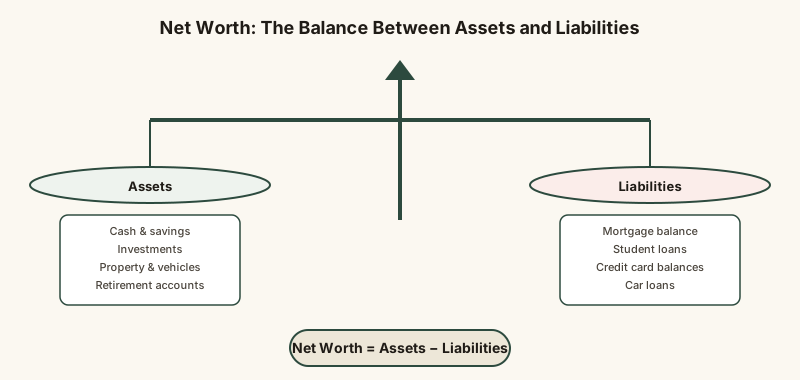
Net worth is calculated by subtracting everything owed (liabilities) from everything owned of value (assets), producing a single snapshot figure that reflects overall financial position rather than income or cash flow.
Reading time
— 4 min
Updated
— Sep 24, 2026
Fact-reviewed
— Aug 22, 2026
This entry explains how net worth is calculated — it is financial literacy, not personalized advice. What counts as a healthy net worth varies widely by age, location, and circumstances; a financial advisor can help interpret an individual figure.
Key Takeaways
Key Takeaways
1Net worth equals total assets minus total liabilities — a single snapshot number, not a rate of income or spending.
2Assets are anything of monetary value owned (cash, investments, property); liabilities are anything owed (loans, credit card balances, mortgages).
3Net worth can be negative — this is common early in adulthood (student loans, no assets yet) and isn't itself a sign of financial distress.
The concept
Net worth is what someone would theoretically have left if they sold everything they own and paid off everything they owe. Add up the value of everything owned — cash, a car, a house, retirement accounts — then subtract everything owed — credit card balances, a mortgage, student loans, a car loan. Whatever's left is the net worth. It can be positive or negative, and it's different from income, which is about money coming in over time, not a total snapshot.
Understanding which side of the equation something belongs on — asset or liability — is the most common point of confusion.
Quick check
A person owns a home worth $300,000 with a $220,000 mortgage balance remaining. How should this be reflected in a net worth calculation?
Worked examples
Example 1: A simple net worth calculation (baseline case)
Someone has $3,000 in a checking account, $8,000 in a retirement account, and a car worth $12,000, for total assets of $23,000. They owe $2,000 on a credit card and $9,000 on a car loan, for total liabilities of $11,000. Net worth: $23,000 − $11,000 = $12,000.
Example 2: Negative net worth early in adulthood (edge case / variation)
A recent graduate has $1,500 in savings and no other significant assets, for total assets of $1,500. They have $35,000 in student loans, for total liabilities of $35,000. Net worth: $1,500 − $35,000 = −$33,500. This negative figure is common for recent graduates with education debt and doesn't by itself indicate financial trouble — it reflects an investment (education) whose return (higher future earning potential) isn't captured as a dollar-value asset on the balance sheet.
Example 3: Net worth changing over time as debt is paid down (real-world / applied case)
A household tracks net worth annually. Year one: $150,000 in assets (mostly home equity and retirement accounts), $130,000 in liabilities (mortgage and a car loan), for a net worth of $20,000. By year five, the mortgage balance has dropped through regular payments, the home has appreciated, and retirement contributions have grown — assets are now $210,000 and liabilities are $95,000, for a net worth of $115,000. Tracking net worth annually (rather than obsessively) shows the trend of overall financial position, which is more informative than any single year's number.
How it works (visual)
Net worth as the balance between assets and liabilities
Common mistakes
Common Mistakes
✕
Confusing net worth with income, treating a high salary as automatically meaning a high net worth.
→ Remember net worth is a snapshot of assets minus liabilities, unrelated to how much is earned in a given period — a high earner can have low or negative net worth if spending and debt outpace saving.
✕
Leaving out smaller liabilities (a personal loan, a buy-now-pay-later balance) when calculating total debt.
→ List every liability, even small ones, since omitting them overstates net worth and can mask a less healthy financial position than it appears.
✕
Treating a single net worth number as a verdict on financial success or failure.
→ Track net worth over time (annually) rather than judging one number in isolation — the trend matters more than any single snapshot, especially early in adulthood.
Common misconception
“A negative net worth means someone is in financial trouble.”
Negative net worth is common and often expected at certain life stages — most notably right after taking on student loans or a mortgage, before assets have had time to accumulate. It becomes a concern mainly when it's persistent or trending more negative over time, not simply because it's below zero at a single point.
Try it yourself
Net Worth Calculator
Net worth$12,000
What to do next
What to do next
List every asset you own with its current estimated value (cash, investments, property, vehicles).
List every liability you owe with its current balance (loans, credit cards, mortgages).
Subtract total liabilities from total assets to get a single net worth figure.
Recalculate annually (or at a regular interval) and track the trend rather than judging a single snapshot.
FAQ
FAQ
Related terms
Related terms
Net worth
The value of everything a person owns (assets) minus everything they owe (liabilities), calculated as a single number at a specific point in time.
Liability
A financial obligation or debt owed to another party, such as a mortgage balance, credit card balance, or student loan.
This entry was researched from public sources and drafted with AI-assisted tools, then edited — errors are still possible. Spot one, or want a topic covered? Read our disclaimer.
 KnowThis