 KnowThis
Key Takeaways
Key Takeaways
- 1A learning plan that sticks turns a vague goal into a specific target, a baseline assessment, an ordered sequence of sub-skills, a practice schedule, and a checkpoint that revises the plan.
- 2The plan works as an adjustable cycle, not a one-time document — early estimates of the right order and pace are often wrong and get corrected against real practice results.
- 3Over-elaborated, highly detailed plans built before any practice starts are a common reason self-directed learning stalls before it begins.
The concept
Once the decomposition-plus-feedback-loop mechanism is visible, the practical approach follows: define the target, check your real starting point, order the first few sub-skills, start practicing, and let the checkpoint do the work of correcting the plan.
Why does a personal learning plan work better as an ongoing cycle than as a single, fully detailed document written before practice begins?
Worked examples
Example 1: Turning "get better at public speaking" into a plan (baseline case)
Someone wants to "get better at public speaking" — a vague goal. They convert it into a specific target: deliver a confident 10-minute talk to a group of about 20 people within eight weeks. They assess their baseline by recording themselves giving a short talk and noting concrete issues (filler words, rushed pacing, no clear structure). They break the gap into an ordered sequence — structure first, then delivery pace, then handling questions — and build a weekly practice schedule. They set a four-week checkpoint to reassess against a second recording.
Why does recording a baseline talk matter more than just assuming general 'nervousness' is the problem?
Example 2: The over-planning trap (edge case / variation)
One learner spends a month building a detailed, multi-page curriculum for learning a musical instrument before ever playing a note — sequencing dozens of future lessons, theory topics, and practice drills in advance. A second learner picks three basic chords, practices 15 minutes a day, and sets a two-week checkpoint. By the time the first learner finishes planning, the second has already completed two real practice cycles and revised their plan once based on which chord transitions turned out to be genuinely hard.
What's the main problem with the first learner's month-long planning process in this example?
Example 3: Planning a skill shift for a role change (real-world / applied case)
A professional aiming for a role change sets a specific target skill set, grounded in an actual comparison against what the target role requires. They sequence foundational sub-skills before advanced ones, schedule short, regular practice sessions rather than sporadic long ones, and revise the plan after each monthly checkpoint based on which sub-skills turned out to be harder or easier than expected. Six months in, the plan looks noticeably different from the first draft — not because the first draft was badly made, but because the checkpoints did their job.
Why does it make sense that the plan looks noticeably different six months in, even though the original plan wasn't badly made?
How it works (visual)
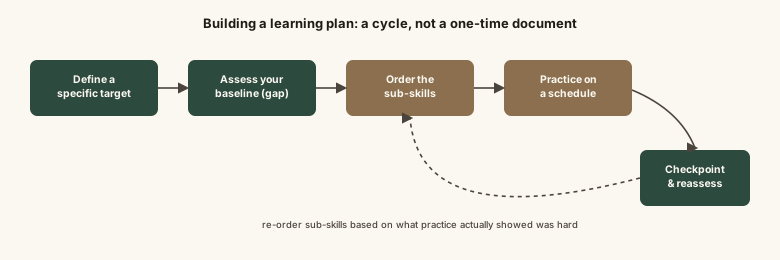
The return arrow is the part most self-made plans skip — without it, a plan is a guess made once instead of a guess that gets corrected.
Common mistakes
Common Mistakes
Starting from a vague goal ('get better at X') instead of a specific, checkable target.
→ Write the target as something you could actually verify — a task you could do, at a stated level, by a stated date.
Spending excessive time building an elaborate, fully detailed plan before ever starting to practice.
→ Build a lightweight first-pass plan with just the first few sub-skills in order, and let checkpoints fill in the rest as you go.
Never revisiting or revising the plan after it's written, even as practice reveals which parts were wrong.
→ Set a real checkpoint date up front, and treat it as a scheduled point to reorder sub-skills or adjust pace based on what practice actually showed.
Common misconception
“A good learning plan just needs to be detailed enough — the more thorough it is up front, the more likely it is to work.”
Over-elaborated, rigid, long plans built entirely before any real practice happens are a documented reason self-directed learning stalls before it gets going. A plan's usefulness mostly comes from three cheap things: a specific target, a right-sized first sub-skill to start on, and a checkpoint to reassess — not from exhaustively mapping every future step in advance. The right order and pace usually become clearer once real practice generates actual feedback, which is exactly what an early, highly detailed plan doesn't have access to yet.
What to do next
What to do next
- Convert your goal into a specific, checkable target with a stated level and a stated date.
- Do an honest baseline assessment — a recording, a practice attempt, or a real comparison against the target — rather than guessing your current gap.
- List and order only the first few sub-skills you need, and start practicing on a realistic, regular schedule.
- Set a real checkpoint date, and use it to revise the sub-skill order or pace based on what practice actually showed was hard.