 KnowThis
Key Takeaways
Key Takeaways
- 1Preparing to teach material forces you to organize it for someone else and anticipate their questions, which drives deeper retrieval and exposes gaps that passive study often misses.
- 2The benefit — known as the protégé effect — shows up even before actual teaching happens, from the expectation of having to explain the material clearly.
- 3The effect depends on genuinely generating your own explanation and anticipating confusion, not merely occupying the teacher role or reciting a prepared script.
The concept
Once the audience-directed encoding mechanism is visible, the practical move follows: study with the specific intent to explain the material to someone else, and treat any question you can't answer clearly as a real gap to go fill, not just a minor stumble.
What is the core mechanism behind the protégé effect?
Worked examples
Example 1: Studying to teach vs. studying to be tested (baseline case)
Two students study the same material for the same amount of time. One studies knowing they'll be tested individually afterward. The other studies knowing they'll need to teach the material to a classmate, so they organize it into a clear explanation and think through likely points of confusion. Both are later tested on the same material. The student who prepared to teach scores better, even though they never actually got tested on their "teaching" itself — the preparation alone changed how deeply they engaged with the material.
Why does the student who prepared to teach score better on the later test, given both students studied for the same amount of time?
Example 2: Reciting a script vs. explaining in your own words (edge case / variation)
One person assigned to "teach" a topic reads a prepared script off a slide, word for word, without engaging with the material beyond reading it aloud. Another explains the same content in their own words and fields real follow-up questions from listeners. The script-reader shows much smaller gains on a later test of the material than the person who explained it generatively and answered real questions — even though both technically occupied the "teacher" role for the same amount of time.
Why does the script-reader show much smaller learning gains than the person who explained the material in their own words?
Example 3: Training a new hire on a work process (real-world / applied case)
A new employee is asked to train an even newer hire on a work process they've been using for a few months. To do it well, they have to organize the process into a clear sequence, anticipate common points of confusion, and answer real follow-up questions the new hire actually asks. A peer who has used the same process for the same length of time, but was never asked to explain it to anyone, comes away with a noticeably less flexible grasp of it — able to execute the steps, but less able to explain why each step matters or troubleshoot when something goes wrong.
What best explains why the employee who trained the new hire ends up with a more flexible grasp of the process than the peer who didn't?
How it works (visual)
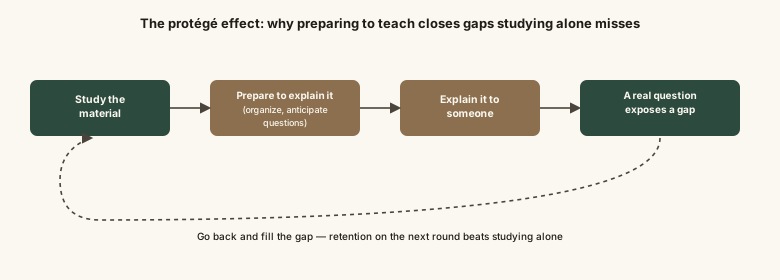
The loop-back step is where most of the actual learning benefit lives — a real question that can't be answered cleanly is the clearest, fastest signal that a gap exists.
Common mistakes
Common Mistakes
Treating any time spent presenting or reciting material as automatically producing the teaching benefit.
→ Make sure you're actually generating and reorganizing the explanation yourself, and genuinely anticipating or fielding real questions, not just reading prepared material aloud.
Waiting until you feel fully confident before attempting to explain material to anyone.
→ Study with the intent to teach from early on — the anticipation of having to explain changes how you study, even before you feel ready.
Brushing past a question you can't answer clearly instead of treating it as a real gap.
→ Note exactly where an explanation breaks down when a real question exposes it, and go back to specifically close that gap before moving on.
Common misconception
“Any time spent explaining something to someone else automatically helps you learn it, regardless of how you do it.”
The benefit specifically comes from generating your own explanation and anticipating an audience's likely confusion — a genuinely generative, retrieval-heavy process — not merely from occupying the role of "teacher." Reciting prepared material or reading a script aloud without engaging with the content in your own words has been shown to produce much smaller gains than actively organizing an explanation and fielding real questions. The mechanism requires generation, not performance.
What to do next
What to do next
- Study new material with the specific intent to explain it to someone else, not just to recall it for yourself.
- Actually anticipate likely points of confusion before you explain, rather than waiting for a real listener to reveal them.
- If you don't have a real audience, explain the material out loud in your own words to an imagined listener, or write out the explanation as if teaching it.
- Treat any question you can't answer cleanly as a specific gap, and go back to close it before considering the material learned.