How Certifications Actually Compare to a College Degree
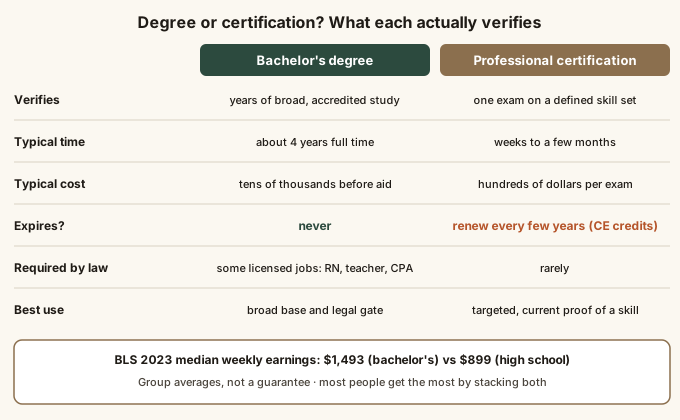
Certifications and college degrees verify different things. A bachelor's degree certifies years of broad study at an accredited institution, has no expiry, and is a legal or licensing requirement for some professions such as registered nursing, public school teaching and CPA licensure. A professional certification verifies that you passed a standardized exam on one defined body of skills, such as IT security or project management, usually costs a few hundred dollars per exam, takes weeks or months, and must be renewed with continuing education. In BLS data for 2023, bachelor's degree holders had median weekly earnings of $1,493 versus $899 for high school graduates. Certifications work best as a fast, targeted signal for specific roles, often on top of a degree or relevant experience, rather than as a general substitute for one.
Reading time
— 5 min
Updated
— Oct 8, 2026
Fact-reviewed
— Oct 8, 2026
Key Takeaways
Key Takeaways
1A degree and a certification answer different questions. A degree says you completed years of broad study. A certification says you passed a test on one specific skill set, recently.
2Some jobs legally require a degree, such as registered nursing, public school teaching and CPA licensure. A certification can't replace it there. In many IT and technical roles, certifications plus experience can.
3Certifications cost hundreds of dollars and take weeks or months, but they expire. Degrees cost tens of thousands and take years, but they last. Most people get the best result by stacking them.
The concept
Think of a degree as a driving school diploma and a certification as a license for one specific vehicle. The diploma says you spent a long time learning the rules of the road, how engines work, and how to think about driving in general. The vehicle license says that, recently, you passed a test proving you can handle one particular truck. An employer hiring someone to drive that truck tomorrow may care more about the license. An employer hiring someone to manage the whole fleet, or a law that says "must hold a diploma," cares about the diploma. That's the real comparison. A college degree takes years and costs a lot, but it never expires and some jobs flatly require it. A certification takes weeks or months and costs far less, but it covers a narrow area and usually has to be renewed every few years. Asking "which is better?" is like asking whether a diploma is better than a license. The useful question is: what does the job you want actually check for?
What is the main thing a certification claims that a degree doesn't?
Worked examples
The people below are hypothetical. Cost figures are rounded illustrations; check current prices with each school or certifying body.
Example 1: Cost and time side by side (baseline case)
Four years of in-state tuition and fees at a public university, at roughly $11,600 a year, comes to about $46,000 before aid, plus four years of mostly part-time earnings. An IT certification path might be a $400-level exam fee, $100 to $300 of study materials and three months of evening study: under $1,000 and no time out of work. Then add renewal: many certifications run three-year cycles requiring continuing education credits and a fee. The certification is cheaper by about 40 times, but it's also verifying about 40 times less.
Example 2: Where the swap doesn't work (edge case)
Jordan wants to become a registered nurse and sees a short medical certification online. It might help get a job as a medical assistant, but it can't lead to RN work: state boards require completion of an approved nursing program before you can sit the NCLEX licensing exam. The same is true for public school teaching and CPA licensure. In regulated professions, the question isn't degree versus certification. The law sets the path, and the BLS Occupational Outlook Handbook lists it under "How to Become One" for each occupation.
Example 3: Stacking (applied)
Aisha has a psychology degree and works in customer support. She wants to move into IT security. Going back for a computer science degree would take years. Instead she earns a foundational IT certification, then Security+, over about eight months, and moves into a help desk role while studying. Her degree still clears the "bachelor's required" filter that many recruiters use, and the certifications show the specific, current skills her degree doesn't. That combination, a degree as a broad base plus certifications as targeted, current proof, is how most people get the most from both. Someone without a degree can follow the same certification path, and many IT postings accept "or equivalent experience," but some employers still screen on the degree.
Quick check
For which goal does a certification most clearly beat going back for a second degree?
How it works (visual)
Certification vs college degree: what each actually verifies
Common mistakes
Common Mistakes
✕
Treating a certification as a degree substitute everywhere.
→ Check the occupation's entry requirements in the BLS Occupational Outlook Handbook first. Licensed jobs often require the degree by law.
✕
Collecting certifications with no target role.
→ Pick the job first, then read 10 to 20 real postings for it and earn the credentials they actually list.
✕
Forgetting renewal.
→ Note the renewal cycle and continuing education requirement when you certify, and log credits as you go.
✕
Reading the BLS earnings gap as a personal guarantee.
→ Those are group medians. Your return depends on the field, the occupation and the cost you pay.
Common misconception
“Certifications have made college degrees worthless.”
Some employers have dropped degree requirements for certain roles, and certifications carry real weight in fields like IT and project management. But degrees remain legally required for many licensed professions, many recruiters still filter on them, and BLS data continue to show higher median earnings and lower unemployment for degree holders as a group. The two are complements more often than competitors.
What to do next
What to do next
Name the specific job you want, then look up its “How to Become One” section in the BLS Occupational Outlook Handbook.
Read 10 to 20 current postings for that job and count how often each degree and certification is listed.
Search the CareerOneStop Certification Finder to see which certifications are recognized in that field.
Check the certifying body's page for current exam cost, prerequisites and renewal rules.
If a degree is legally required, compare accredited programs, including part-time and online options, before anything else.
FAQ
FAQ
Related terms
Related terms
Professional certification
A credential awarded by an industry body or vendor after you pass a standardized assessment of specific skills, usually time-limited and renewed through continuing education.
Bachelor's degree
An academic qualification awarded by an accredited college or university after roughly four years of full-time study across a major and general education.
Accreditation
Recognition that a school or program meets quality standards set by an accrediting agency. Many employers, licensing boards and federal aid programs require an accredited degree.
Occupational license
Government permission to work in a regulated occupation, such as nursing or teaching. Licenses often require a specific degree plus an exam, unlike most certifications.
Skills-based hiring
Hiring that screens on demonstrated skills, assessments and credentials rather than requiring a degree by default.
Continuing education
Ongoing learning, measured in credits or hours, that many certifications require to stay active.
This entry was researched from public sources and drafted with AI-assisted tools, then edited — errors are still possible. Spot one, or want a topic covered? Read our disclaimer.
 KnowThis