 KnowThis
Key Takeaways
Key Takeaways
- 1FIRE math centers on a "FIRE number": annual expenses multiplied by a withdrawal multiple, producing a target portfolio size believed capable of sustaining those expenses through investment withdrawals.
- 2The commonly cited 4% withdrawal rate (a 25x multiple) traces back to 1998 research from Trinity University analyzing historical U.S. market returns over rolling 30-year periods — it is historical research, not a guarantee.
- 3The Trinity study has real, well-documented limitations — it's based on U.S. historical data, generally modeled a 30-year retirement horizon (shorter than many early retirees plan for), and doesn't account for taxes, fees, or flexible spending.
The concept
Working through the FIRE number calculation with real figures, and then looking honestly at what the underlying research does and doesn't establish, makes clear why this is a starting estimate rather than a settled guarantee.
What did the Trinity study actually establish?
Worked examples
Example 1: Calculating a basic FIRE number (baseline case)
Example 2: A more conservative multiple for a longer horizon (edge case / variation)
Example 3: Two different expense levels, same withdrawal multiple (real-world / applied case)
Why might someone planning a 50-year retirement choose a lower withdrawal rate (a higher multiple) than the roughly 4% figure from the Trinity study?
How it works (visual)
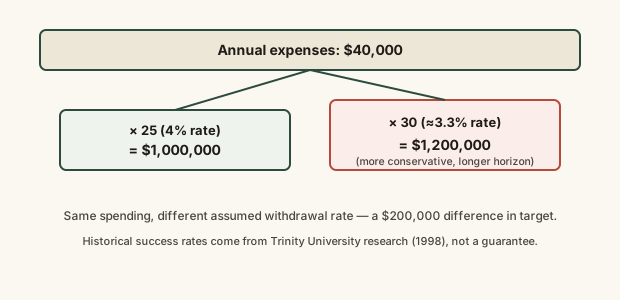
The same annual spending figure produces a meaningfully different target depending entirely on which withdrawal multiple is assumed — which is why understanding where that multiple comes from, and what it does and doesn't guarantee, matters more than memorizing "4%" as a fixed rule.
Common mistakes
Common Mistakes
Treating the 4% withdrawal rate as a guarantee rather than a historical estimate with documented limitations.
→ Recognize it as a starting point from specific historical backtesting, and consider using a more conservative multiple for retirement horizons longer than the roughly 30 years the original research generally tested.
Applying the Trinity study's findings without accounting for taxes or investment fees, both of which reduce the effective amount available for spending.
→ Factor in your specific tax situation and fee structure separately — the original research's headline withdrawal rate doesn't build these in explicitly.
Assuming a fixed, inflation-adjusted withdrawal amount every year regardless of actual portfolio performance.
→ Many modern approaches to safe withdrawal rates use more flexible strategies (like adjusting spending in years of poor portfolio performance) precisely because a rigid fixed withdrawal was a specific assumption of the original static model, not a requirement of retirement math generally.
Common misconception
“The 4% rule guarantees a portfolio will never run out of money over a 30-year retirement.”
The Trinity study found a high historical success rate for a roughly 4% initial withdrawal rate across the specific historical U.S. market periods it tested — not a guarantee about any future retirement period, whose market returns cannot be known in advance. It's a well-researched historical estimate, not a certainty.
Try it yourself
Estimate a target portfolio size based on annual expenses and a chosen withdrawal multiple.
This is a simplified illustration of FIRE mechanics based on historical research, not a projection or guarantee of any individual's actual retirement outcome. It does not account for taxes, fees, or changes in future market returns, which cannot be predicted.
What to do next
What to do next
- Calculate your own baseline FIRE number using your actual annual expenses, not an estimated or aspirational figure.
- Read the original historical research (or a reputable summary of it) directly, rather than relying solely on the simplified "4% rule" shorthand.
- Consider a more conservative withdrawal multiple if your planned retirement horizon is meaningfully longer than roughly 30 years.
- Consult a qualified financial professional before making retirement decisions based on any withdrawal-rate research, since individual tax situations and risk tolerance vary.