Understanding Political Ideologies (Neutral Overview)
A political ideology is a coherent set of beliefs about how government and society should be organized; the common left-right spectrum offers a rough, widely-used shorthand for comparing ideologies on questions like the role of government and social change, though political scientists also use additional axes (like authoritarian-libertarian) to capture positions the single left-right line misses.
Reading time
— 4 min
Updated
— Aug 21, 2026
Fact-reviewed
— Aug 21, 2026
Key Takeaways
Key Takeaways
1A political ideology is a coherent, relatively stable set of beliefs about how government, the economy, and society should be organized, not just a single opinion on one issue.
2The common left-right spectrum is a rough, widely-used simplification, historically dating back to seating arrangements in the French Revolutionary assembly, not a scientifically precise or universally agreed-upon measurement.
3Political scientists often use additional dimensions, like an authoritarian-libertarian axis, specifically because a single left-right line can't distinguish between people who share an economic position but differ sharply on individual liberty versus government authority.
The concept
A political ideology is a connected set of beliefs about how a country should be run — questions like how much the government should be involved in the economy, how quickly society should change, and how much weight individual freedom should carry against collective decisions. The familiar left-right spectrum is a common shorthand for comparing these belief sets on a single line, but it's a simplification, not a precise scientific scale.
The most useful thing to understand about the spectrum isn't where any specific ideology sits on it — it's that political scientists themselves treat the single-line model as a convenient simplification, not a complete map of anyone's actual views.
Quick check
Do political scientists generally treat the left-right spectrum as a complete, precise description of anyone's full set of political views?
Worked examples
Example 1: Where the left-right terms actually come from (baseline case)
In France's 1789 National Assembly, delegates who supported keeping the existing monarchy sat to the presiding officer's right, while delegates pushing for revolutionary change sat to the left. Over time, "left" and "right" became general shorthand across many countries for favoring change versus favoring existing arrangements — a seating-chart origin most people using the terms today have never heard, even though it directly explains why the labels exist at all.
Example 2: Why a second axis is needed (edge case / variation)
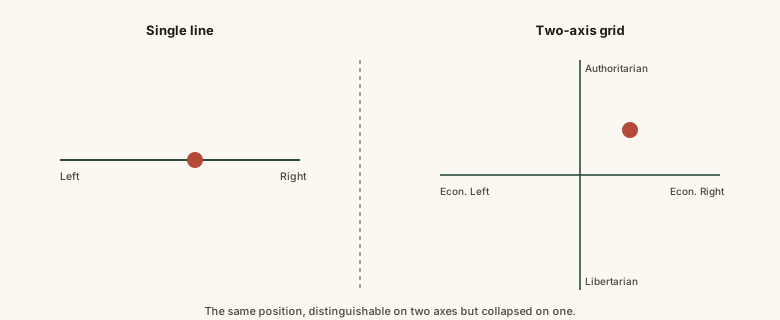
Consider two people who hold similar views on economic policy (placing them at a similar point on a left-right line), but one strongly favors extensive government authority over individual choices in daily life, while the other strongly favors minimal government interference beyond the economic question. A single left-right line places these two people at nearly the same point, even though their actual views on liberty versus authority are sharply different — exactly the kind of distinction an added authoritarian-libertarian axis is built to capture.
Example 3: A political typology instead of a single line (real-world / applied case)
Some research organizations survey large populations on many separate issues, then use statistical clustering to group respondents into several distinct typology categories — rather than assigning each person one point on a single line. These typologies often reveal that a meaningful share of people hold a genuine mix of positions that doesn't fit cleanly into a traditional single-line left-right framing, which is exactly the more granular picture a full typology is designed to surface.
Quick check
Why might two people with the same position on a single left-right spectrum still disagree sharply on a specific issue?
How it works (visual)
From a single line to a two-axis model
The same starting position on the horizontal line can correspond to very different points once a second axis is added — the extra dimension doesn't replace the left-right line, it adds the distinction the line alone can't make.
Common mistakes
Common Mistakes
✕
Assuming the left-right spectrum is a precise, universally agreed-upon scientific measurement.
→ Treat it as a widely-used but acknowledged simplification — useful for rough comparison, not a precise or complete measure of anyone's full views.
✕
Assuming a person's position on economic issues automatically predicts their position on unrelated social or authority-related issues.
→ Remember these are often separate dimensions — a two-axis or full typology model exists specifically because a single line can't reliably make this prediction.
✕
Treating 'left' and 'right' as having identical, fixed meanings across every country and era.
→ Check the specific historical and national context — what counts as left or right has shifted over time and varies between political systems.
Common misconception
“Everyone's political views fall neatly at one clear point on a single left-right line, with no meaningful complexity beyond that.”
Political scientists widely treat the single left-right line as a convenient but incomplete simplification. Real ideological positions often involve separate, only loosely correlated dimensions — economic policy views, social/cultural views, and attitudes toward government authority versus individual liberty — which is exactly why additional axes and fuller typologies are commonly used alongside (not instead of) the traditional spectrum.
Quick check
Where does the political use of the terms 'left' and 'right' historically originate?
What to do next
What to do next
Next time you see someone labeled with a single left-right position, consider what specific issue dimension that label is actually describing.
Look at a real political typology study (several research organizations publish these) to see how many distinct clusters of views actually exist beyond a single line.
Notice when 'left' and 'right' are being used to describe economic policy versus social/cultural policy — these aren't always the same dimension.
Read about the 1789 French Assembly seating arrangement as a quick, concrete way to remember the terms' actual historical origin.
FAQ
FAQ
Related terms
Related terms
Political ideology
A coherent, relatively stable set of beliefs about how government, the economy, and society should be organized, which typically shapes a person's or party's policy positions across many issues.
Left-right spectrum
A common one-dimensional model for comparing political positions, historically rooted in the seating arrangement of the French Revolutionary assembly, generally used to describe attitudes toward the role of government and the pace of social change.
Authoritarian-libertarian axis
A second dimension political scientists often add alongside the left-right spectrum, measuring attitudes toward individual liberty versus government authority — capturing positions that a single left-right line can't distinguish.
Political typology
A more detailed classification system, like those used by research organizations, that groups people into several distinct clusters based on their actual combination of views, rather than placing everyone on one single line.
This entry was researched from public sources and drafted with AI-assisted tools, then edited — errors are still possible. Spot one, or want a topic covered? Read our disclaimer.
 KnowThis