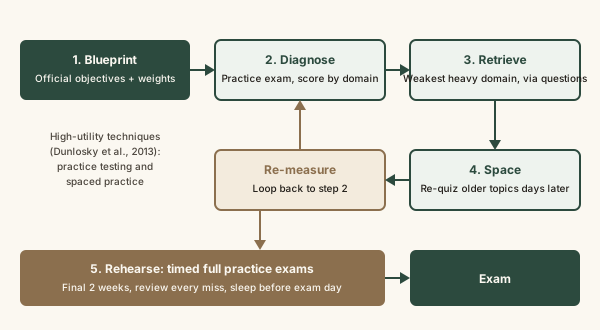
Certification exams test a published list of objectives, usually weighted by domain, so effective preparation starts with the certifying body's official exam outline (for example CompTIA's exam objectives or PMI's Examination Content Outline) rather than a textbook's table of contents. Learning research supports two techniques above the rest: practice testing (retrieval practice), which Roediger and Karpicke (2006) found produced substantially better recall a week later than rereading, and distributed practice (spacing), which Cepeda et al.'s 2006 meta-analysis found reliably beats massed study. Dunlosky et al.'s 2013 review rated both as high-utility and rated rereading and highlighting as low-utility. A practical plan maps the objectives to a calendar, uses timed practice exams to find weak domains, studies the explanation behind every missed question, and rehearses under exam conditions in the final weeks. Exam formats, question counts, passing scores and fees are set by each certifying body and change between exam versions, so they should be checked on the official page before booking.
Reading time
— 5 min
Updated
— Oct 1, 2026
Fact-reviewed
— Oct 1, 2026
Key Takeaways
Key Takeaways
1Start from the certifying body's official exam objectives and domain weights. The exam is written against that list, not against any textbook.
2Test yourself early and often, and space your review across weeks. Research rates practice testing and spaced practice as the two most effective study techniques; rereading and highlighting rate low.
3Use practice exams as a diagnostic, study the reason behind every miss, and rehearse full timed exams in the last two weeks.
The concept
Most people prepare for a certification the way they prepared for school tests: read the book cover to cover, highlight, reread the highlights, take a practice test at the end, then hope. It feels thorough. It's also the least efficient way to do it. A certification exam is more like a driving test with a published checklist. The certifying body tells you exactly what will be assessed and how much each part counts. So the smart order flips: read the checklist first, take a practice test early to see where you stand, then spend your time where you're weak and the exam is heavy. And instead of rereading, quiz yourself. Pulling an answer out of memory is harder than recognizing it on a page, which is precisely why it works.
You have six weeks before an exam. When should you take your first practice test?
A six-week plan that follows the research
Week 1: blueprint and baseline. Download the official objectives. Turn each domain into a checklist. Take one practice exam cold and record your score by domain.
Weeks 2 to 4: weakest-heaviest first. Rank domains by (weight × weakness). Learn the material, then immediately answer questions on it. Revisit earlier domains with short quizzes every few days (spacing).
Week 5: mixed practice. Switch to mixed-topic question sets, which force you to recognize which concept a question is testing, as the real exam does.
Week 6: rehearsal. Two or three full, timed practice exams under real conditions. Review every miss. Light review only in the final 48 hours; sleep matters more than one more chapter.
Worked examples
Example 1: Reading the blueprint (baseline case)
Take CompTIA Security+. As of September 2026, CompTIA lists the SY0-701 exam as up to 90 questions in 90 minutes, including performance-based items, with a passing score of 750 on a 100 to 900 scale, and publishes five domains with percentage weights. Check the current exam page before booking, since versions retire and details change. A candidate who reads the weights before opening a book learns immediately that the two or three heaviest domains will carry well over half the questions. That single step changes how the next six weeks are spent.
Example 2: The candidate who reread everything (edge case)
A candidate reads a 700-page guide twice, highlighting heavily, and scores 62% on a practice exam the week before the test. Every page felt familiar. The problem is the gap between recognizing and recalling: the exam asks him to produce or apply the idea, and rereading trained only recognition. This is the pattern Roediger and Karpicke measured. With one week left, the highest-value switch is to stop reading and do question sets by domain, studying the explanation for every miss. If the gap is large, moving the exam date is usually cheaper than a retake fee.
Example 3: Allocating 40 hours (applied)
A working professional has 40 study hours over six weeks. Her first practice exam shows Domain A (30% of the exam) at 50%, Domain B (20%) at 80%, and the remaining domains (50% combined) at around 65%. A rough weight-times-gap allocation gives Domain A about 16 hours, the remaining domains about 16, and Domain B about 4, with 4 hours reserved for two timed full exams. Each session follows the same shape: 20 minutes of learning, then questions on that topic, then a short mixed quiz on earlier material. She isn't studying harder than the 700-page rereader; she's studying where the points are, in the way that makes them stick.
Quick check
Which session structure best matches the research on retention?
How it works (visual)
The exam prep loop: blueprint, diagnose, retrieve, space, rehearse
Common mistakes
Common Mistakes
✕
Studying the textbook in chapter order.
→ Allocate time by domain weight and your measured weakness, using the official objectives as the map.
✕
Saving practice exams for the end.
→ Take one in week one as a diagnostic, and use question sets throughout as your main study method.
✕
Memorizing answers to a question bank.
→ For every question, be able to explain why each wrong option is wrong. Real exam items are worded differently.
✕
Using brain-dump sites that sell real exam questions.
→ Avoid them entirely. Certifying bodies treat this as a violation of exam rules, and it can lead to a revoked credential.
✕
Cramming the night before.
→ Keep the last 48 hours light and protect sleep, which supports memory consolidation and focus on exam day.
Common misconception
“If you've read all the material carefully, you're ready for the exam.”
Reading builds familiarity, which feels like knowing. Exams test whether you can recall and apply the idea without the page in front of you. Research consistently finds that self-testing produces better long-term retention than rereading for the same time spent. The real readiness check is a timed practice exam, not a finished book.
What to do next
What to do next
Download the official exam objectives from the certifying body and note the weight of each domain.
Check the current exam version, format, passing score, fee and retake policy on the official page.
Take a baseline practice exam this week and record your score per domain.
Build a calendar that puts the most hours on weak, heavily weighted domains, with short review quizzes every few days.
Schedule two or three full timed practice exams in the final two weeks.
If test nerves are a factor, read up on what test anxiety does to performance and practice under realistic conditions.
FAQ
FAQ
Related terms
Related terms
Exam objectives
The certifying body's official list of what the exam tests, usually grouped into domains with a percentage weight for each.
Domain weighting
The share of exam questions drawn from each topic area, such as 28% of questions on one domain. It tells you where study time pays off most.
Retrieval practice
Learning by recalling information from memory, for example by answering practice questions, instead of re-reading it.
Spaced (distributed) practice
Spreading study of the same material across several sessions separated by days, rather than massing it into one block.
Scaled score
A reported score converted to a fixed scale (for example 100 to 900) so results are comparable across different versions of an exam.
Performance-based question
An exam item that asks you to do a task, such as configure a setting or sort steps, rather than pick from multiple choices.
This entry was researched from public sources and drafted with AI-assisted tools, then edited — errors are still possible. Spot one, or want a topic covered? Read our disclaimer.
 KnowThis