 KnowThis
Key Takeaways
Key Takeaways
- 1A meeting is the right tool only when several people's real-time input is genuinely needed to reach a decision — pure information-sharing can usually be handled asynchronously instead.
- 2Effective meetings run on a time-boxed agenda with named owners for each topic and end with recorded decisions and assigned action items, not just a shared sense that things were discussed.
- 3Inviting more people than are actually needed to make the decision doesn't make a meeting more thorough — it makes it slower and less likely to reach a clear outcome.
The concept
Once a meeting is understood as a tool for reconciling drifted understanding across people, not a default way to communicate anything, the fix follows: reach for it only when real-time, multi-person input is genuinely needed, and default to an asynchronous update otherwise.
Why is a meeting generally the wrong tool for a pure status update that no one needs to react to in real time?
Worked examples
Example 1: A well-run decision meeting (baseline case)
A team needs to choose between two vendors for a project. The organizer sends a short agenda beforehand: the decision to be made, the two options with a one-paragraph summary of each, and the specific people whose input is needed. The meeting runs 20 minutes, ends with a clear decision, and a follow-up message goes out within the hour listing the decision and who owns the next step. Everyone invited had a genuine role in reaching the decision — nobody was there purely to listen.
Example 2: A recurring check-in with no agenda item that looks avoidable (edge case / variation)
A short recurring check-in has no formal decisions on its agenda, but regularly surfaces small misunderstandings between team members before they cause bigger problems. Is this meeting doing useful work?
Example 3: Fixing a recurring meeting that had grown too large (real-world / applied case)
A weekly planning meeting had grown from four attendees to eleven over several months, as more people were added "just in case" they were needed. Decisions started taking longer to reach, and several attendees stopped participating because most of the discussion didn't involve them directly. The meeting owner cut the standing invite list down to the four people who actually made the relevant decisions and moved to sending a short written summary to the wider group afterward. Decision time dropped, and the people removed from the meeting reported feeling just as informed, since the summary reached them without requiring their live attendance.
Why did cutting a meeting's attendee list down to only the people needed for the actual decision improve the meeting, rather than making it less thorough?
How it works (visual)
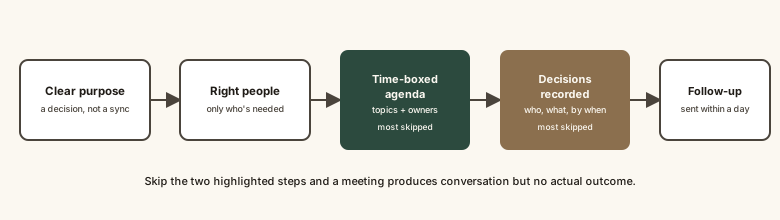
The two highlighted steps are also the two most commonly skipped — which is a large part of why so many meetings end with plenty of discussion but no actual record of what was decided.
Common mistakes
Common Mistakes
Scheduling a meeting for information that could have been shared in a written update instead.
→ Before scheduling, ask whether the goal genuinely requires real-time, multi-person input — if not, send an update instead.
Inviting extra people 'just in case' they're needed, rather than only those with a real role in the decision.
→ Keep the invite list to people who actually contribute to or are affected by the decision, and send a summary to everyone else afterward.
Ending a meeting without recording the decisions made or assigning specific owners to next steps.
→ Close every meeting with a quick recap of what was decided and who owns each follow-up action, sent out the same day.
Common misconception
“A meeting with no clear decision on the agenda is automatically a wasted meeting.”
Some of the most useful meetings, especially short recurring check-ins, don't produce a single formal decision — their value comes from catching small misalignments between people's understanding of a shared project before those misalignments turn into real mistakes. The test for whether a meeting earned its place isn't whether a decision was made; it's whether the real-time, multi-person format did something an asynchronous update genuinely couldn't have done as well.
What to do next
What to do next
- Before scheduling a meeting, ask whether the goal genuinely needs real-time, multi-person input, or whether a written update would do the same job.
- Send a short agenda beforehand naming the purpose, the topics, and who owns each one.
- End every meeting with recorded decisions and specific, owned action items, sent out the same day.
- Read How Note-Taking Methods Actually Differ next to capture what gets decided in a meeting in a way you can actually act on afterward.