 KnowThis
Key Takeaways
Key Takeaways
- 1The purpose of the email should be readable from the subject line and first sentence alone, before the reader commits to reading the rest.
- 2Every effective professional email ends with one specific, unambiguous call to action — vague emails get skimmed and forgotten, not acted on.
- 3Length isn't the problem with most weak emails — a buried purpose is. A long email with the ask up front outperforms a short one that makes the reader hunt for it.
The concept
Once the reader's actual behavior is visible — skim first, read in full only if the opening earns it — the structure follows: put the purpose where a skim will catch it, and put the request where it won't get missed.
Why does putting the main point in the first sentence of an email tend to work better than building up to it gradually?
Worked examples
Example 1: Requesting sign-off on a document (baseline case)
Subject line: "Sign-off needed: Q3 report, by Friday." Opening line: "Could you review and approve the attached Q3 report by end of day Friday?" The email then adds two short lines of context (what changed since the last draft) and closes with the same specific ask restated: "Let me know if Friday works, or if you need more time." A reader who only reads the subject line and first sentence already knows exactly what's being asked and by when.
In the sign-off request example, what makes the email effective even for a reader who only skims the first line?
Example 2: A purely informational update with no action needed (edge case / variation)
An email is purely informational and needs no response. What's the most effective way to handle the 'call to action' in this case?
Example 3: Following up on an unanswered request (real-world / applied case)
A first email asking for budget approval goes unanswered for a week. Rather than re-sending the full original message, an effective follow-up restates the specific ask in the first line — "Following up on the budget approval request below, still needed by [date]" — and only includes the original details for reference underneath. The recipient, likely managing dozens of unread threads, can act on the follow-up in seconds because it re-states the purpose and deadline without requiring them to reread the whole earlier thread to reconstruct what was being asked.
Why does an effective follow-up email restate the specific request in its own first line, rather than only forwarding the original message?
How it works (visual)
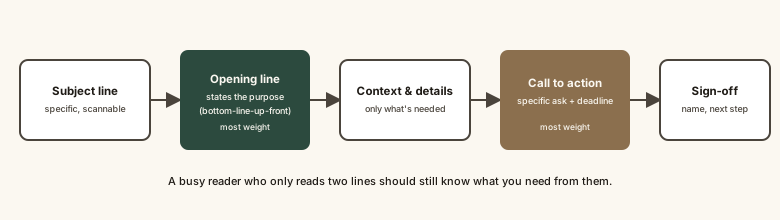
Notice that only two of the five parts are highlighted as carrying the most weight — the middle section exists to support those two, not to compete with them for the reader's attention.
Common mistakes
Common Mistakes
Writing a subject line like 'Question' or 'Update' that gives the reader no reason to open the email first.
→ Make the subject line specific enough to act as a one-line summary — what it's about and, if relevant, what's needed.
Saving the actual request for the final paragraph after several paragraphs of background.
→ State the request in the opening line, then use the rest of the email to support it — not to build up to it.
Ending an email without a specific, actionable next step, leaving the reader to guess what response is expected.
→ Close with one clear ask — what you need, from whom, and by when — even if the honest answer is 'no response needed.'
Common misconception
“A longer, more detailed email always looks more thorough and professional than a short one.”
Length isn't what signals thoroughness — clarity is. A long email that buries its purpose in the middle often gets skimmed, misread, or ignored, while a shorter email that leads with the point and states one clear request tends to get acted on faster. Extra detail is useful when it's genuinely needed to answer a question the reader will have, not as a default way to seem diligent.
What to do next
What to do next
- Before sending, check that your subject line and first sentence alone would tell the reader why you're writing.
- Cut any paragraph that doesn't directly support the request or the context needed to understand it.
- End with one specific, unambiguous call to action — what you need, from whom, and by when.
- Read What Active Listening Actually Looks Like at Work next to see the listening side of the same communication skill set.