What Digital Etiquette Actually Means in Group Chats
Digital etiquette in group chats is a set of norms that solve three problems specific to the medium. First, text strips out tone of voice and facial expression, and research by Kruger and colleagues (2005) found people greatly overestimate how well their tone comes across in writing. Second, every message notifies everyone, so the cost of a message is multiplied by the number of members. Third, a question asked to a group often goes unanswered because each member assumes someone else will reply, the diffusion of responsibility first shown by Darley and Latane in 1968. Good group-chat etiquette follows from those mechanisms: keep messages relevant to the whole group, take one-on-one conversations to a direct message, name a person when you need an answer, ask before adding people or sharing screenshots, respect time zones and quiet hours, and leave or mute quietly when a group no longer fits. Norms differ between family, friend and work chats and across cultures, so the specific rules matter less than the reasons behind them.
Reading time
— 5 min
Updated
— Oct 8, 2026
Fact-reviewed
— Oct 8, 2026
Key Takeaways
Key Takeaways
1Group chat etiquette isn't arbitrary politeness. It answers three real problems: text loses tone, every message buzzes every phone, and group questions go unanswered because everyone assumes someone else will reply.
2People overestimate how well their tone comes across in writing. In one study, senders expected about 78% of readers to catch their sarcasm or seriousness; readers managed about 56%, close to a coin flip.
3The practical rules follow from those mechanisms: post what concerns everyone, move side conversations to a DM, name the person you need, ask before adding people or sharing screenshots, and mind the clock.
The concept
A group chat is like talking in a room where everyone can hear you, but nobody can see your face, and every time you speak, everyone's pocket buzzes. That's why the manners are different from a one-on-one text. A joke that works face to face can land as an insult, because the reader can't hear you laughing. A chat between two people about their own plans makes ten other phones light up for nothing. And a question like "can someone send the address?" can sit there for hours, because each person figures somebody else will answer. Good group chat etiquette is simply a set of habits that fix those problems: think about whether the whole group needs this message, be clearer than feels necessary, name a person when you need something, and remember that people read the chat on their own schedule, in their own time zone. The details differ between a family chat, a friends' chat and a work channel, but the reasons are the same.
You post 'Can someone confirm the restaurant booking?' in a 14-person family chat. Three hours later, no one has replied, though 12 people have read it. What's the most likely cause?
Worked examples
Example 1: The notification math of a side chat (baseline case)
A 12-person friends' group is planning a birthday dinner. Two members, Ana and Leo, start chatting about a TV show and trade 20 messages in half an hour. Each message notifies the other 10 members who aren't part of it, so that's 20 × 10 = 200 unwanted buzzes, plus the dinner details now buried under the thread. Nobody did anything rude on purpose; the cost just scaled with the group. The etiquette fix is small: "Let's take this to DM," and the group stays useful. It's the same reason people mute busy chats, and once a chat is muted, the important message about the dinner time gets missed too.
Example 2: The joke that didn't land (edge case)
In a work channel, a manager replies to a late report with "Great timing as always." She meant it warmly; the report was early by her standards. The writer read it as sarcasm and spent the evening worried. Kruger's research predicts exactly this: the sender heard her own friendly tone, but readers detect intended tone at little better than chance. The fix isn't to never joke. It's to remove ambiguity where the stakes are higher: "Thanks for getting this in early, it really helps." In close friend chats, emoji and shared history do some of the work that tone of voice does in person. In work chats with mixed relationships, plain wording does it better.
Example 3: A chat across time zones (applied case)
A family chat has members in Mumbai, London and Los Angeles. For most of the year, Mumbai is about 4.5 to 5.5 hours ahead of London and London about 8 hours ahead of Los Angeles, a spread of roughly 12.5 to 13.5 hours. A 9 p.m. message from Mumbai lands around 3:30 to 4:30 p.m. in London but around 7:30 to 8:30 a.m. in Los Angeles; a 9 a.m. post from LA hits Mumbai around 9:30 to 10:30 p.m. No time works for everyone, so the practical norms are: don't send anything urgent-sounding that isn't urgent, let people mute overnight without taking offence, and phone, rather than text, if something genuinely can't wait. Etiquette here is less about the rule and more about not making anyone feel they must answer at midnight.
Quick check
A colleague replies 'Fine.' to your proposal in the team chat. Based on texting research, what should you keep in mind before reacting?
How it works (visual)
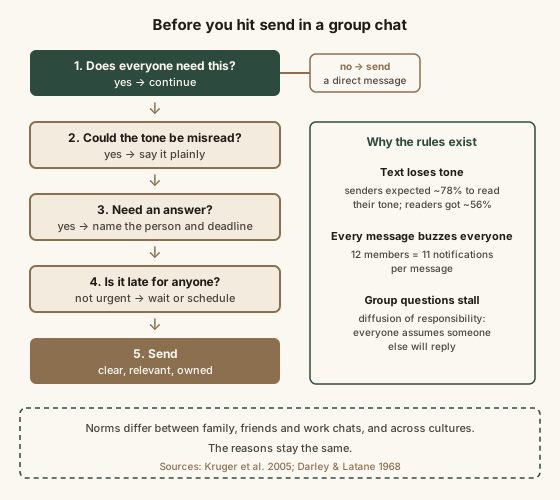
Before you hit send in a group chat
Each question in the flow maps to one of the three mechanisms. Most etiquette slips in group chats come from skipping the first box: posting something that only one or two people needed to see.
Common mistakes
Common Mistakes
✕
Asking the whole group a question and waiting for 'someone' to answer.
→ Name the person, or ask for a specific action: 'Sam, can you confirm by 6?' Diffusion of responsibility disappears when one person owns it.
✕
Adding people to a group without asking.
→ Check first. Adding someone shares their number with every member and commits their attention to every notification.
✕
Relying on sarcasm or dry humour with people who don't know you well.
→ Use plain wording or a clarifying emoji when stakes are higher. Readers miss intended tone far more often than writers expect.
✕
Screenshotting the chat to people outside it.
→ Ask first, or crop names and personal details. Members wrote for that group, not for a wider audience.
✕
Leaving a group with a dramatic farewell or an unexplained exit after an argument.
→ Mute quietly, or leave with a brief, friendly line such as 'Stepping back from chats for a bit, message me any time.'
Common misconception
“Leaving or muting a group chat is rude.”
Muting is invisible to other members and is the normal way people manage busy groups. Leaving is noticed, so a short friendly note helps, but etiquette guides, including the Emily Post Institute's, treat protecting your time and attention as legitimate. What's rude is making the exit about other people: a public complaint, or vanishing mid-argument. For the broader skill of saying no without guilt, see setting boundaries without guilt.
What to do next
What to do next
Before posting, ask: does everyone here need this? If it's for one or two people, send a direct message.
When you need a reply, name the person and the deadline instead of asking 'anyone?'.
Reread anything with an edge to it as if you were the most anxious person in the group, then reword if it could sting.
Ask before adding someone to a group, and before sharing a screenshot outside it.
Check your groups' time zones; save non-urgent posts for reasonable hours or use scheduled send if your app has it.
Mute groups that don't need your real-time attention instead of leaving abruptly.
FAQ
FAQ
Related terms
Related terms
Diffusion of responsibility
The tendency for each person in a group to feel less personally responsible for acting, because the responsibility seems shared. It's why a question to a whole group often gets no reply.
Egocentrism in communication
Assuming others will read your message the way you meant it, because you can hear your own tone in your head even though the reader can't.
Side conversation
An exchange between two or three members that doesn't concern the rest of the group. In chats it's better moved to a direct message.
Mute
A chat setting that silences notifications from a group without leaving it or notifying anyone.
Quiet hours
The times, usually late night and early morning, when a group agrees, formally or informally, not to post non-urgent messages.
This entry was researched from public sources and drafted with AI-assisted tools, then edited — errors are still possible. Spot one, or want a topic covered? Read our disclaimer.
 KnowThis