 KnowThis
Key Takeaways
Key Takeaways
- 1"Delivered" and "read" are two separate status signals, triggered by two separate events — arriving on a device, and later being rendered on that device's screen — not one continuous process.
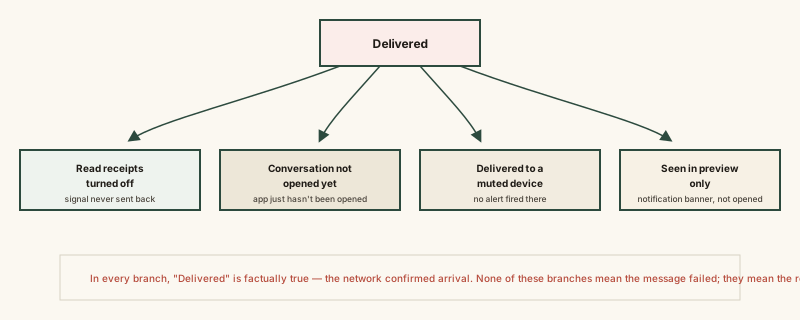
- 2A message can sit at "delivered" indefinitely for entirely mundane reasons: read receipts turned off, the conversation not yet opened, a muted or secondary device, or a notification preview that doesn't count as a full read event.
- 3A stall between delivered and read is not itself evidence of anything about the recipient's intentions — it reflects which of several possible everyday conditions happens to apply.
The concept
Once delivered and read are understood as two independently triggered events rather than two points on one continuous progress bar, a message stuck at "delivered" stops looking suspicious and starts looking like exactly what it usually is — one of several unremarkable, everyday conditions on the recipient's end.
A message has shown 'delivered' for several hours with no 'read' status. What does this most directly tell you?
Worked examples
Example 1: A message that reaches read status normally (baseline case)
In a normal case where a message quickly shows 'read' after 'delivered,' what actually happened?
Example 2: A message stuck at delivered for days (edge case / variation)
A message stays at 'delivered' for several days with no read status. Which of these is a plausible, entirely ordinary explanation?
Example 3: Deciding whether to worry about an unread message (real-world / applied case)
Someone sends an important message to a family member and, after seeing "delivered" with no "read" status for a full day, starts worrying something is wrong. Understanding the mechanism suggests a calmer read of the situation: delivered confirms the message safely reached a device that has connectivity — which rules out the more concerning possibility of a completely offline or powered-off device — while an unread status for a day is well within the range of ordinary explanations like read receipts being off, a muted conversation, or simply not having opened the app. If genuine concern about the person's wellbeing exists, delivered-but-unread status alone isn't informative enough to act on either way — a phone call or a different, more direct channel is a better next step than reading meaning into a status icon that was never designed to report on a person's overall state. In a busy group thread the same signal is even easier to over-read; see what digital etiquette actually means in group chats.
Why is 'delivered but not read for a day' generally weak evidence that something is wrong with the recipient?
How it works (visual)
Common mistakes
Common Mistakes
Treating 'delivered' and 'read' as two points on one automatic, continuous progress bar.
→ They're two independently triggered events — successful transfer to a device, and separately, that device rendering the message on screen — with no guaranteed timing between them.
Assuming a message stuck at 'delivered' means it failed to send properly.
→ 'Delivered' specifically confirms successful transfer — a failed send would show a different status, not delivered.
Reading emotional or relational meaning into a delivered-but-unread status.
→ Multiple mundane, unrelated conditions (disabled read receipts, a muted device, an unopened conversation) can each independently cause the exact same visible status.
Assuming delivered-but-unread for a long time means the recipient's device is offline.
→ 'Delivered' specifically confirms the device was reachable and received the message — an offline device wouldn't be able to receive it and show 'delivered' at all.
Common misconception
“If a message says 'delivered' but not 'read,' the person has definitely seen it and is choosing not to respond.”
A read status requires its own distinct triggering event — the message being rendered on the recipient's screen in a way their specific app counts as a qualifying view. Delivered only confirms the message reached a connected device; it says nothing about whether, when, or how the recipient will encounter it. Disabled read receipts, a muted conversation, a secondary device, or simply not having opened the app yet can each independently produce the exact same delivered-but-unread status, with no bearing on the recipient's intentions.
What to do next
What to do next
- Don't read intent into a delivered-but-unread status — check for a more direct way to reach someone if a message is genuinely urgent.
- Remember that disabled read receipts, muted conversations, and unopened apps are all common, unrelated explanations for the exact same status.
- If you personally rely on read receipts to gauge urgency, check whether the recipient has that feature enabled at all before assuming anything from its absence.
- Read Read Receipts and Typing Indicators next to see exactly what triggers the read event itself.