 KnowThis
Key Takeaways
Key Takeaways
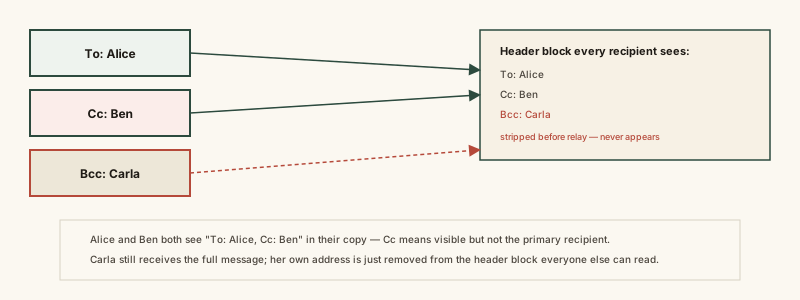
- 1Cc addresses are written into a header block that gets copied into every recipient's version of the message — that's why everyone can see the full Cc list.
- 2Bcc addresses are used only to route a copy of the message to that recipient; they're stripped out before the shared header block is generated, so no other recipient's copy ever shows a Bcc address.
- 3Every recipient in To, Cc, and Bcc receives the identical message content — the difference between the three is entirely about which addresses appear in the visible header each recipient's copy carries.
The concept
Once Cc and Bcc are understood as two different fates for an address at the header level — kept in, or stripped out, before the message content is finalized — a lot of confusion about what a Bcc'd person can and can't see clears up immediately.
What is the core technical difference between adding someone as Cc versus Bcc on an email?
Worked examples
Example 1: A routine email with one To and one Cc recipient (baseline case)
In an email with one To recipient and one Cc recipient, what does the To recipient see regarding the Cc recipient?
Example 2: Adding several people as Bcc (edge case / variation)
If fifty people are all added as Bcc on the same email, can any one of them see the other forty-nine Bcc addresses in their own copy?
Example 3: Choosing Cc vs. Bcc for a work email (real-world / applied case)
Someone is drafting an email to a client and needs to loop in a coworker for internal visibility, without the client knowing that coworker is included. Understanding the header/envelope mechanism makes the choice direct: adding the coworker as Cc would put their address into the header the client's copy displays, defeating the goal. Adding the coworker as Bcc delivers them an identical copy of the message while keeping their address out of the header the client sees entirely. The one thing worth remembering: if that coworker were to hit "reply all" from their Bcc'd copy, their reply would go out as a new message including the client, effectively revealing their involvement after the fact — Bcc hides the original header, not any action the Bcc'd recipient later takes on their own.
A coworker is added as Bcc on an email to a client, specifically to keep their involvement invisible to the client. What could accidentally reveal it anyway?
How it works (visual)
Common mistakes
Common Mistakes
Assuming Bcc recipients get a different or reduced version of the message.
→ Every recipient — To, Cc, and Bcc — receives identical message content; only the visible header list differs between their copies.
Adding someone as Cc when the goal was actually to keep their involvement invisible to other recipients.
→ Cc addresses are written into the shared header every recipient sees — Bcc is specifically the field designed to hide an address from other recipients' copies.
Assuming a Bcc'd recipient can see who else was Bcc'd.
→ The sending server strips all Bcc addresses from the header uniformly before generating any individual copy — no Bcc'd recipient sees the rest of the Bcc list either.
Forgetting that a Bcc'd recipient's reply-all reveals their involvement.
→ Bcc only hides the original message's header — a reply-all from a Bcc'd recipient creates a new message that can expose their address to everyone else.
Common misconception
“Bcc recipients secretly get to see the entire conversation, including who else is Bcc'd, without anyone knowing.”
A Bcc'd recipient receives the identical message content as everyone else, but their own copy's header is generated the same stripped way as every other recipient's — showing only the To and Cc addresses, with no visibility into who else was Bcc'd. Bcc doesn't grant special access to hidden information; it simply keeps that recipient's own address out of the header block copied into other people's versions of the message.
What to do next
What to do next
- Use Cc when you want every recipient to see who else received the message; use Bcc specifically when you need an address kept out of that visible header.
- Before Bcc'ing someone into a sensitive thread, remind them that a reply-all from their end will expose their involvement in a new, visible message.
- Don't assume Bcc recipients can see each other — the header stripping applies uniformly, so no Bcc'd recipient sees the rest of the Bcc list.
- Read How Email Actually Gets Delivered (SMTP, Explained Simply) next to see how the same header/envelope split fits into the full delivery chain.