 KnowThis
Key Takeaways
Key Takeaways
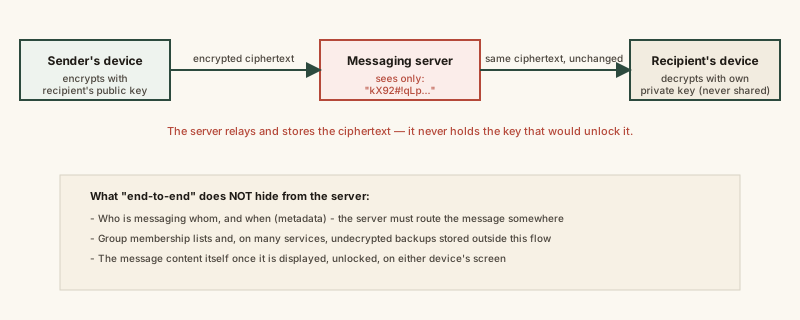
- 1End-to-end encryption locks a message with the recipient's public key before it leaves the sender's device, so only the recipient's private key — which never leaves their device — can unlock it.
- 2The messaging company's own server still relays and stores the encrypted blob, but it never holds the key needed to read it — that's the entire point of the design.
- 3E2EE protects message content, not the fact that a conversation happened — metadata like who messaged whom, when, and how often is typically still visible to the service provider.
The concept
Once you separate "the message content is locked" from "everything about the conversation is invisible," the real scope of what E2EE promises — and doesn't promise — becomes much clearer.
A messaging app advertises end-to-end encryption. What exactly does that guarantee?
Worked examples
Example 1: Sending a single encrypted message (baseline case)
If a messaging company's server were hacked, what would an attacker most likely see in an E2EE conversation's stored messages?
Example 2: A message backed up to the cloud in unencrypted form (edge case / variation)
A messaging app uses genuine end-to-end encryption, but a person's chat backup stored elsewhere is not itself encrypted end-to-end. What does this mean?
Example 3: Deciding whether E2EE matters for a specific conversation (real-world / applied case)
Someone is choosing between two apps to discuss sensitive medical results with a family member. One offers E2EE by default; the other encrypts messages only while traveling between the device and the company's server (in transit), but the company itself can still decrypt and read messages on its servers. For this specific use case — keeping the content itself private even from the service provider — the E2EE option provides a meaningfully stronger guarantee. But if the goal were instead to hide that the conversation happened at all, from someone who could see the phone's metadata or the account activity, E2EE alone wouldn't fully deliver that; both apps would still generally reveal that two accounts communicated, at what times.
Someone wants a messaging app where the company itself cannot read their message content. Which feature should they specifically look for?
How it works (visual)
Common mistakes
Common Mistakes
Assuming 'end-to-end encrypted' means the app company can't see anything about the conversation at all.
→ E2EE protects message content specifically — metadata like who messaged whom, when, and group membership is typically still visible to the provider unless separately addressed.
Believing encryption 'in transit' and 'end-to-end' are the same protection level.
→ In-transit encryption still lets the service provider decrypt messages on its own servers; only end-to-end encryption removes that capability from the provider entirely.
Thinking a backup of an E2EE conversation is automatically just as protected as the live conversation.
→ Check separately whether backups (to a device's general cloud backup, for instance) are themselves end-to-end encrypted — this is a common, real gap.
Assuming E2EE makes a conversation impossible to compromise under any circumstance.
→ E2EE protects the transmission and storage-in-transit of content — it doesn't protect a message once it's decrypted and displayed on a device that is itself compromised or physically accessed.
Common misconception
“If an app has end-to-end encryption, the company can't see who I'm talking to or when.”
End-to-end encryption is specifically about message content. To deliver a message at all, most services still need to know which accounts are communicating and when — that routing information is metadata, and E2EE alone doesn't automatically hide it. Some tools go further to minimize metadata exposure, but that's a separate design choice on top of E2EE, not something E2EE guarantees by itself.
Try it yourself
Cryptographic key strength scales exponentially with key length in bits — this shows roughly how many possible keys an attacker guessing blindly would have to search through.
For very large exponents like 256, this number is astronomically large — far beyond what any calculator or brute-force attack could search in a practical timeframe, which is the entire point of using a long key.
What to do next
What to do next
- Check whether a messaging app's E2EE claim covers backups too, especially if you're discussing something sensitive — the live chat and the backup can have different protection levels.
- Remember that E2EE hides content, not the fact that a conversation is happening — plan accordingly if metadata visibility matters to you.
- If choosing between two apps for a sensitive conversation, confirm which one specifically advertises end-to-end encryption rather than just 'encryption' in general marketing language.
- Read How Group Chats Sync Across Devices next to see how E2EE design gets more complex once more than two devices are involved.