What Professional Email Etiquette Actually Requires
Professional email etiquette comes down to respecting the reader's time and attention, per writing guidance from Purdue University's Online Writing Lab and the U.S. federal government's plain language guidelines: a specific subject line, the request or main point in the opening lines rather than at the end, only the background the reader needs to act, a clear next step with any deadline, a tone suited to a message that may be forwarded, and a final check of recipients, names, and attachments. Formality level varies by workplace and relationship, but these structural habits hold across nearly all of them, and most real email mistakes (reply-all to a large list, a buried request, a message sent to the wrong person) are structural, not about greetings or sign-offs.
Reading time
— 4 min
Updated
— Sep 25, 2026
Fact-reviewed
— Sep 25, 2026
Key Takeaways
Key Takeaways
1Email etiquette is mostly about the reader's time: a clear subject line, the point or request at the top, and only the context they need.
2End with an obvious next step (who does what, by when) instead of a vague 'let me know.'
3Most real email mistakes are about recipients and structure, not greetings. Check the To, CC, names, and attachments before you send.
The concept
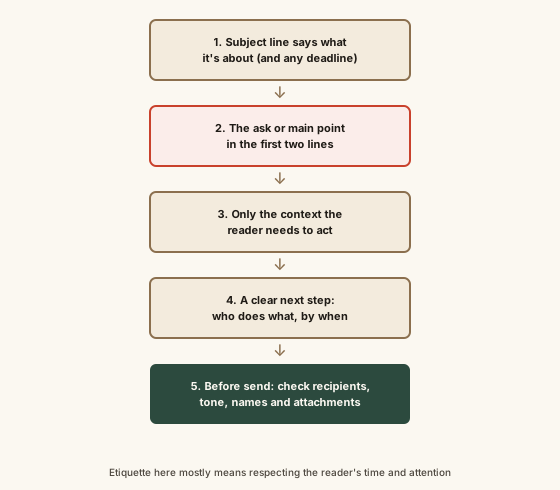
People get a lot of email and read most of it quickly, often on a phone. A polite email isn't the one with the fanciest greeting. It's the one that's easy to act on. Say what the email is about in the subject. Put what you need in the first couple of lines. Add just enough background for the reader to do it. Finish with exactly what happens next. Then, before sending, look at who's on it, check you spelled their name right, and make sure the attachment is actually attached. That covers most of what "professional" means in practice.
For step-by-step drafting help, see how to write an effective professional email. Many of the same habits apply to spoken conversations at work, especially active listening: reading the other person's message carefully before responding to it.
Quick check
A colleague's email has three paragraphs of background and the question 'Can you approve this by Friday?' at the very end. What's the most helpful fix?
Worked examples
Example 1: Rewriting a buried request (baseline case)
Before: subject "Question," then a paragraph about last quarter's event, a paragraph about vendor quotes, and finally "so anyway, would you be OK with the second option?" After: subject "Decision needed by Wed: event vendor (Option B, $4,200)." First line: "Could you approve Option B for the October event by Wednesday?" Then two bullets comparing A and B, and a closing line: "If I don't hear back by Wednesday noon, I'll call you so we don't lose the date." Same information, much less work for the reader.
Example 2: The reply-all trap (recipient etiquette)
HR emails 300 people about a holiday schedule. One person hits Reply All to say "Thanks!", three more reply all asking to be removed, and the thread becomes the day's distraction. The etiquette rule is simple: reply only to the people who need your response. A thank-you goes to the sender alone, and a question about the content usually does too.
Example 3: Emailing someone senior you've never met (tone and formality)
You want 15 minutes of a department head's time. A good message opens with who you are in one line, states the ask immediately ("Could I get 15 minutes in the next two weeks to ask about the data team's hiring?"), gives one sentence on why them, offers two or three time windows, and ends politely. It's a bit more formal than an email to a peer, but not longer. Senior people get the most email of anyone, so brevity is the respectful choice.
Quick check
In Example 2, what should someone who just wants to say thanks to HR do?
How it works (visual)
A five-step check before any professional email
Common mistakes
Common Mistakes
✕
Ending with 'Let me know your thoughts' when you actually need a decision.
→ Say exactly what you need and when: 'Could you confirm by 3pm Thursday?'
✕
Adding the recipient's address first and writing after.
→ Write and reread the email, then add recipients last. It prevents sending a half-finished draft.
✕
Sending a heated reply in the moment.
→ Save it as a draft, reread it later, and consider a call instead. Tone is easy to misread and emails last.
Common misconception
“Professional email etiquette is mainly about formal greetings, sign-offs, and polished phrases.”
Greetings and sign-offs matter a little, and they vary by workplace. What consistently separates professional email is structure: a subject line that says what the email is about, the request up front, a clear next step, and the right people on the thread. Purdue OWL and the federal plain language guidelines both center the reader's needs, not ceremony. A short, clear "Hi Sam" email beats an elaborate "Dear Mr. Smith" one that hides its question.
What to do next
What to do next
Reread the last three work emails you sent: is the request in the first two lines?
Rewrite vague subject lines so they include the topic and any deadline.
Before sending, check recipients (To vs. CC), names, and attachments every time.
Replace 'let me know' with a specific next step and date.
FAQ
FAQ
Related terms
Related terms
Bottom line up front (BLUF)
Putting the main point or request at the very start of a message, so the reader knows what's needed before reading the details.
Reply all
Sending your reply to the sender and everyone on the To and CC lines. Useful when everyone needs the answer; noisy when only the sender does.
CC (carbon copy)
Recipients who are kept informed but aren't expected to act. Everyone can see who's been CC'd.
BCC (blind carbon copy)
Recipients hidden from everyone else on the email. Useful for protecting addresses on a large mailing; risky if used to secretly include someone.
Call to action
The specific thing you want the reader to do after reading, ideally with who does it and by when.
This entry was researched from public sources and drafted with AI-assisted tools, then edited — errors are still possible. Spot one, or want a topic covered? Read our disclaimer.
 KnowThis