Most punctuation marks each do one specific job — separating, joining, introducing, or showing possession — and most punctuation mistakes come from using the wrong mark for the job, not from not knowing any rules at all.
Reading time
— 5 min
Updated
— Aug 16, 2026
Fact-reviewed
— Aug 16, 2026
Key Takeaways
Key Takeaways
1Each punctuation mark has one core job: commas separate, semicolons join closely related independent clauses, colons introduce, and apostrophes show possession or mark a missing letter.
2The three most commonly confused marks — comma, semicolon, and colon — can be told apart by what comes before and after them, not by feel.
3'Its' versus 'it's' and other apostrophe errors are the single most common punctuation mistake in everyday writing, and the fix is a one-question test, not a memorized rule.
The concept
Punctuation marks aren't random decoration — each one signals something specific to the reader about how the words around it connect. A comma tells the reader "pause briefly, this is a separate item or aside." A period tells the reader "full stop, sentence complete." An apostrophe tells the reader "something is owned" or "a letter is missing." Learning punctuation is really learning what job each mark is doing, then matching the right mark to the right job.
With the "what job does this mark do" framing in mind, the trickiest real-world punctuation decisions become much more mechanical to work through.
Quick check
'I finished the report, I sent it to my manager.' What's the punctuation problem here?
Worked examples
Example 1: Comma, semicolon, or colon — choosing between the three (baseline case)
Take the two ideas "I love hiking" and "my sister prefers swimming." With a comma alone: "I love hiking, my sister prefers swimming" — incorrect, a comma splice. With a comma plus conjunction: "I love hiking, but my sister prefers swimming" — correct, standard compound sentence. With a semicolon: "I love hiking; my sister prefers swimming" — also correct, since both are independent clauses closely related in contrast. With a colon: "My family has one shared trait: outdoor hobbies" — this works because the first part is a complete independent clause introducing what follows, which "I love hiking" doesn't do for "my sister prefers swimming." The colon example shows why a colon isn't interchangeable with a semicolon even though both can sit between two clause-like chunks — a colon specifically sets up an explanation or elaboration, a semicolon just links two related-but-separate complete thoughts.
Example 2: Its versus it's — the apostrophe error everyone makes (edge case / variation)
"Its" (no apostrophe) is a possessive pronoun, like "his" or "her" — "the dog wagged its tail." "It's" (with an apostrophe) is always a contraction of "it is" or "it has" — "it's raining" means "it is raining." The confusion happens because apostrophes usually show possession elsewhere ("the dog's tail"), so people expect "its" to need one too — but personal pronouns (his, hers, its, theirs, yours) never take an apostrophe for possession, unlike regular nouns. The reliable test: mentally expand the word to "it is" or "it has." If the sentence still makes sense, use "it's." "The company announced it's [it is] quarterly results" fails the test (it should be "its quarterly results"), while "it's [it is] been a long week" passes.
Example 3: Punctuating a list correctly, including the serial comma debate (real-world / applied case)
"I packed a jacket, boots and a flashlight" versus "I packed a jacket, boots, and a flashlight." The only difference is the comma before "and" — the serial (Oxford) comma. Both versions are grammatically defensible; major style guides genuinely disagree (many newspapers drop it, most book and academic publishers use it). The real-world case where it matters is ambiguity: "I'd like to thank my parents, Beyoncé and God" (no serial comma) can misread as claiming Beyoncé and God are your parents, while "I'd like to thank my parents, Beyoncé, and God" (with the serial comma) can't be misread that way. This is the actual argument for using it consistently — not that the no-comma version is wrong, but that the comma version is never ambiguous, while the no-comma version sometimes is.
Quick check
'The company reported it's best quarter yet.' Is this sentence punctuated correctly?
How it works (visual)
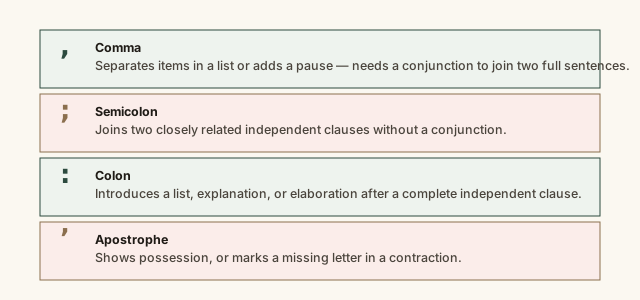
What job each punctuation mark does
Notice that comma, semicolon, and colon all sit visually "between two things," which is exactly why they get confused — but the diagram shows each one requires a different relationship between what's on its left and what's on its right. Once you check that relationship first, picking the right mark becomes mechanical rather than a guess.
Common mistakes
Common Mistakes
✕
Joining two independent clauses with only a comma (comma splice).
→ Add a conjunction after the comma, swap in a semicolon, or split into two sentences.
✕
Confusing 'its' (possessive) with 'it's' (contraction of 'it is'/'it has').
→ Mentally expand to 'it is' — if the sentence still works, use the apostrophe; if not, use 'its.'
✕
Using an apostrophe to make a plural noun, like 'apple's for sale'.
→ Apostrophes never make a word plural on their own — 'apples' (no apostrophe) is the plural; the apostrophe version would incorrectly imply possession or a contraction.
✕
Using a colon after an incomplete clause, like 'My favorite foods are: pizza, pasta, and sushi.'
→ A colon needs a complete independent clause before it — 'My favorite foods are pizza, pasta, and sushi' (no colon) or 'I have three favorite foods: pizza, pasta, and sushi' (colon works because the first part is complete on its own).
Common misconception
“A comma should be placed wherever you'd naturally pause while reading a sentence aloud.”
This is a common but unreliable rule of thumb — natural speech pauses don't map cleanly onto grammatical comma rules, and following it leads to both missing necessary commas and inserting unnecessary ones. Comma placement follows structural rules (separating items in a list, setting off an introductory phrase, joining clauses with a conjunction, setting off non-essential information) rather than the rhythm of speech. A sentence can have a natural speaking pause with no grammatical reason for a comma there, and vice versa.
Quick check
'My brother who lives in Denver is visiting this weekend.' Versus 'My brother, who lives in Denver, is visiting this weekend.' What's the actual difference in meaning?
What to do next
What to do next
Next time you write 'its' or 'it's,' pause and mentally expand to 'it is' — the one-question test resolves it every time.
When you're tempted to join two sentences with just a comma, check whether a semicolon or conjunction is the grammatically correct connector instead.
Before using a colon, check that what comes before it is a complete independent clause on its own.
Read the related entry on Common Grammar Mistakes for more everyday errors punctuation issues often get lumped in with.
FAQ
FAQ
Related terms
Related terms
Comma splice
Joining two independent clauses with only a comma, when a conjunction, semicolon, or period is needed instead.
Serial comma
The comma before the final 'and' or 'or' in a list of three or more items — also called the Oxford comma. Style guides differ on whether to use it.
Apostrophe of possession
The apostrophe-s used to show ownership — 'the dog's bone' — distinct from the apostrophe used in contractions like 'don't.'
This entry was researched from public sources and drafted with AI-assisted tools, then edited — errors are still possible. Spot one, or want a topic covered? Read our disclaimer.
 KnowThis