Every complete English sentence needs a subject and a predicate, and combining clauses in different ways produces the four sentence types: simple, compound, complex, and compound-complex.
Reading time
— 5 min
Updated
— Aug 16, 2026
Fact-reviewed
— Aug 16, 2026
Key Takeaways
Key Takeaways
1Every complete sentence needs two things: a subject (who or what) and a predicate (what's being said about it).
2Clauses combine in specific patterns to make the four sentence types — simple, compound, complex, and compound-complex — and each type does a different rhetorical job.
3Most 'this sentence feels off' problems (run-ons, fragments, comma splices) come down to mishandling how clauses connect, not vocabulary or spelling.
The concept
A sentence is a complete thought, and every complete sentence in English has two required parts: a subject (who or what the sentence is about) and a predicate (what's being said about that subject, built around a verb). "Birds fly" is a complete sentence — "Birds" is the subject, "fly" is the predicate. Everything else in English grammar — clauses, phrases, sentence types — is really just different ways of combining and dressing up that basic subject-predicate pair.
Knowing the four sentence types is useful, but the real payoff is being able to spot when clauses are combined incorrectly — which is where most everyday grammar errors actually live.
Quick check
Which of these is a dependent clause on its own, not a complete sentence?
Worked examples
Example 1: Identifying subject and predicate (baseline case)
Take "The old lighthouse keeper checked the lamp every night." Splitting this into its two required parts: the subject is "The old lighthouse keeper" (everything describing who the sentence is about), and the predicate is "checked the lamp every night" (everything describing what he did). Note that the subject isn't just one word — "old" and "lighthouse keeper" are all part of the noun phrase that makes up the full subject. The predicate similarly isn't just the verb "checked" — it includes the object ("the lamp") and the modifying phrase ("every night"). This full-subject / full-predicate split is the fastest way to check whether a group of words is actually a complete sentence: cover up everything except what you think is the subject, then check if what's left makes a coherent statement about it.
Example 2: Building all four sentence types from the same idea (edge case / variation)
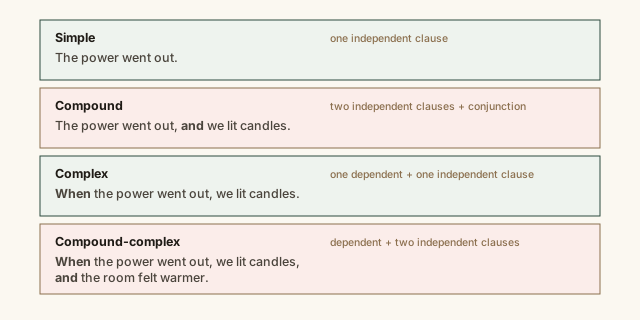
Start with two facts: "The power went out" and "we lit candles." As a simple sentence, you'd write just one: "The power went out." As a compound sentence, join both independent clauses with a coordinating conjunction: "The power went out, and we lit candles." As a complex sentence, subordinate one clause to the other: "When the power went out, we lit candles" (the "when" clause is now dependent, subordinate to the main action). As a compound-complex sentence, combine all of it: "When the power went out, we lit candles, and the kids thought it was an adventure" — one dependent clause plus two independent clauses. Same core information, four different emphases: the simple version is blunt, the compound version treats both events as equally important, the complex version emphasizes the second event as the point, and the compound-complex version adds a third idea into the mix.
Example 3: Fixing a run-on sentence (real-world / applied case)
A common real-world sentence problem: "I finished my homework I went outside to play." This is a run-on sentence — two independent clauses ("I finished my homework" and "I went outside to play") jammed together with no connector at all. There are several correct fixes, each with a slightly different feel: split into two sentences ("I finished my homework. I went outside to play."), join with a coordinating conjunction and comma ("I finished my homework, and I went outside to play."), join with a semicolon if the ideas are closely related ("I finished my homework; I went outside to play."), or subordinate one clause ("After I finished my homework, I went outside to play."). None of these is "more correct" than the others in an absolute sense — the right choice depends on how closely connected the two ideas are and how you want the sentence to read.
Quick check
'I love hiking, my sister prefers swimming.' What's wrong with this sentence, and what type of error is it?
How it works (visual)
The four sentence types, built from the same two clauses
The diagram uses the same two facts throughout so you can see exactly what changes between sentence types — it's never the content that changes, only how the clauses are wired together. That's the core skill: once you can spot an independent clause and a dependent clause, you can consciously choose which sentence type best serves what you're trying to say.
Common mistakes
Common Mistakes
✕
Joining two independent clauses with just a comma (a comma splice).
→ Add a coordinating conjunction after the comma ('and', 'but', 'so'), swap the comma for a semicolon, or split into two sentences.
✕
Writing a sentence fragment by punctuating a dependent clause as if it were complete.
→ Check whether the clause can stand alone as a full thought — if it starts with 'because,' 'although,' 'when,' or 'if' and trails off, attach it to an independent clause instead of ending it with a period.
✕
Overusing simple sentences, making writing feel choppy and disconnected.
→ Combine related simple sentences into compound or complex ones to show how the ideas relate to each other, not just that they both happened.
✕
Stringing too many clauses together into one overloaded compound-complex sentence.
→ If a sentence needs more than one comma to track, consider whether it should be split into two shorter sentences for clarity.
Common misconception
“A long sentence is automatically a run-on sentence, and a short sentence is automatically 'correct' grammar.”
Length has nothing to do with it. A run-on sentence is specifically about how independent clauses are connected (or not connected) — a 40-word sentence can be perfectly grammatical if its clauses are joined correctly, while a 6-word sentence can be a run-on ("I'm tired I want sleep"). The test is always structural: are there two or more independent clauses, and if so, are they joined with the correct punctuation or conjunction?
Quick check
'Because she studied every night for a month' — is this a complete sentence?
What to do next
What to do next
Take a paragraph you've written and label each sentence's type (simple, compound, complex, compound-complex) — notice if you're overusing one type.
Next time a sentence feels like a run-on when you read it aloud, check whether it has two independent clauses joined by only a comma.
Practice building all four sentence types from the same two ideas, the way Example 2 does — it's the fastest way to internalize the pattern.
Read the related entry on Common Grammar Mistakes for more on run-ons, fragments, and comma splices specifically.
FAQ
FAQ
Related terms
Related terms
Independent clause
A group of words with a subject and a verb that can stand alone as a complete sentence.
Dependent clause
A group of words with a subject and a verb that cannot stand alone — it depends on an independent clause to complete its meaning.
Predicate
The part of a sentence that says something about the subject — usually built around the main verb.
Run-on sentence
Two or more independent clauses joined without the correct punctuation or connecting word between them.
This entry was researched from public sources and drafted with AI-assisted tools, then edited — errors are still possible. Spot one, or want a topic covered? Read our disclaimer.
 KnowThis