 KnowThis
Key Takeaways
Key Takeaways
- 1Every word in English belongs to one of eight parts of speech based on the job it does in a sentence, not its spelling or meaning alone.
- 2The same word can be a different part of speech in different sentences — 'run' can be a verb ('I run') or a noun ('a home run').
- 3You don't need to memorize the eight categories to write well, but recognizing them helps you fix sentences that feel 'off' and explains why grammar rules exist in the first place.
The concept
Knowing the categories in theory is one thing — spotting them in a real sentence, especially when the same word keeps changing jobs, is the actual skill.
In the sentence 'She books a flight and reads three books,' what part of speech is 'books' the first time versus the second time?
Worked examples
Example 1: Tagging a simple sentence (baseline case)
Example 2: A word that changes category mid-conversation (edge case)
Example 3: Why this matters for real writing (applied case)
Which sentence uses 'fast' as an adjective rather than an adverb?
How it works (visual)
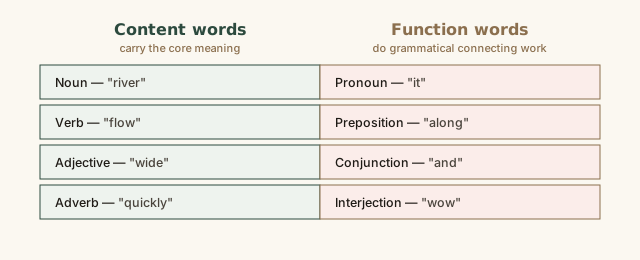
Notice how the diagram splits into two halves. The left side — nouns, verbs, adjectives, adverbs — is where new words get added to English constantly (nobody's coining a new preposition next year, but new nouns and verbs appear every year). The right side is a much smaller, much older set of words that mostly hasn't changed in centuries. If you're ever unsure which half a word belongs to, ask whether you could imagine a brand-new word being invented to do that same job — if yes, it's almost certainly a content word.
Common mistakes
Common Mistakes
Assuming a word always belongs to the same part of speech no matter the sentence.
→ Check what job the word is doing in that specific sentence — many common English words (light, well, fast, back, round) shift categories depending on context.
Confusing adjectives and adverbs because they both 'describe' something.
→ Ask what's being described: if it's a noun, you need an adjective ('a quick decision'); if it's a verb, adjective, or another adverb, you need an adverb ('decided quickly').
Treating articles (a, an, the) as their own mysterious category instead of connecting them to nouns.
→ Articles are determiners that always attach to a noun phrase — think of them as a signal that a noun is coming, not a standalone part of speech to worry about separately.
Believing -ly words are always adverbs.
→ Most -ly words are adverbs (quickly, happily), but some are adjectives (friendly, lovely, a lonely road) — check what the word is modifying, not just its ending.
Common misconception
“Every word has one fixed, permanent part of speech that never changes.”
Most common English words can function as more than one part of speech depending on the sentence. This is called conversion, and it's one of the most productive processes in English — it's how "text" became a verb ("text me"), how "impact" started being used as a verb despite traditionally being a noun, and how "google" entered dictionaries as a verb within a few years of the company's founding. A word's part of speech is a description of what it's doing right now in a specific sentence, not a permanent label stamped on the word itself.
A dictionary entry for the word 'run' lists it as both a noun and a verb. What does that tell you?
What to do next
What to do next
- Pick any sentence you just wrote or read and label each word's part of speech — it's a fast way to spot why an awkward sentence feels awkward.
- Next time you catch a word being used in a way that surprises you (a noun used as a verb, like 'let's Zoom later'), notice that you're watching conversion happen in real time.
- When editing your own writing, check adjective/adverb pairs specifically — 'she spoke quiet' should be 'she spoke quietly,' since 'spoke' is a verb and verbs need adverbs, not adjectives.
- Read the related entry on Sentence Structure Basics to see how these eight word-level categories combine into subjects, predicates, and clauses.