English tenses combine three time periods (past, present, future) with four aspects (simple, continuous, perfect, perfect continuous) to produce twelve total verb tenses, each signaling something specific about when and how an action happens.
Reading time
— 5 min
Updated
— Aug 16, 2026
Fact-reviewed
— Aug 16, 2026
Key Takeaways
Key Takeaways
1English has three time periods (past, present, future) but twelve verb tenses, because each time period combines with four different 'aspects' describing how the action unfolds.
2The four aspects — simple, continuous, perfect, and perfect continuous — aren't extra grammar to memorize for its own sake; each one answers a specific question about timing that the others can't.
3Most tense mistakes happen from picking the wrong aspect, not the wrong time period — knowing you need 'past' isn't enough if you pick 'simple past' when you needed 'past perfect.'
The concept
A verb tense tells you when something happens: past ("I walked"), present ("I walk"), or future ("I will walk"). That's the basic idea most people already know. What trips people up is that English doesn't stop at three forms — each time period can also show whether an action is a single event, still ongoing, already finished, or ongoing-up-to-a-point. That's where forms like "was walking," "have walked," and "had been walking" come from.
The three-by-four grid is easiest to understand by comparing how the same underlying event ("finish a report") changes meaning across a few of the twelve combinations.
Quick check
'By the time she arrived, I had finished the report.' What does 'had finished' (past perfect) signal here that simple past ('finished') would not?
Worked examples
Example 1: The four aspects of present tense (baseline case)
Take the verb "work" in present time across all four aspects. Simple present: "I work at a hospital" — a general fact or habit, true regardless of this exact moment. Present continuous: "I am working on a project" — happening right now, in progress. Present perfect: "I have worked here for five years" — started in the past, still relevant to now, with the exact start date de-emphasized. Present perfect continuous: "I have been working since 8 a.m." — emphasizes the ongoing duration itself, more than simple present perfect does. All four are grammatically "present tense," but they answer four genuinely different questions: what's generally true, what's happening right now, what's been accomplished, and how long something's been going on.
Example 2: Future forms and why English has more than one (edge case / variation)
English expresses future time multiple ways, and they aren't fully interchangeable. "I will call you tomorrow" (using "will") typically signals a decision made at the moment of speaking, or a prediction. "I am going to call you tomorrow" (using "going to") typically signals a plan already decided before now. "I am calling you tomorrow" (present continuous used for future) signals a firmly scheduled arrangement, often with another person involved ("I am meeting the dentist tomorrow"). A native speaker chooses between these instinctively based on how firm or spontaneous the plan is — a foreign-language learner has to learn the distinction explicitly, which is why "will" versus "going to" is one of the most commonly taught (and most commonly confused) points in English-as-a-second-language instruction.
Example 3: Why tense choice matters in real writing (applied case)
Consider the difference between "I lived in Paris for two years" (simple past) and "I have lived in Paris for two years" (present perfect). The first implies the living-in-Paris period is over — you don't live there anymore. The second implies you still live there — the two years and counting are ongoing. This single tense choice completely changes the factual claim being made, without changing any other word in the sentence. This is exactly the kind of error that turns up in resumes and cover letters ("I worked as a manager" versus "I have worked as a manager" say different things about whether the job is current), which is why getting comfortable with the perfect aspect specifically pays off far beyond the classroom.
Quick check
A job applicant writes 'I have managed a team of ten people.' What does this imply about their current employment status, compared to 'I managed a team of ten people'?
How it works (visual)
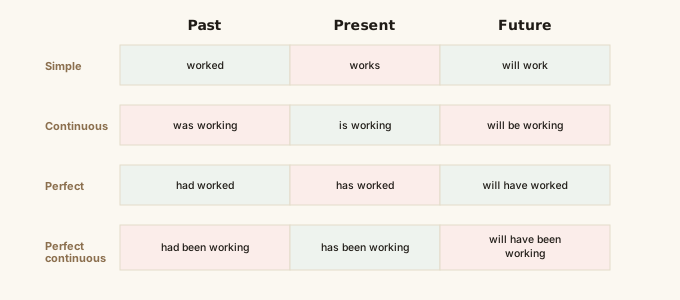
The 12 English tenses: three time periods × four aspects
Reading down any single column shows how one time period (say, past) changes meaning across the four aspects. Reading across any single row shows how one aspect (say, continuous) shifts across the three time periods. Most people already know the "reading across" pattern instinctively — it's the "reading down" pattern, choosing the right aspect within a time period, that actually needs deliberate attention.
Common mistakes
Common Mistakes
✕
Using simple past when past perfect is needed to show sequence between two past events.
→ If you're describing which of two past events happened first, use past perfect ('had') for the earlier one: 'I had eaten before she arrived.'
✕
Mixing tenses within the same sentence or paragraph without a reason.
→ Stay in one tense unless the timeline genuinely shifts — 'She walks into the room and sat down' should be 'She walked in and sat down,' or 'She walks in and sits down,' not a mix.
✕
Using 'will' for a future plan that was actually decided before the moment of speaking.
→ Use 'going to' for plans made in advance ('I'm going to visit my parents next week') and reserve 'will' for on-the-spot decisions or predictions.
✕
Assuming present perfect ('have done') and simple past ('did') are interchangeable.
→ Use simple past for a finished action disconnected from now; use present perfect when the action's effect or relevance continues into the present.
Common misconception
“English has only three tenses: past, present, and future — like most language classes teach in early lessons.”
Introductory lessons teach the three time periods first because they're the easiest entry point, but each one splits into four aspect variations, giving English twelve distinguishable tense forms in everyday use. Many other languages mark aspect with a single word ending rather than English's helper-verb system (be/have + participle), which is part of why English tenses can feel unusually complex to learners coming from those languages — the information being conveyed is often similar, but English spreads it across more visible pieces (auxiliary verbs, participles) rather than one word change.
Quick check
'I am living in Boston' versus 'I live in Boston' — what's the real difference in meaning?
What to do next
What to do next
Take one verb and conjugate it through all twelve tenses, the way Example 1 does with 'work' — it's the fastest way to feel the difference between aspects.
Next time you write a resume or cover letter, check whether each role should be present perfect (current/recent) or simple past (closed chapter) — the tense itself communicates status.
When two past events happen in a sentence, check whether one needs past perfect to show it happened first.
Read the related entry on Active vs Passive Voice to see how tense and voice combine and sometimes get confused with each other.
FAQ
FAQ
Related terms
Related terms
Tense
The grammatical form of a verb that shows when an action happens — past, present, or future.
Aspect
How an action unfolds over time — whether it's a single event, ongoing, completed, or ongoing-and-completed. Combines with tense to produce forms like 'was walking' or 'had walked.'
Auxiliary verb
A helping verb (be, have, will) used with a main verb to build compound tenses, like 'is' in 'is running' or 'had' in 'had finished'.
This entry was researched from public sources and drafted with AI-assisted tools, then edited — errors are still possible. Spot one, or want a topic covered? Read our disclaimer.
 KnowThis