 KnowThis
Key Takeaways
Key Takeaways
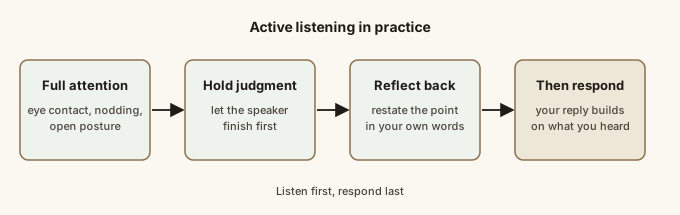
- 1Active listening specifically means reflecting back what you heard, in your own words, before responding — not just staying quiet while someone talks.
- 2Per Harvard's Program on Negotiation, this reflection step is what confirms understanding and is what most distinguishes active from passive listening.
- 3Withholding judgment or a rebuttal until genuine understanding is confirmed is core to the practice, not an optional politeness layer on top of it.
The concept
This is also why active listening is taught heavily in negotiation and conflict-resolution training specifically — confirming understanding before responding tends to lower the emotional temperature of a disagreement before either side even reaches the actual substance of it.
During a disagreement, one person says 'Let me make sure I understand — you're frustrated because the deadline changed without any notice, is that right?' before responding with their own view. What is this an example of?
Worked examples
Example 1: Reflecting before responding in a work conversation (baseline case)
Example 2: Mistaking silence for active listening (edge case / variation)
Example 3: De-escalating a heated disagreement (real-world / applied case)
Why does research in negotiation contexts find that reflective listening reduces defensiveness and conflict escalation, compared to passive listening?
How it works (visual)
Common mistakes
Common Mistakes
Treating silent waiting as the same thing as active listening.
→ Add the explicit reflection step — restate the other person's point before responding, per Harvard Program on Negotiation guidance.
Mentally preparing your response while the other person is still talking.
→ Focus fully on understanding first; a genuine response is easier to form after understanding is confirmed, not during.
Reflecting back words mechanically without actually capturing the underlying concern.
→ Aim for a reflection specific enough that the other person would say 'yes, exactly' — not a generic paraphrase.
Common misconception
“Active listening just means being polite and not interrupting while someone else talks.”
Not interrupting is a baseline courtesy, but per Harvard's Program on Negotiation, active listening specifically requires the added step of reflecting the speaker's point back in your own words before responding, plus deliberately withholding judgment until you've genuinely understood. Silence alone — without that reflection step — is passive listening, which doesn't reliably produce the same reduction in defensiveness and conflict escalation that active listening does in negotiation and conflict-resolution research.
What to do next
What to do next
- Before responding in a disagreement, briefly restate the other person's point in your own words and check it's accurate.
- Withhold your counterargument until you've confirmed genuine understanding, not just waited for a pause.
- Use non-verbal attention cues (eye contact, nodding) alongside verbal reflection, not as a substitute for it.
- Notice when you're mentally rehearsing a response instead of processing what's being said, and redirect your attention.