 KnowThis
Key Takeaways
Key Takeaways
- 1Active listening is proven through reflecting back what someone said in your own words, not just through silence, eye contact, or nodding while they talk.
- 2The reflect-back step is what catches misunderstandings while they're still cheap to fix — skipping it lets a wrong assumption survive until it causes a real problem.
- 3Active listening includes tracking emotional tone, not just factual content — a technically accurate paraphrase that misses the emotion behind it still lands as not having really listened.
The concept
Once listening is understood as a loop that has to close — hear, interpret, reflect back, confirm — it explains why silent, attentive-looking listening can still miss the mark entirely, and why the reflect-back step is the part that's easiest to skip and most costly to lose.
Why does simply staying quiet and nodding while someone talks not count as active listening, even if you're genuinely paying attention?
Worked examples
Example 1: Confirming a project update accurately (baseline case)
A colleague explains a change to a project timeline in a few sentences. Instead of immediately responding with a plan, the listener says: "So if I've got this right, the deadline moved up because the client wants an earlier launch — is that the main driver?" The colleague confirms, and the conversation moves forward with both people working from the same understanding. If the listener had misunderstood the reason for the change, this is the point where that would have surfaced — before any decisions got made on the wrong assumption.
Example 2: Reflecting emotional tone, not just facts (edge case / variation)
A colleague vents with visible frustration about a project setback. A listener accurately paraphrases only the factual details but doesn't acknowledge the frustration. What's missing?
Example 3: Catching a misunderstanding before it becomes a real problem (real-world / applied case)
A manager gives a verbal instruction about which version of a report to send to a client. The employee reflects it back: "Got it — so I should send the version with the updated Q3 numbers, not the draft from last week, right?" The manager realizes they actually meant a different, more recent draft than either option mentioned, and corrects it on the spot. Without that reflect-back step, the employee would have sent the wrong file, and the mistake likely wouldn't have been caught until the client responded — a much more expensive place to catch it.
In the report example, why did reflecting the instruction back before acting on it matter more than simply listening carefully?
How it works (visual)
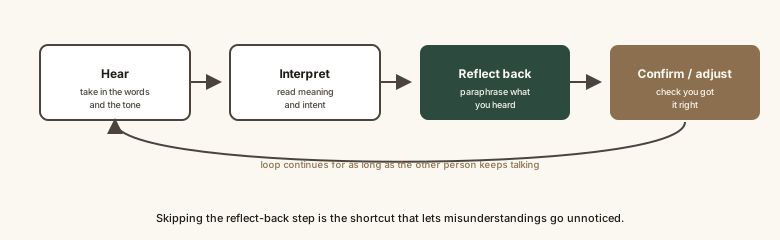
The loop doesn't run once and stop — it repeats through a conversation, and each pass either confirms shared understanding or catches a mismatch while it's still easy to correct.
Common mistakes
Common Mistakes
Mentally preparing your response while the other person is still talking, instead of actually processing what they're saying.
→ Hold off on formulating your reply until after you've reflected back what you heard — the reflection itself takes the pressure off doing both at once.
Paraphrasing only the facts of what someone said while ignoring the emotional tone behind it.
→ When a statement carries visible frustration, concern, or excitement, reflect that tone back too, not just the content.
Reflecting back after every single sentence, which interrupts the natural flow of conversation.
→ Save the reflect-back step for genuine decision points, complex instructions, or emotionally loaded moments — not every exchange needs it.
Common misconception
“Active listening just means staying quiet, making eye contact, and not interrupting while someone talks.”
Those behaviors are supportive, but none of them actually confirm understanding — a listener can do all three and still walk away with a completely wrong idea of what was said. The defining move in active listening is reflecting the message back, in your own words, and getting it checked. Without that step, silent attentiveness is really just polite waiting, not active listening.
What to do next
What to do next
- In your next important conversation, pause before responding and briefly reflect back what you heard, in your own words.
- When someone's tone carries visible emotion, acknowledge the tone as well as the content, not just the facts.
- Save the reflect-back step for complex instructions or decision points, not every single sentence.
- Read What Makes a Meeting Actually Effective next to see how active listening plays into group settings, not just one-on-one conversations.