 KnowThis
Key Takeaways
Key Takeaways
- 1An apology that lands names what you did, says plainly that it was your fault, and offers to fix it.
- 2In a 2016 study of 755 people, acknowledging responsibility mattered most and asking for forgiveness mattered least.
- 3Non-apologies like 'I'm sorry if you were offended' fail because they make the other person's reaction the problem.
- 4Let the other person be heard first; an instant apology can feel like a way to end the conversation.
The concept
Why is something this simple so hard? Okimoto, Wenzel and Hedrick (2013) found that people who refused to apologize for a real wrong reported a short-term boost in feelings of power and self-worth compared with people who apologized. Refusing protects your self-image in the moment. That's the pull you're working against, and knowing it exists makes it easier to override.
Which part of an apology did 755 study participants rate as least important?
Worked examples
Example 1: The missed deadline (baseline case)
Example 2: Apologizing too fast (edge case)
Example 3: The explanation that became an excuse (applied case)
Your friend is still explaining why they're upset. What's the best move?
How it works (visual)
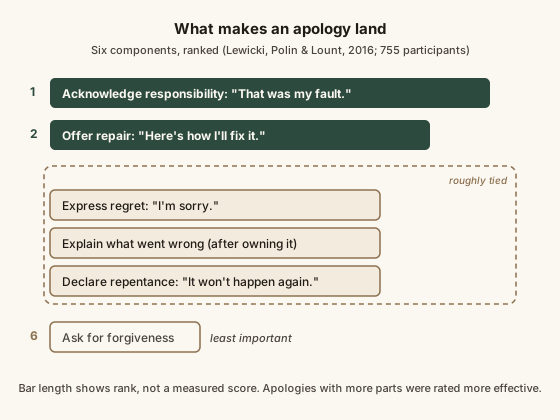
The top two carry most of the weight. If you only remember one line, make it "that was my fault, and here's how I'll fix it." Regret, explanation and repentance came out roughly tied in the middle, so their order on the chart is not a ranking; the clear finding is the top two versus the last one.
Common mistakes
Common Mistakes
Saying 'I'm sorry if you were offended' or 'I'm sorry you feel that way'.
→ Apologize for what you did, not for their reaction: 'I'm sorry I said that in front of everyone.'
Adding 'but' after the apology.
→ Own it first, full stop. Add context only after, and only if it helps explain how you'll prevent a repeat.
Leading with 'please forgive me'.
→ Forgiveness is theirs to give on their own timeline. Offer repair instead, and let them decide.
Promising to change and then not changing.
→ Promise only a change you'll actually make, and make it specific enough to check.
Over-apologizing until they have to comfort you.
→ Keep the focus on their experience. If your guilt becomes the topic, the apology has turned around.
Common misconception
“A sincere apology is mostly about how sorry you sound.”
Emotion helps, but in the 2016 Lewicki study the component people valued most was a plain acknowledgment of responsibility, followed by an offer to repair. An apology delivered with feeling but without ownership ("I feel terrible about how things turned out") leaves the hurt person unsure whether you actually think you did anything wrong.
What to do next
What to do next
- Before you apologize, write one sentence naming exactly what you did, with no 'if' and no 'but'.
- Let the other person say how it affected them before you apologize, and reflect back what you heard.
- Say 'that was my fault' (or your own plain version) out loud.
- Offer a specific repair: pay, redo, replace, or change the habit that caused it.
- Skip 'please forgive me'; let them take the time they need.
- Follow through on the change, since the next time the situation comes up is the real apology.