A personal boundary is a clearly communicated limit on what you will do, accept, or tolerate, and it functions very differently from silently absorbing something you don't want and hoping it resolves itself; the guilt that shows up when stating a boundary is typically a reaction to someone else's discomfort, not a signal that the boundary itself is wrong, and clinical guidance on boundary-setting consistently recommends stating the limit plainly, once, without an extended justification, rather than over-explaining to try to earn the other person's agreement.
Reading time
— 4 min
Updated
— Sep 30, 2026
Fact-reviewed
— Sep 23, 2026
Key Takeaways
Key Takeaways
1A boundary is a stated limit, not an unspoken preference — if it never gets communicated, the other person has no real chance to respect it.
2The guilt that shows up when setting a boundary is usually a reaction to the other person's disappointment, not evidence that the boundary itself is unreasonable.
3Clinical guidance favors stating a boundary plainly and briefly over justifying it at length — over-explaining tends to invite negotiation rather than acceptance.
The concept
A boundary is simply a limit you actually say out loud — "I can't take that on this week" or "please don't call after 9pm" — instead of quietly going along with something you don't want and hoping the other person eventually figures it out on their own. The guilty feeling that shows up when you say it isn't proof you're being unreasonable. It's usually just your brain reacting to the other person's disappointment, which is a different thing from actually doing something wrong.
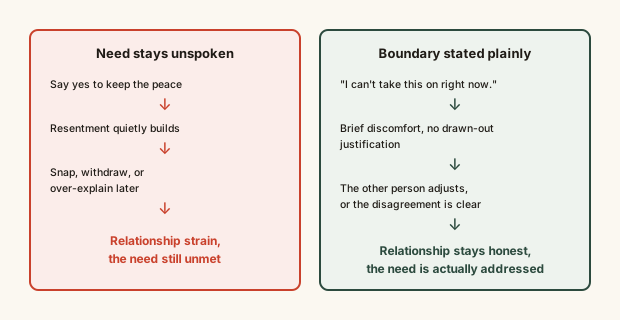
This is also why boundaries and resentment are so closely linked: every time a real limit goes unstated, the underlying need doesn't disappear, it just goes unmet — and unmet needs that keep recurring are exactly what resentment is built from.
Quick check
Someone feels a flash of guilt right after telling a friend they can't lend them money this month. What does that guilty feeling actually indicate?
Worked examples
Example 1: Declining an extra work task (baseline case)
Instead of "I guess I could try to squeeze it in, sorry, I know you're slammed too, I just have a lot going on right now...", stating "I can't take that on this week — my plate is full" delivers the same limit in one clear sentence, without stacking on enough justification to invite a counter-argument.
Example 2: A boundary the other person pushes back on (edge case / variation)
A family member reacts to a stated boundary — "we won't be able to host every holiday at our place going forward" — with visible disappointment or repeated attempts to negotiate. Per Cleveland Clinic's guidance, holding a boundary doesn't require winning the other person over or getting their agreement; it requires calmly restating the limit rather than caving because the initial reaction wasn't warm. The other person's reaction is information about them, not evidence the boundary needs to be withdrawn.
Example 3: Setting a boundary before resentment builds (real-world / applied case)
Someone who has quietly answered work messages every evening for months, and has started feeling irritable about it, states the boundary proactively — "I don't check messages after 7pm; anything urgent can call me" — rather than waiting until the resentment boils over into a tense confrontation. Stating the limit while it's still a preference, not yet a grievance, keeps the conversation calmer and more matter-of-fact.
Quick check
Why does Cleveland Clinic's guidance recommend stating a boundary in a short, direct sentence rather than a long, heavily justified explanation?
How it works (visual)
Two paths for the same unmet need
Common mistakes
Common Mistakes
✕
Treating a private preference as if it were an already-stated boundary.
→ Actually say the limit out loud — the other person can't respect a boundary they were never told about.
✕
Over-justifying a boundary with a long chain of reasons.
→ State the limit in one or two plain sentences and stop there, rather than stacking on justifications that invite negotiation.
✕
Treating the other person's disappointment as proof the boundary was wrong.
→ Separate their reaction (which you don't fully control) from whether the boundary itself is reasonable (which you can evaluate on its own).
Common misconception
“If setting a boundary makes you feel guilty, that guilt means you're doing something wrong or being selfish.”
Per guidance from Cleveland Clinic and Georgetown University's nursing school, guilt after stating a boundary is a common emotional reaction, not a reliable signal about whether the boundary is fair. It's not your fault if someone else is unhappy about a limit you've stated to protect your own time, health, or capacity — the guilt reflects discomfort with someone else's reaction, which is a separate question from whether the boundary itself was reasonable.
What to do next
What to do next
Identify one recurring situation where you've been silently going along with something you don't actually want.
Write the boundary as one plain sentence, without a chain of justifications attached.
State it directly to the person involved, using clear language rather than a hint you expect them to pick up on.
If the other person pushes back, calmly restate the limit rather than caving or over-explaining further.
FAQ
FAQ
Related terms
Related terms
Boundary
A clearly communicated limit on what you will do, accept, or tolerate — distinct from a preference you keep to yourself and hope others notice.
Over-explaining
Adding extended justification, apologies, or backstory to a stated boundary, often in an attempt to make the limit more acceptable to the other person or to pre-empt their disagreement.
Resentment
The build-up of frustration that results from repeatedly agreeing to something you don't actually want, usually because the underlying need or limit was never stated out loud.
This entry was researched from public sources and drafted with AI-assisted tools, then edited — errors are still possible. Spot one, or want a topic covered? Read our disclaimer.
 KnowThis