Small talk exists to do social work, not to exchange information. The anthropologist Bronisław Malinowski called it 'phatic communion' in 1923: talk whose purpose is to create a bond and signal goodwill, which is why nobody minds that 'Nice weather today' carries no news. It does three jobs: it signals that you are friendly and non-threatening, it lets both people test for common ground at low risk before sharing anything personal, and it opens the door to a deeper conversation if both want one. Research supports its value: in Epley and Schroeder's 2014 experiments, commuters asked to talk with a stranger reported a more pleasant journey than those told to keep to themselves, even though most predicted the opposite, and Sandstrom and Dunn (2014) found people felt more belonging on days with more interactions with casual acquaintances. Norms vary by culture, from how much silence feels comfortable to how long greetings run before business begins, so the underlying purpose is more reliable than any script.
Reading time
— 5 min
Updated
— Oct 1, 2026
Fact-reviewed
— Oct 1, 2026
Key Takeaways
Key Takeaways
1Small talk is phatic communication: its job is social, not informational. 'Nice weather' means 'I'm friendly and open to talking.'
2It does three things: signals you're safe, tests for common ground at low risk, and opens a door to deeper conversation if both people want it.
3Research backs it: commuters told to talk to strangers enjoyed the ride more than those told to stay quiet, and more contact with casual acquaintances is linked to more belonging.
4The skill isn't the opener. It's noticing the 'free information' people give and asking a follow-up question.
The concept
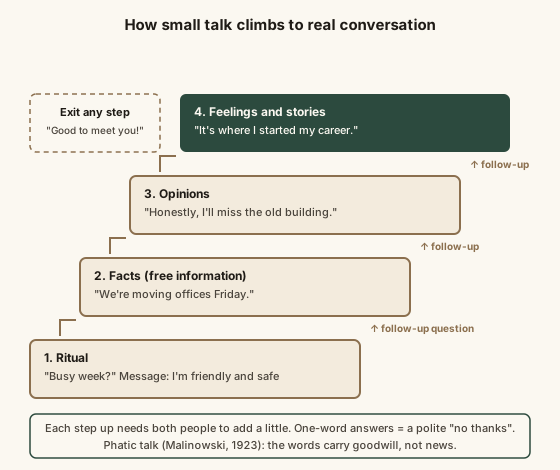
Small talk feels pointless if you judge it by the information it carries. Nobody needs to be told it's raining. But small talk is closer to a handshake than to a news report. When you say "Busy day?" to the person next to you in a queue, the words are a vehicle for a different message: I see you, I'm friendly, and I'm open to talking. Because the topic is safe and shared, nobody risks anything. If the other person replies with a little extra ("Yes, my daughter starts school tomorrow"), they're offering a thread you can follow toward a real conversation. If they reply with one word, they're politely declining, and nobody is embarrassed. Small talk is the low-risk way strangers find out whether they want to know each other.
The common complaint, that small talk is "fake", misreads what it's for. It isn't pretending to be a deep conversation. It's the on-ramp to one, and it lets either person exit gracefully at any point. That built-in exit is exactly why it works with strangers. Those first minutes carry extra weight, too, because first impressions form remarkably fast.
Quick check
A colleague you barely know says, 'Morning! Survived the traffic?' What is the main function of that question?
Worked examples
Example 1: The office kitchen (baseline case)
You're waiting for the kettle next to someone from another team. You: "Busy week?" Them: "Very. We're moving offices on Friday." The move is free information, an offered thread. You: "Oh, where to?" Them: "Across the river, which adds twenty minutes to my bike ride." Now you've learned they cycle to work, and if you do too, there's your common ground. Total time: about 90 seconds. Nothing deep was said, but next week you're no longer strangers, which is exactly the "weak tie" that Sandstrom and Dunn linked to belonging.
Example 2: When the other person declines (edge case)
On a train you say, "Long day?" and get "Mm, yeah," with eyes returning to a phone. That's not a failure. It's small talk working as designed: you signalled openness, they signalled they'd rather not, and nobody lost face. The mistake would be to push with a second and third question. Epley and Schroeder found people underestimate how willing strangers are to talk, so trying is reasonable, but one-word answers and closed body language are a clear, polite "no thanks". A smile and a return to your own book completes the ritual.
Example 3: Business across cultures (applied case)
A project manager from a culture where meetings start with business in the first minute joins a call with partners who expect several minutes on family, travel and the weather first. Jumping straight to the agenda reads to them as cold, and possibly as a sign the relationship doesn't matter. Here small talk isn't filler; it's the part of the meeting where trust is checked. A practical approach: ask a colleague who knows the culture what the opening usually looks like, follow the host's lead on timing, and let them be the one to move to business. The purpose is constant; the length and topics are local.
Quick check
According to Huang and colleagues (2017), what conversational habit most increased how much people liked their partner?
How it works (visual)
How small talk climbs from ritual to real conversation
Common mistakes
Common Mistakes
✕
Treating small talk as an information exchange and judging it pointless.
→ Judge it by its social job: did you both leave feeling a bit more connected? That's the success test.
✕
Answering every opener with one word.
→ Add one piece of free information ('Good, just back from visiting my brother'). It gives the other person a thread without oversharing.
✕
Ignoring the thread someone offers and jumping to your own story.
→ Ask one follow-up first. It's the habit most linked to being liked in conversation research.
✕
Pressing on when someone signals they'd rather not talk.
→ One-word answers and turning away are a polite 'no'. Smile, let it go, and don't take it personally.
Common misconception
“Small talk is fake, and people secretly hate it.”
The evidence points the other way. In Epley and Schroeder's 2014 experiments, commuters who talked to a stranger reported a more pleasant journey than those who kept to themselves, despite predicting the opposite. Kardas, Kumar and Epley (2022) found people also underestimate how much strangers enjoy going deeper. Small talk feels awkward in anticipation more than in practice. It's not fake; it's a polite, low-risk way of finding out whether there's more to say.
What to do next
What to do next
Use a context opener: comment on something you're both experiencing (the queue, the event, the weather). It needs no wit, just friendliness.
Listen for free information in the answer and ask one follow-up about it before sharing your own story.
Offer a little free information yourself so the other person has something to pick up.
Watch for a polite 'no' (short answers, turning away) and exit warmly: 'Good to meet you, enjoy the rest of the evening.'
In an unfamiliar culture, follow the host's lead on how long the opening chat lasts before business. Our guide to active listening covers the follow-up skill in more depth.
FAQ
FAQ
Related terms
Related terms
Phatic communication
Talk whose main purpose is social bonding rather than conveying information, such as greetings and remarks about the weather. Malinowski called it 'phatic communion' in 1923.
Weak ties
Casual acquaintances such as a barista, a neighbour or a colleague from another team. Research links daily contact with weak ties to a greater sense of belonging.
Free information
Details a person volunteers beyond what was asked, such as 'Good, just back from my sister's wedding.' Each one is an optional thread for the next question.
Follow-up question
A question that builds on what the other person just said. Huang and colleagues (2017) found follow-up questions in particular increased how much people were liked.
This entry was researched from public sources and drafted with AI-assisted tools, then edited — errors are still possible. Spot one, or want a topic covered? Read our disclaimer.
 KnowThis