First impressions form in a fraction of a second because the brain reads a face or a short clip of behavior for two quick questions: is this person warm (friend or threat) and competent (able to act on it). In Willis and Todorov's 2006 study, judgments of trustworthiness, likeability, competence, aggressiveness and attractiveness made after a 100-millisecond look at a face closely matched judgments made with no time limit; longer looks mostly raised confidence rather than changing the verdict. Ambady and Rosenthal's 1993 'thin slices' research found that strangers' ratings of silent video clips of teachers, some as short as a few seconds, predicted end-of-term student evaluations. Todorov and colleagues (2005) showed that competence judgments from a one-second look at candidates' faces picked the winner in about 68.8% of 2004 U.S. Senate races. Speed is not the same as accuracy: Olivola and Todorov (2010) found that face-based guesses about people often did worse than simply using base rates. Early impressions also spill over into unrelated traits (the halo effect, Nisbett and Wilson 1977) and color how later information is read (Asch 1946). They can be revised, especially by new, clearly diagnostic information (Mann and Ferguson 2015), but they act as an anchor.
Reading time
— 5 min
Updated
— Oct 3, 2026
Fact-reviewed
— Oct 3, 2026
Key Takeaways
Key Takeaways
1A tenth of a second looking at a face is enough for judgments of trustworthiness and competence that closely match untimed judgments (Willis & Todorov, 2006).
2The brain is answering two quick questions: does this person mean well (warmth), and can they act on it (competence)?
3Fast is not the same as right. People agree with each other about what a face signals far more than that signal matches the person.
4First impressions spill into unrelated traits (the halo effect) and color how later information is read, but clearly diagnostic new information can revise them.
The concept
You've probably felt it: someone walks into a room and before they've said a word, you already have a sense of them. That isn't imagination. Experiments show the judgment forms in about a tenth of a second, faster than a blink. Think of it like a smoke alarm rather than a fire inspector. A smoke alarm doesn't investigate; it reacts instantly to a rough cue, because for most of human history reacting late to a threat cost more than reacting wrongly. Your brain does the same with people, asking two quick questions: is this person friendly or a threat, and are they capable? It answers from whatever is available, mostly the face, posture and tone of voice. Waiting longer usually doesn't change the answer; it just makes you more sure of it. The catch is that a smoke alarm also goes off for burnt toast. Snap judgments are consistent (most people reach the same one), but consistent is not the same as correct.
Quick check
In the 100-millisecond face studies, what did giving people more viewing time mostly change?
Worked examples
Example 1: The job interview that was decided at the handshake (baseline case)
An interviewer meets two candidates with near-identical résumés. One smiles, makes eye contact and speaks clearly; the other is tense and looks at the floor. Within seconds, the interviewer has a warmth and competence read on each. For the next 40 minutes, the same answer ("I like to double-check my work") sounds conscientious from the first candidate and anxious from the second. Nothing about the answer changed; the frame did. This is Asch's finding in a modern setting: an early central trait reorganizes how everything after it is understood. It's also why structured interviews, where every candidate gets the same questions scored against a written rubric, exist.
Example 2: The trustworthy-looking face that isn't (edge case)
Faces that look slightly happy even at rest, with upturned mouth corners and raised brows, are rated as more trustworthy, while faces that look slightly angry at rest get the opposite rating. Those features are mostly anatomy, not character. When Olivola and Todorov tested whether people could use faces to guess real facts about strangers, using the face often made guesses worse than ignoring it and going with how common each answer was overall. So the same speed that makes first impressions useful for spotting obvious hostility makes them misleading for subtle traits like honesty, where a face is a poor cue. Agreement among observers is high; accuracy is the weak link.
Example 3: A one-second look that predicts elections (applied case)
Todorov and colleagues showed people pairs of U.S. congressional candidates' faces for about one second and asked which looked more competent. Participants didn't know the candidates. Those snap competence ratings picked the actual winner in 68.8% of the 2004 Senate races, against 50% by chance, and tracked margins of victory too. That doesn't mean voters chose on looks alone; it means a fast appearance-based competence signal is strong enough to show up in real outcomes. The applied lesson for any of us judging or being judged: the first second leaves a mark, so it's worth controlling what you can (clarity, eye contact, a calm start) and deliberately slowing down when you're the one deciding.
Quick check
Snap competence ratings of candidates' faces picked 68.8% of 2004 Senate winners. What's the most accurate reading?
How it works (visual)
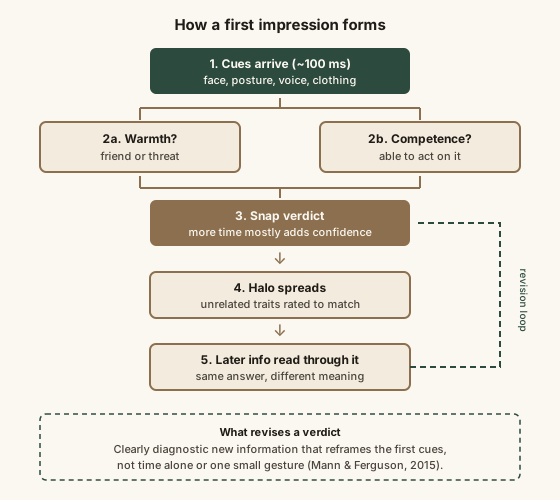
How a first impression forms, and where it can be revised
The diagram shows why first impressions feel so certain. The verdict arrives early, gets more confident with time, and then filters what comes next. The only reliable exit is the loop: new information strong enough to reframe what the first cues meant.
Common mistakes
Common Mistakes
✕
Treating a gut feeling about someone as evidence about their character.
→ Treat it as a hypothesis. Faces are a weak cue for traits like honesty; behavior over time is a stronger one.
✕
Quoting '7 seconds' or '55% body language' as scientific rules.
→ The measured time is closer to a tenth of a second for faces, and the 7-38-55 figures come from narrow studies of single words, not all communication.
✕
Assuming you'd notice if a first impression were biasing you.
→ Nisbett and Wilson's students didn't. Use written criteria before meeting people you'll evaluate.
✕
Trying to fix a bad first impression with one small gesture.
→ Small acts get read through the old frame. Clear, new information that reinterprets the first moment works better.
✕
Ignoring the first minute because 'the content will speak for itself'.
→ The opening frames how the content is heard. A clear, calm start is worth preparing.
Common misconception
“People who are good judges of character can read someone accurately within seconds.”
People are fast and consistent, not reliably accurate. Observers agree strongly with each other about what a face signals, which feels like accuracy. But tests against real facts about the people show face-based judgments are often no better, and sometimes worse, than guessing from base rates. Thin slices of behavior (how someone actually teaches or talks) carry more real information than a still face. Reading other people's emotions accurately, not just quickly, is a separate and measurable skill; see what emotional intelligence actually means.
What to do next
What to do next
Before an interview, date or meeting, prepare your first 30 seconds: a clear greeting, eye contact and a calm opening line.
When you're the one judging, write your criteria down before you meet people, then score against them.
Notice your instant read on someone and label it 'first impression', not 'fact'.
Look for one piece of behavior that would change your mind, then actually check for it.
If you made a bad first impression, address it directly with new information rather than hoping it fades.
FAQ
FAQ
Related terms
Related terms
Thin slicing
Forming judgments about a person from a very brief sample of their behavior, such as a few seconds of silent video. Coined in research by Nalini Ambady and Robert Rosenthal.
Trait inference
Concluding something about a person's stable character (honest, capable, hostile) from a cue such as a face, voice or single action.
Halo effect
The tendency for one positive (or negative) impression of a person to spill over into judgments of their unrelated traits.
Primacy effect
Information received first has a stronger influence on an overall impression than the same information received later.
Warmth and competence
The two dimensions social psychologists find people judge first: whether someone intends good or harm, and whether they can act on those intentions.
Base rate
How common something is in the population overall. Ignoring base rates in favor of vivid cues like a face is a common judgment error.
This entry was researched from public sources and drafted with AI-assisted tools, then edited — errors are still possible. Spot one, or want a topic covered? Read our disclaimer.
 KnowThis