Emotional intelligence (EI) was defined by psychologists Peter Salovey and John Mayer in 1990 as the ability to monitor your own and other people's emotions, tell them apart, and use that information to guide thinking and action. Their ability model has four branches: perceiving emotions, using emotions to help thinking, understanding how emotions work and change, and managing emotions in yourself and others. It is measured with performance tests such as the MSCEIT, where answers can be right or wrong. The popular version, spread by Daniel Goleman's 1995 book, mixes those abilities with personality traits and motivation and is usually measured by self-report, which overlaps heavily with traits like emotional stability and conscientiousness. Meta-analyses find EI is linked to job performance modestly, more so in jobs that demand a lot of emotional work, but it does not replace general cognitive ability as a predictor, and the popular claim that EQ matters more than IQ is not what the research shows.
Reading time
— 6 min
Updated
— Oct 8, 2026
Fact-reviewed
— Oct 8, 2026
Key Takeaways
Key Takeaways
1Emotional intelligence (EI) was defined by Salovey and Mayer in 1990 as a set of abilities: perceiving, using, understanding and managing emotions. It's a skill set, not a personality type.
2There are two very different ways to measure it. Ability tests like the MSCEIT have better and worse answers; self-report questionnaires mostly capture how confident you feel, and overlap heavily with existing personality traits.
3Meta-analyses find EI predicts job performance modestly, more in emotionally demanding jobs. The popular line that EQ matters more than IQ goes well beyond the evidence.
The concept
Think of emotions as information. A knot in your stomach before a meeting, a friend's flat "fine" in a text, a colleague who suddenly goes quiet: each is data about what's happening and what might happen next. Emotional intelligence is how well you handle that data. Can you notice it accurately? Can you use it to think better, the way a slightly anxious mood can make you check a contract more carefully? Do you understand where a feeling came from and where it tends to lead, like irritation turning into anger if the cause keeps repeating? And can you manage it, calming yourself down or helping someone else cool off, without just bottling it up? That's the original definition from psychologists Peter Salovey and John Mayer in 1990. It's narrower and more testable than the version on posters, which tends to lump together empathy, optimism, motivation, self-control and social charm. The useful takeaway is that EI is a set of skills, and like other skills, some people are better at parts of it than others, and it can be practiced.
A manager rates herself 9 out of 10 on an emotional intelligence questionnaire but scores below average on a performance-based EI test. What's the most likely explanation?
Worked examples
Example 1: One tense meeting, four branches (baseline case)
A project lead, Priya, opens a budget review. A teammate answers with clipped, one-word replies and crossed arms. Perceiving: Priya notices the signals rather than missing them. Understanding: she knows that clipped replies after a budget cut often mean frustration mixed with worry, and that frustration tends to sharpen if it's ignored. Using: she recognises her own mild anxiety is useful for checking the numbers carefully, but not for the conversation, so she slows down. Managing: she says, "This cut lands hardest on your team; let's take five minutes on that after the numbers," which lowers the temperature without derailing the meeting. Nothing here is magic or personality. It's four distinct skills used in order, and any one of them can be the weak link.
Example 2: The confident self-rater (edge case)
Two job candidates take both kinds of test. Candidate A rates himself at the 90th percentile on a self-report EI questionnaire but lands near the 35th percentile on an ability test. Candidate B rates herself at the 50th percentile and scores at the 80th on the ability test. Which one has the higher emotional intelligence? On the ability definition, B. A's high self-report score mostly reflects confidence and traits like extraversion and emotional stability, which Joseph and Newman's meta-analysis found make up much of what self-report EI captures. This is the trap in many workplace "EQ assessments": they ask people how emotionally skilled they are, and the people least aware of their gaps have no way of reporting them.
Example 3: Where EI pays off most (applied case)
Compare a hospital nurse and a back-office data analyst. The nurse spends the shift calming frightened patients and families while staying composed, which psychologists call high emotional labor. The analyst's work is mostly with spreadsheets. Joseph and Newman (2010) found the link between ability EI and job performance was stronger in high emotional-labor jobs and weaker, sometimes near zero, in low ones. So the honest answer to "does EI matter at work?" is "it depends on the job." Across all jobs, O'Boyle and colleagues' 2011 meta-analysis found EI adds some prediction beyond IQ and personality, a modest increment rather than the dominant factor that popular books suggest.
Quick check
According to meta-analyses, in which role would you expect ability EI to relate most strongly to job performance?
How it works (visual)
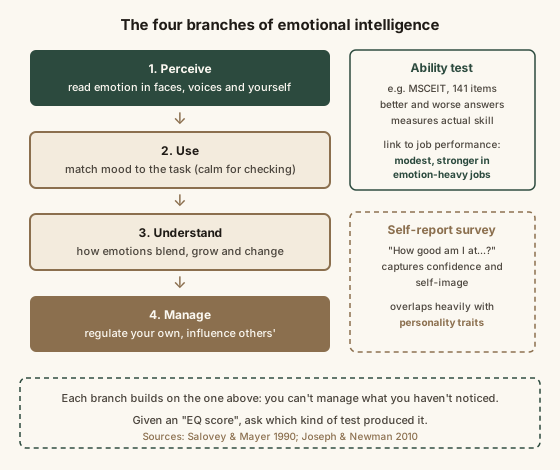
The four branches of emotional intelligence
The diagram runs from the most basic skill to the most complex. Each branch depends on the one before it: you can't manage an emotion you haven't noticed or don't understand. The side panel is the single most useful thing to remember when someone hands you an "EQ score": ask which kind of test produced it.
Common mistakes
Common Mistakes
✕
Treating emotional intelligence as being nice, agreeable or always calm.
→ EI is accuracy and skill with emotions. Sometimes the emotionally intelligent move is to show disagreement or let someone see you're upset.
✕
Trusting a self-rated 'EQ score' as a measure of skill.
→ Self-report scores mostly reflect confidence and personality. Ability tests, or feedback from people who work with you, are better evidence.
✕
Equating managing emotions with suppressing them.
→ Suppression hides the expression but often leaves the feeling in place. Managing includes reappraising, timing, and choosing how to express it.
✕
Assuming EI matters equally in every job.
→ The research link is strongest where emotional labor is high, such as care, service and leadership roles, and weaker elsewhere.
Common misconception
“Emotional intelligence matters twice as much as IQ for success in life and work.”
That claim, popularised in the 1990s, isn't what the meta-analyses show. Studies such as O'Boyle et al. (2011) find EI adds a modest amount of prediction for job performance beyond IQ and personality, and Joseph and Newman (2010) show the effect depends heavily on the job. General cognitive ability remains the stronger single predictor in most large datasets. EI is real and useful; it just isn't a master key.
What to do next
What to do next
Practice naming emotions precisely. 'Frustrated and a bit embarrassed' gives you more to work with than 'bad'.
Before reacting in a tense moment, ask what the emotion is telling you and where it usually leads if nothing changes.
Match your mood to the task: tackle careful checking when you're calm and alert, and brainstorm when you feel upbeat.
Ask two people you trust how you come across under stress. Their view is better evidence than your own rating.
Treat any workplace 'EQ score' with care: find out whether it came from a performance test or a self-report questionnaire.
FAQ
FAQ
Related terms
Related terms
Ability emotional intelligence
Emotional intelligence treated as a set of mental abilities about emotions, measured with test items that have better and worse answers, like an IQ test for emotional information.
Trait emotional intelligence
Emotional intelligence treated as a cluster of self-perceptions and personality dispositions, measured by self-report questionnaires about how you see yourself.
MSCEIT
The Mayer-Salovey-Caruso Emotional Intelligence Test, a 141-item performance test with two tasks for each of the four branches of the ability model.
Emotional labor
The work of managing your own displayed emotions as part of a job, such as staying calm and friendly with upset customers or patients.
Emotion regulation
The processes people use to influence which emotions they have, when they have them, and how they experience and express them.
This entry was researched from public sources and drafted with AI-assisted tools, then edited — errors are still possible. Spot one, or want a topic covered? Read our disclaimer.
 KnowThis