 KnowThis
Key Takeaways
Key Takeaways
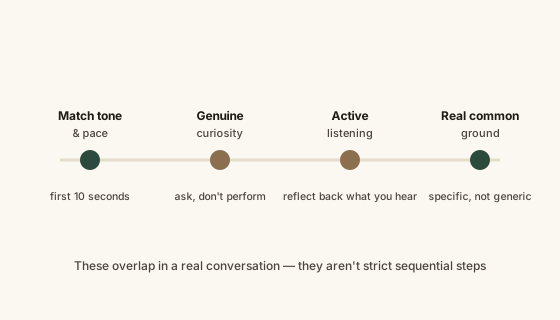
- 1Rapport builds through a handful of specific, learnable behaviors — matching tone, genuine curiosity, active listening, and finding real common ground.
- 2These behaviors overlap and happen quickly, often within the first ten to thirty seconds of an interaction, not as a strict step-by-step sequence.
- 3The single biggest tell that breaks rapport fast is performed rather than genuine interest — people are surprisingly good at sensing the difference.
The concept
Because these elements overlap and happen fast, rapport-building in practice looks less like a checklist you consciously run through and more like a general orientation toward the other person — genuinely paying attention tends to naturally produce most of the other behaviors.
Two people meet for the first time. One asks a generic scripted question ('So, what do you do?') and immediately starts thinking about their own response. The other asks a genuine follow-up based on what the person actually just said. Which is more likely to build real rapport quickly, and why?
Worked examples
Example 1: A quick introduction at a networking event (baseline case)
Example 2: Building rapport across a real difference in communication style (edge case / variation)
Example 3: Rapport in a negotiation (real-world / applied case)
In a negotiation context, what's the practical benefit of building rapport before discussing substantive terms, according to negotiation research?
How it works (visual)
Common mistakes
Common Mistakes
Using obvious, exaggerated mirroring that reads as mimicry.
→ Keep mirroring subtle — matching general energy and pace, not literally copying specific words or gestures.
Asking generic rapport-building questions without actually listening to the answer.
→ Ask a genuine follow-up based on what the person actually said, rather than moving to a pre-planned next question.
Forcing common ground that isn't real ('me too!' about something you don't actually relate to).
→ Only highlight common ground that's genuinely specific and true — forced or vague common ground reads as insincere.
Common misconception
“Some people are just naturally charismatic and good at building rapport, and others simply aren't.”
Rapport-building breaks down into specific, observable behaviors — matching tone, genuine curiosity, active listening, real common ground — that can be identified, practiced, and improved like any other skill. What looks like effortless natural charisma is very often just these behaviors becoming automatic through repeated use, not an innate trait some people are simply born with and others aren't.
What to do next
What to do next
- In your next new interaction, focus on asking one genuine follow-up question rather than planning what you'll say next.
- Notice and gently match the other person's tone and energy level, without exaggerating it.
- Reflect back a short version of what someone just told you before responding — it proves you were actually listening.
- Only mention common ground when it's specific and genuinely true, not as a generic pleasantry.