 KnowThis
Key Takeaways
Key Takeaways
- 1The most common reason difficult conversations fail isn't poor wording — it's going in with the goal of winning rather than understanding and resolving.
- 2Separating what actually happened (observation) from what you concluded it meant (interpretation) reduces defensiveness, because interpretations are what tend to feel like accusations.
- 3A conversation can be handled well and still not end in full agreement — the realistic goal is mutual understanding, not guaranteed consensus.
The concept
This distinction matters because most defensiveness in hard conversations is a reaction to feeling accused, not to the underlying facts themselves — and facts alone are much harder to argue with than a stated interpretation of someone's intentions. Staying calm enough to tell the two apart in the moment draws on emotional intelligence, which is a learnable skill set rather than a personality type.
Someone says to a coworker, "You clearly don't care about this project since you missed the deadline again." Why is this likely to trigger defensiveness rather than a productive conversation?
Worked examples
Example 1: Addressing a roommate's mess (baseline case)
Example 2: A conversation that still ends in disagreement (edge case / variation)
Example 3: A performance conversation with a direct report (real-world / applied case)
Why does asking an open question ('what's been going on with the deadlines?') after stating an observation tend to work better than immediately proposing a fix?
How it works (visual)
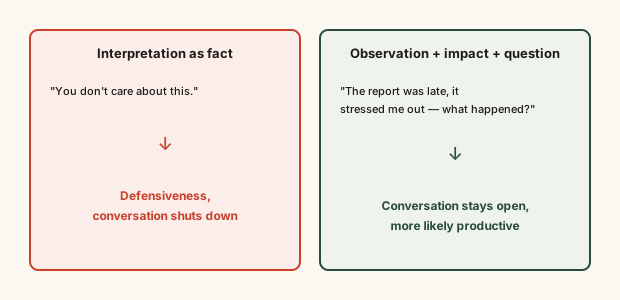
The underlying facts can be identical in both cases — what changes is whether the other person feels accused of a motive or informed of an event, and that difference drives whether the conversation stays open or shuts down.
Common mistakes
Common Mistakes
Stating an interpretation of someone's motives as if it were an established fact.
→ Separate the observable event from your interpretation, and share the interpretation as your own reaction, not a certain conclusion about their intentions.
Going into the conversation focused on winning or being proven right.
→ Reframe the goal as mutual understanding — a conversation can go well without ending in full agreement.
Proposing a solution before actually understanding the other person's perspective.
→ Ask an open question about their side before jumping to a fix, since the right solution often depends on context you don't have yet.
Common misconception
“A difficult conversation was only successful if it ends in full agreement or resolution.”
Per conflict-resolution frameworks used in negotiation training, genuine mutual understanding — both sides clearly hearing and accurately restating the other's actual position and reasoning — is itself a legitimate, valuable outcome, even without full agreement; treating disagreement after a well-handled conversation as failure sets an unrealistic bar that discourages people from having the conversation at all.
What to do next
What to do next
- Before a hard conversation, write down the specific observable fact separately from your interpretation of what it means.
- Open with the observable fact and your own reaction to it, not an assertion about the other person's intentions.
- Ask an open question about their perspective before proposing any fix or conclusion.
- Go in aiming for mutual understanding, not a guaranteed win or full agreement.