How to Actually Disagree Without Being Disagreeable
Disagreeing without being disagreeable means separating the claim from the person making it and showing you've understood their view before challenging it. Research on 'conversational receptiveness' by Yeomans, Minson and colleagues (2020) found that people who signal they've heard the other side, by acknowledging the view, hedging their own claims, stating points of agreement and framing things positively, are seen as more reasonable and more desirable to work with, even when they don't change their position. Philosopher Daniel Dennett popularized 'Rapoport's rules': restate the other person's position so well they wish they'd put it that way, list points of agreement, mention anything you learned from them, and only then rebut. Relationship researcher John Gottman found that how a conflict conversation starts predicts how it ends; in one study, the first three minutes predicted outcomes with high accuracy, and contempt (mockery, eye-rolling, sarcasm) was among the strongest signs of a relationship in trouble. Paul Graham's 'disagreement hierarchy' ranks responses from name-calling at the bottom to refuting the central point at the top. Norms vary: some cultures treat open debate as respectful, others treat it as rude, so adjust directness to the setting.
Reading time
— 5 min
Updated
— Oct 3, 2026
Fact-reviewed
— Oct 3, 2026
Key Takeaways
Key Takeaways
1Disagreeing well means separating the claim from the person: argue with the idea, never with their worth or motives.
2Show you understand before you challenge. Restate their view, name what you agree on, then make one clear counterpoint.
3Receptive language (acknowledging, hedging, stating agreement) makes people see you as more reasonable, even when you don't budge.
4The opening matters most. A harsh start, and especially contempt, predicts a bad ending.
The concept
Most disagreements that go wrong aren't really about the topic. They go wrong because one person hears "you're wrong" as "you're stupid" or "you're a bad person". Once that happens, they stop defending a point and start defending themselves, and nobody listens to anything after that. Think of it like a door with two locks. The first lock is "do you understand me?" and the second is "are you attacking me?". Your argument, however good, can't get through until both are open. So disagreeing without being disagreeable is mostly about order. First, show you've heard them: say their view back in a way they'd agree with. Second, name what you genuinely agree on, because there's almost always something. Only then say where you see it differently, about the idea and not the person. You can stay completely firm on substance. What changes is that the other person can actually hear it.
Quick check
What's the first step in Rapoport's rules before you criticize a view?
Worked examples
Example 1: The holiday-dinner argument (baseline case)
Your uncle says a new local housing development will ruin the neighborhood. You think the town badly needs the homes. The disagreeable version: "That's such a selfish take." The respectful version, step by step. Restate: "So your worry is traffic and that the place you've lived for 30 years will feel different?" He nods. Agree: "The traffic point is fair; that road is already jammed." Differ, about the idea: "Where I see it differently is that my friends can't afford to live here at all, so I think the trade-off is worth it if they fix the road." He may not agree. But he heard your point, because you never told him who he was.
Example 2: When they're being disagreeable to you (edge case)
A friend rolls their eyes and says, "Only an idiot would believe that." That's contempt plus an ad hominem, the bottom of Graham's hierarchy. Matching it escalates, and Gottman's research suggests it rarely recovers from there. Instead, name the process, not the person: "I'm happy to disagree about this, but I don't want to do it with insults. Can you tell me what you think I'm missing?" If the temperature stays high, take a break. Gottman recommends pausing when people are "flooded", physiologically overwhelmed, because nobody reasons well in that state. Respectful disagreement takes two people; you can only control your half, and ending a conversation politely is a valid move.
Example 3: Disagreeing in a group chat (applied case)
Someone in your friends' group chat shares a claim you know is wrong. Text strips out tone, so receptive markers matter more, not less. Compare "No, that's false" with "I'd seen that too and nearly shared it. When I looked, the original study said something narrower, here's the link. Still agree the bigger issue is worth worrying about." The second version acknowledges, finds common ground, gives a reason and keeps the door open. It also avoids correcting them in a way that makes them look foolish in front of everyone, which, for many people, is what makes a disagreement personal. For bigger disagreements, a private message is often kinder than a public reply.
Quick check
A friend says 'Only an idiot would believe that.' What's the most constructive response?
How it works (visual)
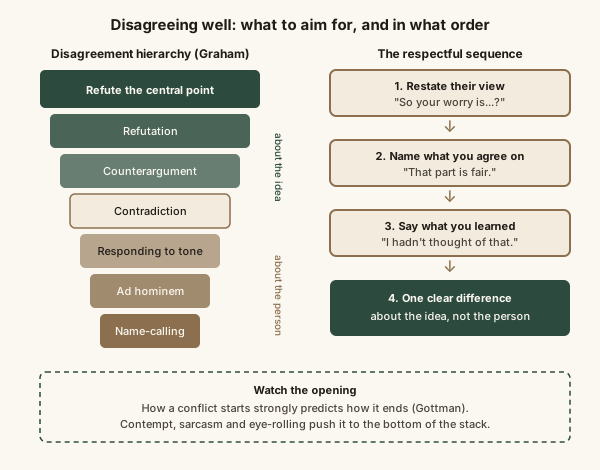
The disagreement hierarchy, and the respectful sequence
The left side tells you whether a response is about the person or the idea. The right side is the order of operations that keeps you in the top half of the stack, even when the other person starts in the bottom half.
Common mistakes
Common Mistakes
✕
Opening with a verdict on the person ('That's selfish', 'You always...').
→ Open with a restatement of their view or a question. Criticize the claim, not the character.
✕
Answering a straw-man version of what they said.
→ Check your summary out loud: 'So you're saying X, is that right?' Respond to the version they confirm.
✕
Thinking politeness means hiding your view.
→ Receptive language softens delivery, not substance. Say clearly where you differ.
✕
Piling on five counterpoints at once.
→ Lead with your single strongest point. A list feels like an attack.
✕
Using sarcasm or eye-rolling 'as a joke'.
→ Contempt lands as contempt. Gottman found it among the most damaging conflict behaviors.
Common misconception
“Being agreeable in tone makes you look weak or like you're conceding.”
The research points the other way. In Yeomans and colleagues' studies, people who acknowledged opposing views and named points of agreement were seen as more reasonable and more desirable to work with, and they hadn't changed their position. Firm substance plus a receptive delivery is the combination that gets heard.
What to do next
What to do next
In your next disagreement, restate the other person's view before giving yours, and ask if you got it right.
Find one genuine point of agreement and say it out loud.
Swap 'you always' and 'you never' for 'I see it differently because...'.
Make one clear counterpoint, not five.
If either of you is getting heated, suggest a short break and come back to it.
For workplace disagreements, see our guide to disagreeing with a colleague professionally.
FAQ
FAQ
Related terms
Related terms
Conversational receptiveness
Using language that shows you are willing to engage with an opposing view: acknowledging it, hedging your own claims, stating agreement and framing points positively.
Rapoport's rules
A four-step guide to criticism popularized by Daniel Dennett: restate the other view fairly, list agreements, say what you learned, then rebut.
Steelmanning
Restating an opposing argument in its strongest form before responding, the opposite of a straw man.
Straw man
Misrepresenting someone's argument as a weaker version that is easier to knock down.
Harsh startup
Gottman's term for opening a conflict with criticism or contempt, which tends to make the whole conversation go badly.
Contempt
Communicating superiority through mockery, sarcasm, name-calling or eye-rolling; in Gottman's research, one of the most damaging conflict behaviors.
Ad hominem
Attacking the person making an argument rather than the argument itself.
This entry was researched from public sources and drafted with AI-assisted tools, then edited — errors are still possible. Spot one, or want a topic covered? Read our disclaimer.
 KnowThis