 KnowThis
Key Takeaways
Key Takeaways
- 1A disagreement lands as reasoning, not conflict, when it's built on facts the other person already accepts, with the exact point of divergence named clearly.
- 2Restating the other person's position accurately before disagreeing with it — rather than arguing against a weaker version of what they said — is what makes pushback credible instead of combative.
- 3Framing disagreement around the idea or plan, not the person who proposed it, is what keeps a professional relationship intact after the disagreement is resolved.
The concept
Once disagreement is understood as a chain the other person needs to be able to verify, not just a conclusion delivered to them, the approach follows: establish the shared ground first, name the exact divergence, then offer something concrete instead of just a competing opinion.
Why does starting a disagreement by naming the facts both people already agree on tend to work better than opening directly with a competing conclusion?
Worked examples
Example 1: Disagreeing with a proposed project approach (baseline case)
A colleague proposes launching a feature in three weeks. Rather than opening with "that timeline won't work," the response starts with common ground: "We agree the client needs this live before their fiscal quarter ends [shared fact]. Where I think we differ is whether three weeks includes enough time for QA on the payment flow [the specific divergence] — the last two features with a similar scope took closer to five weeks in testing alone [evidence]. Could we look at a four-week timeline with a lighter initial scope instead?" The colleague can trace exactly where the disagreement starts and evaluate the evidence themselves.
Example 2: Disagreeing when there's genuinely no time to build the full chain (edge case / variation)
A colleague is seconds away from sending a client an email with an incorrect figure. Is it appropriate to state the disagreement directly, without first walking through shared facts and reasoning?
Example 3: Disagreeing with a manager's decision without damaging the relationship (real-world / applied case)
A manager decides to cut a feature from an upcoming release. An employee who disagrees steelmans the decision first — "I understand the reasoning: we're tight on time and this feature isn't core to the launch" — before raising the concern: "Where I'd push back is that this feature is the one two of our largest clients specifically asked for last quarter [evidence] — could we look at a smaller version of it instead of cutting it entirely?" Because the pushback is framed around the decision, not the manager's judgment as a person, and is grounded in something checkable, the manager can evaluate it on the merits without it reading as a challenge to their authority.
Why does steelmanning the manager's decision before raising a concern about it help keep the working relationship intact?
How it works (visual)
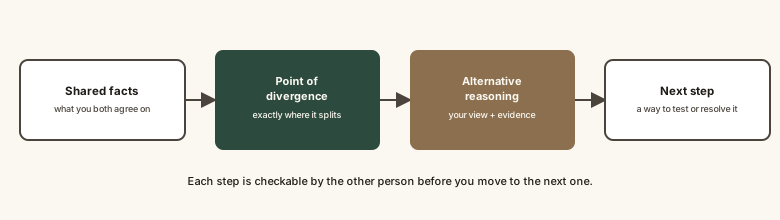
Each link in the chain is something the other person can check for themselves before moving to the next one — which is exactly what keeps the disagreement feeling like reasoning rather than an assertion dropped on them.
Common mistakes
Common Mistakes
Opening a disagreement directly with a competing conclusion instead of establishing shared ground first.
→ Start by naming what you both already agree on, then point at the specific place your reasoning splits from theirs.
Arguing against a weaker or distorted version of what the other person actually said.
→ Restate their position accurately, in its strongest form, before disagreeing with it — this is what makes pushback credible.
Framing the disagreement around the person ('you always...') instead of the idea or approach being discussed.
→ Keep the language pointed at the plan, decision, or approach — not at the person's judgment or character.
Common misconception
“The professional way to disagree is to avoid stating the disagreement directly and instead just ask a lot of leading questions.”
Vague, indirect questioning often reads as evasive or passive-aggressive rather than professional, and it can leave the other person unsure whether you actually disagree at all. Being direct about the disagreement isn't the problem — being direct without first establishing shared ground or without engaging with what the other person actually said is. A clearly stated disagreement, built on verifiable common ground, tends to land better than an indirect one dressed up as neutral questions.
What to do next
What to do next
- Before raising a disagreement, write down the specific facts you and the other person both already accept.
- Restate the other person's position accurately, in its strongest form, before explaining where you diverge from it.
- Frame your pushback around the idea or plan, not around the other person's judgment or character.
- Read What Active Listening Actually Looks Like at Work next, since confirming you understood the other side accurately is what makes steelmanning possible in the first place.