 KnowThis
Key Takeaways
Key Takeaways
- 1Feedback that names a specific, observable behavior and its concrete impact gets heard as actionable — feedback that names a trait tends to get heard as a personal attack.
- 2The same underlying observation can be delivered as a character judgment or as a fixable action; the structure of the language, not the content, is usually what determines which one lands.
- 3Because criticism tends to be weighed more heavily than praise, one piece of vague negative feedback can undo several genuine compliments — which is a reason to make critical feedback specific, not a reason to avoid giving it.
The concept
Once feedback is understood as something that gets decoded on the other end, not just said, the fix follows: encode it carefully — specific situation, specific behavior, specific impact — instead of relying on the recipient to correctly guess your intent from a general statement.
Why does feedback like 'you're not detail-oriented' tend to land as an attack, while feedback naming a specific missed detail and its impact tends to land as actionable?
Worked examples
Example 1: Correcting a recurring mistake using SBI (baseline case)
A manager notices an employee has missed the same formatting requirement on client deliverables twice. Instead of saying "you need to be more careful," they say: "In the last two client reports [situation], the summary section didn't follow the standard template [behavior], which meant I had to reformat both before they went out, adding about an hour each time [impact]. Can you walk me through what happened?" The employee now has a specific, fixable target — not a vague character note to feel bad about.
Example 2: Giving specific feedback that still lands badly due to timing (edge case / variation)
Feedback is specific and well-structured (situation, behavior, impact), but it's delivered publicly right after a stressful moment and lands defensively anyway. What does this show?
Example 3: Balancing critical feedback with genuine praise in a performance review (real-world / applied case)
A reviewer wants to raise one significant concern in an otherwise strong performance review. Rather than opening with vague praise, then a vague criticism, then more vague praise (a pattern sometimes called a feedback sandwich, which can come across as formulaic), they give specific, genuine positive feedback on two distinct achievements, then a specific SBI note on the one concern, clearly separated rather than diluted between compliments. Because the critical point is specific and isolated rather than vague and buried, it doesn't disproportionately overshadow the genuine praise the way an imprecise criticism tends to.
Why does making a single piece of critical feedback specific and clearly separated (rather than vague and sandwiched between compliments) help it be received more fairly, alongside genuine praise?
How it works (visual)
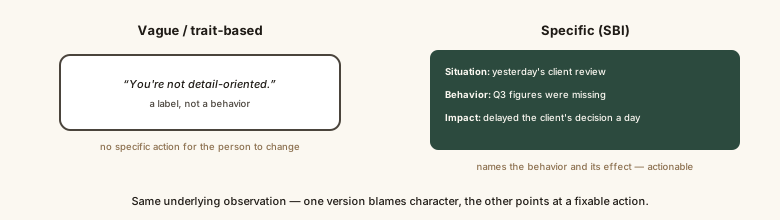
Both versions can come from the exact same underlying observation — the difference is entirely in what gets encoded into words before it reaches the other person.
Common mistakes
Common Mistakes
Naming a trait ('you're disorganized') instead of a specific, observable behavior.
→ Describe the specific situation and behavior instead — what happened, exactly, and when — leaving character out of it entirely.
Leaving out the impact, so the recipient knows something was wrong but not why it mattered.
→ State the concrete consequence — a delay, a cost, a confusion caused — so the feedback connects to something real, not just a preference.
Delivering specific, well-worded feedback in a public or poorly timed setting.
→ Save critical feedback for a private setting and a moment that isn't immediately after a stressful or high-pressure event.
Common misconception
“The safest way to give critical feedback is to soften it heavily or bury it between compliments so it doesn't feel harsh.”
Heavily softened or buried feedback often fails in the opposite direction from what's intended — the recipient either misses the actual point entirely or, because of negativity bias, fixates on the one critical line and forgets the surrounding praise was genuine. Specific, clearly stated feedback focused on behavior rather than character tends to land more accurately and less harshly than a vague version wrapped in extra compliments.
What to do next
What to do next
- Before giving feedback, write out the specific situation, the observable behavior, and its concrete impact — not a general impression.
- Check your language for trait words ('careless,' 'disorganized') and replace them with the specific behavior you actually observed.
- Deliver critical feedback privately, and avoid timing it right after a stressful or high-pressure moment.
- Read How to Disagree With a Colleague Professionally next for how to handle it when the other person pushes back on feedback you've given.