 KnowThis
Key Takeaways
Key Takeaways
- 1Networking means building and maintaining professional relationships continuously, based on mutual value — not a one-time pleasant exchange at an event.
- 2Loose acquaintances (weak ties) frequently surface more opportunities than close friends, because they connect you to information and people outside your existing circle.
- 3A network built only when you need something (a job, a favor) starts from zero trust — the relationships that actually help were invested in well before that moment arrived.
The concept
Once networking is understood as an ongoing index of relationships rather than a series of one-off encounters, the practical difference from small talk becomes obvious: it's not about what you say in a five-minute conversation, it's about what happens in the weeks and months after.
Why do weak ties (acquaintances) often produce more job leads or opportunities than close friends do?
Worked examples
Example 1: Turning a conference conversation into a real connection (baseline case)
Someone meets a person from a different company at an industry conference and has a genuinely good ten-minute conversation about a shared professional interest. Instead of leaving it there, they exchange contact information and send a short follow-up message within a week — referencing the specific topic they discussed and sharing a relevant article. Six months later, they check in again with a brief, low-pressure update. That short exchange, reinforced twice, is what turns a single conversation into an actual professional connection instead of a name that fades from memory.
Example 2: Reaching out only when a favor is needed (edge case / variation)
Why does a cold ask for a referral to someone you haven't spoken to in years tend to land poorly, even if the past working relationship was good?
Example 3: A dormant weak tie surfacing an opportunity (real-world / applied case)
A professional stays loosely in touch with a former classmate over several years — an occasional message congratulating them on a new role, a shared article now and then, nothing frequent or demanding. Two years after graduating, that classmate happens to hear about an opening at their company that fits their contact's background well, and proactively flags it, because the relationship has stayed warm enough to come to mind. Neither person was "networking" in the moment the opening appeared — the groundwork had already been laid years earlier.
Why did the classmate think to mention the opening two years later, when neither person had been in frequent contact?
How it works (visual)
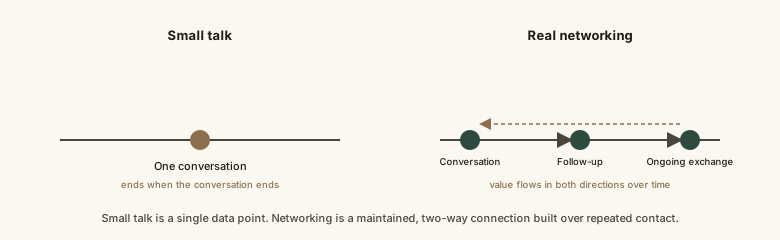
The conversation itself looks nearly identical in both cases. What separates networking from small talk happens entirely in what does, or doesn't, come next.
Common mistakes
Common Mistakes
Only reaching out to your network when actively job searching or needing a favor.
→ Maintain light, periodic contact continuously — a network built entirely on demand starts every ask from zero relationship.
Treating a single good conversation as the whole job, with no follow-up afterward.
→ Send a brief, specific follow-up within a week of any promising conversation to turn a one-off exchange into a real connection.
Focusing only on close friends and immediate colleagues, ignoring looser acquaintances.
→ Deliberately maintain weaker ties too — they often surface information and opportunities your close circle can't.
Common misconception
“Networking means being naturally outgoing and working a room full of strangers.”
Effective networking has very little to do with charisma or how many people you talk to at an event. The actual mechanism is consistency and follow-through in a smaller set of relationships — sending a genuine follow-up, checking in occasionally, offering something useful before asking for something back. Someone who has one real conversation and follows up thoughtfully is doing more effective networking than someone who works an entire room and never speaks to anyone again.
What to do next
What to do next
- List 3-5 people in your existing loose network (former colleagues, classmates, past contacts) worth reconnecting with this month.
- After any real professional conversation, send a specific follow-up within about a week rather than letting it fade.
- Look for a small way to offer value to a contact — sharing something relevant, making an introduction — before you need to ask them for anything.
- Read How to Ask for an Informational Interview next to turn a new or dormant connection into an actual conversation.