 KnowThis
Key Takeaways
Key Takeaways
- 1A mentor's core job is offering perspective and honest feedback based on their own experience — not making decisions for the mentee or guaranteeing outcomes.
- 2A mentor and a sponsor are different roles: a mentor advises directly, while a sponsor advocates for someone in rooms and conversations that person isn't part of.
- 3Mentorship works as a repeating cycle over months or years, not a single conversation — the value comes from bringing real decisions back to the same person over time.
The concept
Once mentorship is understood as a repeating feedback loop rather than a single dose of advice, it becomes clear why a single coffee chat with someone senior, however useful, isn't really mentorship yet — the loop hasn't had a chance to run more than once.
What is the core function a mentor is actually providing in an ongoing mentoring relationship?
Worked examples
Example 1: An informal mentor inside the same company (baseline case)
A newer employee starts occasionally asking a more senior colleague for advice on how to handle tricky situations at work. Over several months, this becomes a loose but regular pattern — a short conversation every few weeks where the newer employee describes a real situation, the senior colleague shares how they've seen similar situations play out, and the newer employee reports back on what happened next time they talked. Neither person ever formally labeled it "mentorship," but the repeating structure is exactly what makes it function as one.
Example 2: Mistaking a sponsor's role for a mentor's (edge case / variation)
A mentee is disappointed that their mentor never recommended them for an open role. What's the most likely explanation?
Example 3: Finding a mentor through a formal program (real-world / applied case)
Someone with no obvious senior contact in their target field joins a formal mentoring program run by a professional association in their industry. They're matched with a mentor and set up recurring check-ins every few weeks. Over a year, bringing real decisions to those sessions — which projects to pursue, how to handle a difficult manager, whether to make a lateral move — gradually shifts the direction of their career in ways a single conversation never could have, because each session built on what was discussed and tried in the last one.
Why did the mentoring relationship in this example meaningfully shift the person's career direction, when a single conversation with a senior contact likely wouldn't have?
How it works (visual)
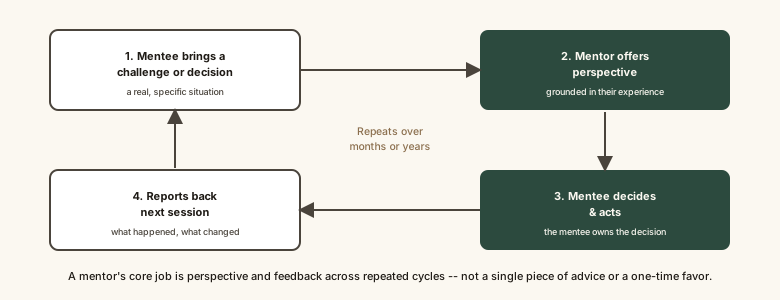
A single trip around this loop is useful advice. Mentorship is what happens once the loop has run enough times that the mentor's perspective is actually tracking the mentee's real, evolving situation.
Common mistakes
Common Mistakes
Expecting a mentor to make career decisions for you rather than inform them.
→ Bring specific, real questions, but keep ownership of the final decision — a mentor's job is perspective, not a verdict.
Never reporting back on what happened after acting on a mentor's advice.
→ Close the loop by telling them the outcome next time — it's what makes each future round of advice more relevant, and it keeps the relationship active.
Assuming any mentor will also actively sponsor you for opportunities without ever discussing it.
→ If direct advocacy matters to you, raise it explicitly — don't assume a mentoring relationship automatically includes sponsorship.
Common misconception
“A good mentor will get you a promotion or your next job directly.”
That kind of direct advocacy is closer to what a sponsor does, not a mentor. A mentor's actual job is offering perspective and honest feedback based on their own experience — helping a mentee think more clearly and make better decisions, not opening doors on their behalf. Some people do both, but treating advocacy as a guaranteed part of any mentoring relationship sets up an expectation the relationship was never built to meet.
What to do next
What to do next
- Get specific about what kind of guidance you actually need before looking for a mentor — technical skill, industry perspective, or leadership development often call for different people.
- Look first among people already loosely in your network before searching for a stranger to formally approach.
- If nothing turns up informally, look into a formal mentoring program through a professional association, employer, or nonprofit.
- Read How Professional Networking Profiles Actually Get Discovered next to make yourself easier for a potential mentor to find.