 KnowThis
Key Takeaways
Key Takeaways
- 1Discovery runs on literal word matching between a search query and a profile's fields — being qualified for something isn't enough if the matching words aren't actually present.
- 2Among profiles that match a search, results are typically ranked further by profile completeness and recent activity, not by qualification alone.
- 3Mirroring the specific terms used in real job postings for a target role, rather than vague or overly clever phrasing, makes a profile far more likely to surface in a relevant search.
The concept
Once discovery is understood as keyword matching against an index rather than a holistic read of qualifications, the practical fix becomes clear: a profile has to actually contain the words someone would search for, not just describe the same skills in different language.
Why might two candidates with genuinely similar real-world qualifications rank very differently for the exact same recruiter search?
Worked examples
Example 1: A recruiter's search matches literal profile text (baseline case)
A recruiter searching for candidates types specific terms into a search field — a job title, a location, and one or two key skills. The system compares those terms against the headline, skills section, and experience text of every profile in its index, surfacing the ones that contain matching language. A profile that uses those exact terms (or close, common variants of them) appears in the results; a profile describing the same underlying experience with entirely different wording may not surface at all for that particular search.
Example 2: Similar qualifications, very different visibility (edge case / variation)
Why does a complete, recently active profile tend to rank higher in search results than a sparse, dormant one, even with similar underlying qualifications?
Example 3: Updating a profile to match target job postings (real-world / applied case)
Someone job searching reviews several real postings for the type of role they want and notices a handful of specific terms — a job title variant, particular tools, a certification name — that show up repeatedly. They update their headline and skills section to include those exact terms where genuinely accurate, fill in previously blank sections, and start engaging with the platform periodically rather than leaving it untouched. Within a few weeks, they notice more recruiter messages arriving for roles that closely match what they're actually looking for.
Why did updating the profile's headline and skills section with terms pulled directly from real job postings lead to more relevant recruiter contact?
How it works (visual)
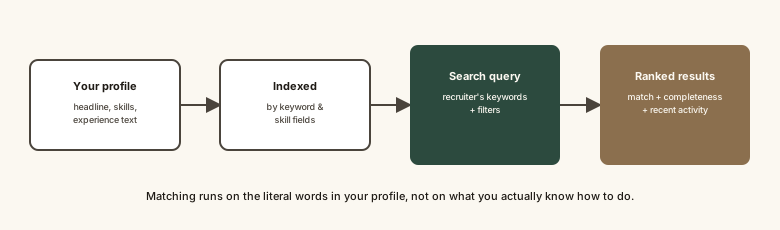
Nothing in this process reads a profile the way a human would. It matches text, then ranks by a fixed set of signals — which is exactly why the specific words on a profile matter as much as they do.
Common mistakes
Common Mistakes
Writing a vague or overly creative headline instead of one containing concrete role and skill keywords.
→ Mirror the specific terms used in real job postings for your target role, as long as they're genuinely accurate.
Leaving profile sections blank or minimally filled out.
→ Complete every relevant section — profile completeness is commonly weighed as a ranking factor, separate from how good the content itself is.
Setting up a profile once and never engaging with it again.
→ Periodic activity is a common ranking signal in these systems — light, regular engagement helps keep a profile visible in recency-weighted searches.
Common misconception
“Having a profile online with your real experience listed means you'll show up whenever someone searches for your actual skill set.”
Discovery runs on matching the literal words in a search query against the literal words in a profile, not on some deeper evaluation of what a person can actually do. A genuinely qualified profile that describes the same skills using different terminology than what's being searched for may not surface at all for a relevant query. Being findable is a separate, deliberate step from being qualified — it requires actually using the words a searcher would type.
What to do next
What to do next
- Review several real job postings in your target role and note the specific terms that repeat across them.
- Update your profile's headline, skills, and experience sections to include those terms, where genuinely accurate.
- Fill out every available profile section fully rather than leaving parts blank.
- Read How to Ask for an Informational Interview next to turn increased visibility into actual conversations.