 KnowThis
Key Takeaways
Key Takeaways
- 1A specific, low-commitment ask — a named length of time and one or two topics — gets answered far more often than an open-ended request to 'pick your brain.'
- 2An informational interview stays focused on learning about the person's role, path, or industry; turning it into a job pitch breaks the implicit agreement and tends to backfire.
- 3A warm introduction through a mutual contact usually gets a faster response than cold outreach, but a well-targeted cold message can still work when it's specific and clearly researched.
The concept
Once the request is framed as small, specific, and low-commitment, the rest follows naturally: come prepared with real questions, mostly listen, and treat it as a conversation about their path, not an audition for a job.
Why does a request naming a specific time length and topic ('20 minutes on how you moved into product management') tend to get a better response than an open-ended one ('can I pick your brain sometime')?
Worked examples
Example 1: A warm introduction with a specific ask (baseline case)
A former classmate is now working in a field someone wants to learn about. Instead of a vague message, they write: "I'd love to hear about how you moved into this field — would you have 15-20 minutes sometime in the next couple weeks for a quick call? I'm mainly curious about [specific topic]." Because there's an existing connection and the ask is short, specific, and easy to schedule, the classmate agrees quickly, and the conversation stays focused and useful for both sides.
Example 2: Cold outreach to a stranger (edge case / variation)
Why does a cold, unsolicited request for an informational interview generally get a lower response rate than the same request sent through a warm introduction?
Example 3: Using informational interviews before a career change (real-world / applied case)
Someone considering a career change requests several short informational interviews with people already in the target field before applying anywhere. Across those conversations, they learn details no job posting mentioned — what the day-to-day actually looks like, what skills matter most in practice, and which parts of the job description are aspirational rather than accurate. Because they stayed focused on learning rather than pitching themselves for a role, at least one contact later mentions an opening on their own, without being asked.
Why did a contact later mention a job opening on their own, without being asked, after an informational interview that stayed focused on learning rather than a job pitch?
How it works (visual)
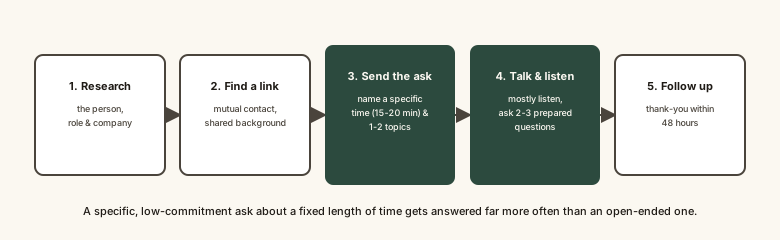
Each step exists to lower the effort required from the other person — the more specific and bounded the request, the less deciding they have to do before saying yes.
Common mistakes
Common Mistakes
Sending a vague 'can I pick your brain?' message with no time frame or topic.
→ Name a specific length of time (15-20 minutes) and one or two topics so the recipient can say yes without extra thinking.
Turning the conversation into an indirect pitch for a job opening.
→ Keep the focus on learning about their path and the field — let any job-related opportunities come up naturally, if they do at all.
Showing up without prepared questions and asking things easily answered by a quick search.
→ Research the basics in advance and bring 2-3 specific, informed questions that couldn't be answered by reading their profile or the company website.
Common misconception
“An informational interview is really just a disguised way to ask a stranger for a job.”
Treating it that way is exactly what makes these requests fail. An informational interview works because the recipient knows there's no obligation to hire, refer, or advocate for the requester — that low-pressure framing is what makes people willing to give their time at all. Turning it into a job pitch mid-conversation breaks that implicit agreement, and it's usually obvious when it happens. Real opportunities that follow from these conversations tend to come from the contact offering, on their own, once genuine rapport exists — not from being asked directly.
What to do next
What to do next
- List 5-10 people in roles or industries you genuinely want to learn more about.
- Draft a short outreach message that names a specific length of time and one or two topics, rather than an open-ended ask.
- Prepare 2-3 specific, well-researched questions before the conversation happens.
- Read Why Following Up After a Networking Conversation Actually Matters next to make sure the relationship doesn't end when the call does.