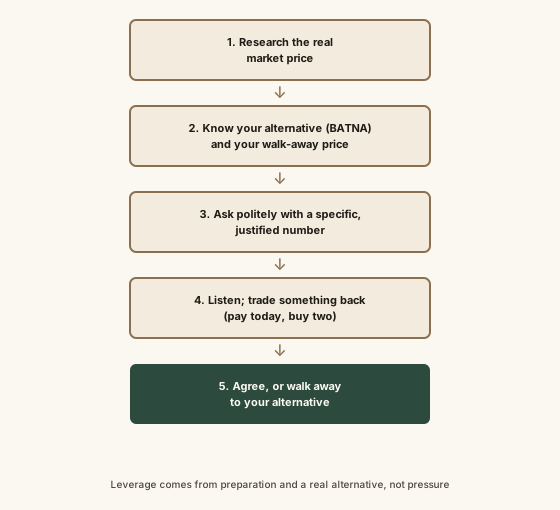
Negotiating a better price depends less on bargaining tactics than on preparation. Negotiation research from Harvard's Program on Negotiation centers on the BATNA, your best alternative to a negotiated agreement: the better your fallback (another seller, waiting, doing without), the more leverage you have. Tversky and Kahneman's 1974 work on anchoring shows that the first number mentioned pulls later estimates toward it, which is why researching the market price and naming a specific, justified number early matters. Consumer agencies such as the FTC note that prices on items like used cars are often negotiable, and some prices people assume are fixed have formal routes to reduction: nonprofit U.S. hospitals, for example, must maintain written financial assistance policies under IRS rules. Courtesy matters too. A calm, specific request that leaves the other side a way to say yes tends to work better than pressure.
Reading time
— 4 min
Updated
— Sep 26, 2026
Fact-reviewed
— Sep 26, 2026
Key Takeaways
Key Takeaways
1Your bargaining power comes from your alternative, called a BATNA: another seller, waiting, or doing without. Improve it before you start talking.
2Research the real market price and name a specific, justified number. The first number mentioned tends to anchor the deal.
3Polite and specific beats pushy. Give the other person a reason, and a way, to say yes.
The concept
Picture two shoppers asking for a discount on the same sofa. The first says, "Can you do better on this?" and has no idea what it costs elsewhere. The second says, "The same model is $780 at another store. If you can do $800 with free delivery, I'll buy it now." The second shopper isn't more aggressive; they're more prepared. They know the real price, they have somewhere else to go, and they've made it easy for the salesperson to say yes. That's most of negotiation: homework first, then a calm, specific ask.
If the conversation feels tense, the approach in how to have a difficult conversation applies: state the facts, say what you want, and listen to their side.
Quick check
Before visiting a dealership, you get a written offer from another dealer for the same car. What have you improved?
Worked examples
Example 1: A big-ticket appliance (baseline case)
A refrigerator is listed at $1,299. Online you find the same model at $1,190 from another retailer, plus $80 delivery. Your BATNA is $1,270 all in. At the store you say: "I like this one. The same model is $1,190 at another store. If you can match that and include delivery, I'll buy it today." The manager meets you at $1,210 with free delivery. You saved $89 against list, and even if they had said no, you had a better option waiting.
Example 2: When there's no deal to be had (edge case)
You're selling a used bike and won't take less than $300, because a shop offered you $300 on trade-in. A buyer's maximum is $250. There's no zone of agreement, so no phrasing will close the gap. The right move is to say so kindly: "Thanks. I have a $300 offer already, so I'll pass." Knowing your BATNA stops you from accepting a worse deal just because you're already in the conversation.
Example 3: A medical bill (real-world use)
A patient receives a $4,800 bill from a nonprofit hospital after an emergency visit. Instead of just paying or ignoring it, they call billing and ask two things: "Can you send me your financial assistance policy?" and "Is there a discount for paying in full or a payment plan?" Because nonprofit hospitals must maintain a written financial assistance policy under IRS rules, they learn they qualify for a partial discount based on income. This isn't aggressive haggling. It's asking the right, specific question.
Quick check
In Example 2, why can't the seller reach a deal with that buyer?
How it works (visual)
A simple price-negotiation sequence
Common mistakes
Common Mistakes
✕
Negotiating without knowing the market price.
→ Check two or three other sources first. A specific, real number is your strongest opening.
✕
Revealing your maximum budget at the start.
→ Ask for their best price on your specific need, or open with your researched figure instead.
✕
Being rude to signal toughness.
→ Stay friendly and specific. People make concessions to people they want to help.
Common misconception
“Negotiating is about being tough and refusing to budge until the other side caves.”
Research on negotiation points the other way. Leverage comes from preparation (a real alternative and a researched number), not from pressure. Hardball tactics often end talks or make the other side dig in. The people who get better prices tend to be calm, specific, and willing to walk away, and they give the other side a reason to agree, like paying today or buying more than one item.
What to do next
What to do next
Before any purchase over a few hundred dollars, check the price at two or three other sellers.
Write down your walk-away price and your alternative before the conversation.
Open with a specific number and the reason for it.
Offer something in return: paying today, buying more, flexible delivery.
For large medical bills, ask for the hospital's financial assistance policy and an itemized bill.
FAQ
FAQ
Related terms
Related terms
BATNA
Best Alternative To a Negotiated Agreement: what you'll do if this deal falls through. A strong BATNA is the main source of bargaining power.
Reservation price
Your walk-away number: the most you'll pay as a buyer, or the least you'll accept as a seller.
Anchoring
The tendency for the first number mentioned to pull later judgments toward it, even when people know it's arbitrary.
ZOPA
Zone of possible agreement: the range between the buyer's highest acceptable price and the seller's lowest. A deal is possible only if it exists.
Financial assistance policy
A written policy that nonprofit U.S. hospitals must maintain under IRS section 501(r), describing who qualifies for free or discounted care.
This entry was researched from public sources and drafted with AI-assisted tools, then edited — errors are still possible. Spot one, or want a topic covered? Read our disclaimer.
 KnowThis