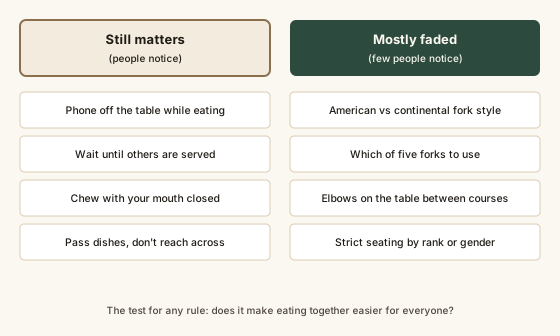
Table manners that still matter today are the ones that affect the people eating with you, not the ones that test knowledge of formal rules. The most noticed today is phone use: in a 2015 Pew Research Center survey, 88% of U.S. adults said it is generally not OK to use a cellphone during a family dinner. Other manners that still carry weight: waiting until everyone is served (or the host starts) before eating, chewing with your mouth closed, not talking with food in your mouth, passing dishes rather than reaching across people, and keeping your napkin on your lap. The Emily Post Institute's guidance adds practical conventions: pass food counterclockwise (to the right) so dishes don't collide, and remember 'b and d' (bread plate on the left, drink on the right). Rules that matter much less now include American versus continental fork style, which are both correct, and elbows on the table between courses. In business meals and other cultures, the stakes and specifics change, so it's worth watching the host.
Reading time
— 4 min
Updated
— Sep 27, 2026
Fact-reviewed
— Sep 27, 2026
Key Takeaways
Key Takeaways
1The table manners that still matter are about the people you're eating with: phone away, wait for others, chew quietly, pass instead of reach.
2Many formal rules, like fork style or never resting elbows on the table, matter much less than they used to.
3When unsure, especially abroad or at a business meal, watch the host and follow their lead.
The concept
Most table manners exist so people can share a meal without annoying or grossing each other out. That's a useful test for any rule. Checking your phone tells the people across from you they're less interesting than your screen, so it matters a lot. Chewing with your mouth open is unpleasant to watch, so it still matters. Reaching across someone's plate is awkward, so pass instead. But whether you switch your fork to your right hand after cutting? Nobody is bothered either way. Once you know the reason behind a rule, you can tell which ones still count.
Quick check
What's the best test for whether a table manner still matters?
Worked examples
Example 1: A family dinner (baseline case)
Eight people, one table, shared dishes. You put your phone away (face-down still signals you're half elsewhere), place your napkin on your lap when you sit, and wait for the host to start. Dishes move counterclockwise; when you want the potatoes, you ask for them to be passed rather than stretching across your cousin. You take a reasonable portion so there's enough to go around, and if you step away, you leave your napkin on your chair. None of this is fancy. It just keeps the meal pleasant for eight people at once.
Example 2: The urgent phone call (edge case)
You're expecting a call from a hospital about a relative. Rather than silently glancing at your phone all meal, say so at the start: "I'm sorry, I may need to take one call; I'm waiting to hear about my dad." Keep the phone on silent, and if it rings, excuse yourself and take it away from the table. The rule isn't really "never touch your phone." It's "don't make people feel ignored," and explaining ahead of time does that.
Example 3: A business dinner with a client (real-world use)
At a restaurant with a potential client, facing four forks and two glasses: use utensils from the outside in, bread plate on your left, water glass on your right. Order something easy to eat (not ribs or spaghetti) and in a similar price range to your host. Keep your phone out of sight for the whole meal. Match the client's pace so neither of you is left eating alone. When finished, place knife and fork side by side on the plate. The client probably won't notice your utensil technique, but they'll notice whether you listened, the same skill as active listening anywhere else. At a first business meal, these small signals feed into first impressions, which form fast but keep updating as people get to know you.
Quick check
In the phone-call example, what made taking the call acceptable?
How it works (visual)
Table manners that still matter vs ones that have faded
Common mistakes
Common Mistakes
✕
Leaving your phone on the table 'just in case.'
→ Put it in a pocket or bag. If you truly need to be reachable, say so at the start.
✕
Starting to eat as soon as your own plate arrives in a small group.
→ Wait until everyone is served or the host starts, unless others urge you to begin.
✕
Worrying so much about formal rules that you ignore the conversation.
→ Get the basics right, then focus on the people. That's what they'll remember.
Common misconception
“Good table manners mean knowing every formal rule, like which fork is for fish.”
Formal rules still show up at official dinners, and outside-in utensils is an easy default. But the manners people actually notice day to day are about consideration: attention to the people you're with, not making others wait or watch you chew, and not reaching over them. Someone who knows every fork but spends dinner on their phone comes across worse than someone who uses the wrong fork and listens well.
What to do next
What to do next
At your next shared meal, put your phone away before you sit down.
Practice 'b and d' once so you never have to guess which bread plate is yours.
Before a business or cross-cultural meal, look up the two or three customs specific to that setting.
When unsure at the table, pause and follow the host.
FAQ
FAQ
Related terms
Related terms
Continental style
Holding the fork in the left hand and knife in the right throughout the meal, without switching hands.
American (zigzag) style
Cutting with the fork in the left hand, then setting the knife down and switching the fork to the right hand to eat.
B and D
A memory trick: make 'OK' signs with both hands; the left forms a 'b' (bread plate on the left), the right a 'd' (drink on the right).
Finished position
Placing knife and fork side by side on the plate to signal you're done eating.
Host cue
Taking your lead from the host, such as starting to eat or placing your napkin, when you're unsure.
This entry was researched from public sources and drafted with AI-assisted tools, then edited — errors are still possible. Spot one, or want a topic covered? Read our disclaimer.
 KnowThis