 KnowThis
Key Takeaways
Key Takeaways
- 1Reference checks come in different forms that verify very different things — a formal HR employment verification is often limited to dates and title, not a character or performance assessment.
- 2Many employers follow a neutral reference policy, driven by legal liability concerns, that restricts what a former employer will say about a candidate regardless of how the working relationship actually went.
- 3A professional reference the candidate personally chooses is usually where genuine, qualitative feedback about performance and character actually comes through.
The concept
Once the different sources are separated out, it becomes clear why a reference check can range from a purely factual box-check to a genuinely revealing conversation, depending entirely on who's actually being contacted.
Why might a former employer's HR department confirm only dates of employment and job title, even if the candidate was a strong performer?
Worked examples
Example 1: A standard reference check with two chosen references (baseline case)
A recruiter calls two former managers the candidate listed as professional references. Both conversations run 10 to 15 minutes and cover the candidate's strengths, a specific project they contributed to, how they handled a challenging situation, and whether the manager would hire them again. This is the qualitative core of a typical reference check — genuine, detailed feedback from people the candidate specifically chose because the working relationship was strong.
Example 2: A former employer that only confirms dates and title (edge case / variation)
A candidate's former employer confirms only dates of employment and title during a reference check, declining to comment on anything else. What should a recruiter reasonably conclude from this?
Example 3: A hiring manager's informal back-channel check (real-world / applied case)
Before extending an offer, a hiring manager mentions the finalist candidate's name to a former colleague now working elsewhere in the same industry, who happens to have worked alongside that candidate a few years earlier but was never on the candidate's provided reference list. This informal, unlisted conversation gives the hiring manager an additional, unfiltered data point — for better or worse — that sits entirely outside the candidate's control, which is one reason maintaining a consistent professional reputation across a whole industry, not just with people formally listed as references, tends to matter more than candidates often expect.
Why might a candidate's professional reputation with people who aren't on their official reference list still matter during a hiring process?
How it works (visual)
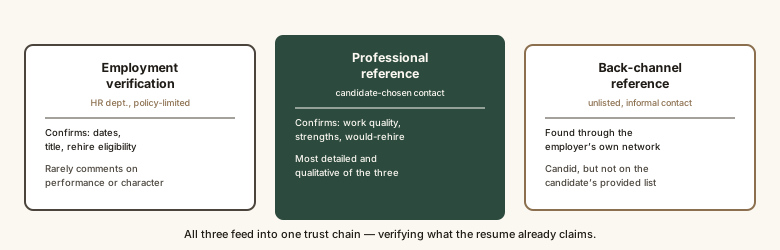
Knowing which of these three a given call actually is changes what a candidate should reasonably expect it to reveal.
Common mistakes
Common Mistakes
Assuming a limited, dates-and-title-only response from a former employer's HR department reflects poorly on you.
→ Recognize this as a common neutral reference policy applied broadly, not a signal about your specific performance — it's worth mentioning to a recruiter proactively if it might otherwise look unusual.
Listing former managers as professional references without asking them first.
→ Confirm with each reference beforehand that they're willing and prepared to speak positively and specifically — an unprepared or lukewarm reference undercuts the value of this reference type.
Assuming the reference check process only involves the specific people you listed.
→ Maintain a consistent, professional reputation across your industry generally, since an informal back-channel reference through the hiring company's own network is possible and outside your control.
Common misconception
“A silent or minimal response from a former employer during a reference check is a bad sign that will hurt your chances.”
A brief, dates-and-title-only response is frequently just a standard neutral reference policy, adopted broadly to limit legal liability, and it's applied the same way to every former employee regardless of how they performed. Recruiters who conduct reference checks regularly are generally familiar with this pattern and don't automatically read it as negative. What tends to matter more is whether the candidate's personally chosen professional references — who aren't bound by any company policy — speak specifically and positively about the working relationship.
What to do next
What to do next
- Before listing anyone as a professional reference, ask them directly and confirm they're prepared to speak specifically about your work.
- Choose references who worked closely enough with you to speak to specific projects and outcomes, not just people with a senior title.
- If you know a former employer follows a strict neutral reference policy, mention that proactively to a recruiter so a brief response isn't misread.
- Read How Recruiters Actually Screen Candidates next to see where a reference check typically fits in the broader hiring funnel.